
Writing a check to a landlord every month can feel like lighting cash on fire. You watch local real estate values climb while your savings balance stays flat, leaving you feeling trapped on the outside looking in. When a property owner offers a rent-to-own arrangement, it can look like an immediate lifeline—a bridge from tenant status to homeownership without needing a massive down payment right away. However, in our contract stress testing, we frequently see these deals turn into financial traps.
Think of a rent-to-own agreement like putting a high-end mountain bike on a retail layaway plan at a local shop. You pay a non-refundable cash deposit up front just to hold the bike, plus an extra fee every week to ride it around the neighborhood while it technically stays the shop’s property. If you fail to clear the final lump-sum balloon payment at the end of the year because your credit score drops or your cash runs thin, the shop owner keeps both the bike and every single premium dollar you handed over. Rent-to-own isn’t free equity; it is an aggressive, high-stakes financial bet against your own future mortgage readiness.
The Option Fee: Your First Structural Hazard
When I’m auditing lease-option clauses, the first structural hazard I look for is the option fee itself. This upfront payment—typically ranging from 1% to 5% of the total purchase price—grants you the exclusive right to buy the property at a fixed date. What many tenants overlook is that this money is almost universally non-refundable. If interest rates spike, local home values drop, or your bank denies your mortgage application in year three, that initial cash outlay vanishes.
Sellers often inflate both the monthly rent and the eventual purchase price above current market benchmarks. They justify this by offering a “rent credit,” promising that $200 or $300 of your monthly check goes toward your down payment. However, if your contract states that missing a single payment by 24 hours voids your accrued credits, your effective equity accumulation drops to zero. Asking yourself is it cheaper to rent or buy a house through this setup requires stripping away the sales pitch and calculating the unrecoverable cash you give away if the purchase fails. Start with baseline rent math on the Rent Calculator, then compare the full ownership path in our rent vs. buy break-even guide.
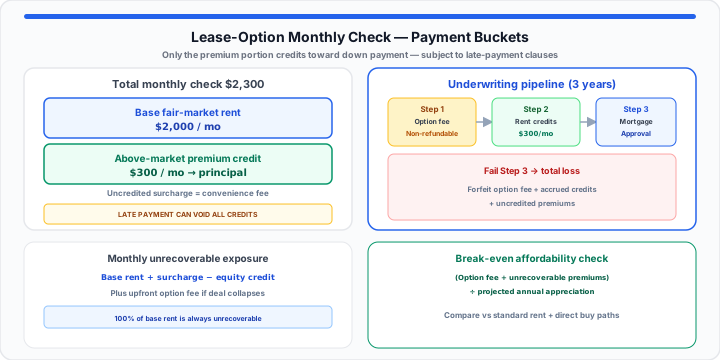
Underwriting reality: failing mortgage approval at the end of the option period results in a total loss of your upfront option fee, accrued rent credits, and any uncredited premium surcharges—not just the premium portion shown in the chart above.
Four Steps to Isolate True Baseline Numbers
In my experience tracking multi-year property appreciation models, evaluating a rent-to-own agreement requires breaking down your monthly check into three distinct buckets: base market rent, option premium overage, and true equity credit.
- Determine base market rent. Research comparable rental properties in the immediate neighborhood to establish what the house would rent for on a standard lease without purchase rights.
- Isolate the monthly option premium. Subtract the base market rent from the total monthly check requested by the seller. This difference is your monthly surcharge.
- Audit the real equity credit. Check the contract text to verify how much of that monthly surcharge actually reduces the final purchase price. If your surcharge is $300 but the contract only credits $200 toward the principal, you are paying a $100 unrecoverable convenience fee every month.
- Calculate unrecoverable outflows. Combine your non-refundable upfront option fee, base market rent, and uncredited premium surcharges. This total represents your true unrecoverable cost exposure if the deal collapses.
Monthly Unrecoverable Option Cost = Base Market Rent + Option Surcharge − Accrued Equity Credit
Break-Even House Affordability = (Upfront Option Fee + Total Unrecoverable Premiums) ÷ Projected Annual Home Appreciation
Comparing unrecoverable rental costs against mortgage equity helps determine your true break-even point. Map rent-only vs. buy scenarios with the Rent vs. Buy Calculator before you treat rent credits as guaranteed equity.
Run the numbers before you sign: Test baseline affordability in the Rent vs. Buy Calculator, then enter your locked purchase price, down payment, rate, tax, and insurance in the Mortgage Payment Calculator to see future principal and interest at option expiry.
The Final Purchase Transition: Hidden Ownership Costs
Moving onto the final purchase transition, a common oversight among lease-option tenants is assuming that taking over the property deed keeps monthly overhead unchanged. In reality, shifting from tenant to homeowner introduces property taxes, hazard insurance, private mortgage insurance (PMI), and routine maintenance costs that were previously handled by the landlord.
If your contract locks in a purchase price of $320,000, you must confirm that your income, debt-to-income (DTI) ratio, and credit score will satisfy bank underwriting requirements when the option period ends. If mortgage interest rates rise during your two-year lease, your future monthly mortgage payment could end up significantly higher than your current rent. Finding your true break-even point house affordability requires verifying whether you can secure bank financing before signing away your cash reserves. Stress-test DTI on the Debt-to-Income Ratio Calculator, buying power on the House Affordability Calculator, and full PITI stacks in our PITI and escrow guide.
For a payment-to-income ceiling walkthrough, see Mortgage Payment vs. Monthly Income and How Much House Can I Afford? If you still need time to rebuild credit or savings while renting, model monthly set-asides with how much to save each month for a down payment.
Three-Year Scenario Comparison ($300,000 Home)
The table below compares three distinct 3-year contract structures against a standard straight lease path for a home valued at $300,000.
| Contract format & scenario | Monthly payment breakdown | 3-year total cash paid out | Total accrued down payment credit | Remaining loan at option expiry | Risk profile & verdict |
|---|---|---|---|---|---|
| Standard straight lease | $2,000 base rent (no option) | $72,000 | $0 | N/A (tenant relocates) | Low risk / zero equity: 100% unrecoverable rent, but zero capital locked in option fees. |
| Fair-market lease option | $2,000 base + $300 premium ($2,300 total) | $82,800 + $6,000 upfront fee | $10,800 ($300/mo credit) | $289,200 | Moderate risk: Requires bank mortgage approval in month 36 to capture equity. |
| Predatory over-market lease | $2,100 base + $400 premium ($2,500 total) | $90,000 + $10,000 upfront fee | $7,200 ($200/mo credit) | $292,800 | High risk: High unrecoverable fees; strict default terms void accumulated credits easily. |
In practical environments, running these multi-year totals highlights whether a lease-option agreement provides a viable path to homeownership or simply increases your unrecoverable housing expenses. For amortization and payoff modeling once you close, use the Mortgage Calculator and Down Payment Calculator.
Frequently Asked Questions
Is it cheaper to rent or buy a house using a rent-to-own contract format?
In most cases, rent-to-own contracts are more expensive than standard renting in the short term because you pay an upfront option fee and an above-market monthly rent premium. A rent-to-own deal only becomes cheaper than buying directly if home prices appreciate significantly during your lease term, your option price remains locked, and you successfully convert the agreement into a standard bank mortgage before the contract expires.
What happens to my accumulated rent credits if I choose not to buy the house at the end of the lease option?
If you choose not to exercise your purchase option or fail to secure mortgage financing before the contract deadline, you forfeit all accumulated rent credits and your upfront option fee. The landlord retains ownership of the home as well as all extra premium payments you made during the lease term.
How do you figure out the exact financial break-even point for home affordability down the road?
Determining your break-even point requires comparing the total unrecoverable costs of renting (base rent, option surcharges, and lost interest on upfront fees) against the unrecoverable costs of homeownership (mortgage interest, property taxes, home insurance, and maintenance expenses). When the total equity accumulated and home appreciation exceed your unrecoverable housing expenses, you have reached your financial break-even milestone.