
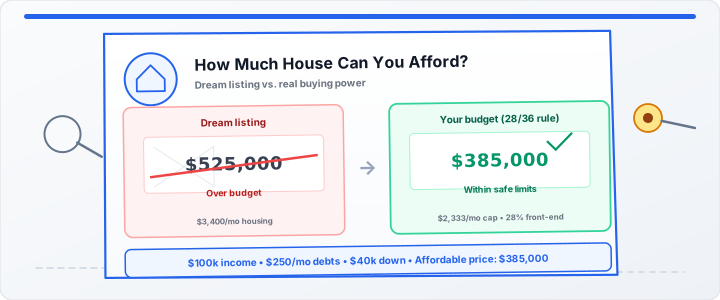
Zillow sends you listings $150,000 above what your bank would approve. You tour a kitchen you love, run the numbers in your head, and assume the listing price must be close enough. In my experience advising first-time buyers, that gap between dream floor plans and actual buying power causes more heartbreak than any rejected offer.
Affordability is not a single number on a mortgage rate billboard. It is a load-bearing structure built from your income, existing debt, down payment cash, and the monthly costs most listing sites quietly hide. Think of your budget like a house foundation: pour it wrong, and everything above it cracks under pressure.
Whether you are moving from rent or upgrading from a starter condo, you need a clear ceiling before you scroll listings. A stable foundation means knowing your safe monthly housing cap first—not picking a price and hoping the math works later.
Instant Buying Power Estimate: Skip guesswork on the 28/36 rule. Run your income, debts, and down payment through our Home Affordability Calculator to see an affordable home price and full monthly housing breakdown.
The Foundation: Your Gross Income and Monthly Cash Flow
To get started, look at gross household income—what you earn before taxes, not what lands in checking. Lenders build your housing cap from that top-line figure because tax withholding varies too much person to person.
Compare your current rent to the all-in cost of owning. Rent covers one check. Ownership stacks principal, interest, taxes, insurance, and sometimes HOA dues into a single monthly load. If that total pushes past roughly 28% of gross income, you are borrowing against groceries and emergency savings.
In our testing with the affordability engine, buyers who anchor on net pay instead of gross routinely overshoot by fifteen to twenty percent. A $100,000 salary equals $8,333 per month gross. At the conventional front-end cap, total housing should stay near $2,333 per month—not the full paycheck.
- List stable income sources. Salary, predictable bonuses, and documented side income count. One-time windfalls do not.
- Subtract fixed non-housing debts. Car notes, student loans, and credit card minimums shrink the room left for a mortgage. Model yours on the Debt-to-Income Ratio Calculator.
- Reserve cash for closing and reserves. Down payment money is not the same as emergency savings. See how cash-on-hand shifts price using the Down Payment Calculator.
The Structural Pillars: The 28/36 Rule Demystified
Moving onto the rule banks use most often, picture two vertical support beams holding up your loan approval. The first beam caps housing alone. The second beam caps housing plus every other debt payment you already owe.
Front-end limit (housing only)
Max Housing Payment = Gross Monthly Income × 0.28
Front-end DTI measures housing stress in isolation. At $8,333 monthly gross, 28% allows about $2,333 for the complete housing bundle—not just principal and interest.
Back-end limit (housing plus all debts)
Max Total Debt = Gross Monthly Income × 0.36
Housing Budget = min(Front-End Cap, Back-End Cap − Other Monthly Debts)
Back-end DTI asks whether your whole debt load still stands after you add a mortgage. Same $8,333 income allows $3,000 total debt. With $250 in car and student payments, housing can still use up to $2,333 because the front-end pillar binds first. Raise those debts to $900, and the back-end pillar drops housing to about $2,100 instead.
FHA and VA programs use different caps—31/43 for FHA and 41% back-end for many VA files. The Home Affordability Calculator switches presets so you can compare conventional, FHA, and VA ceilings without rebuilding the spreadsheet.
The Load-Bearing Limits: Hidden Ownership Costs
A basic loan quote showing principal and interest alone is like inspecting a roof while ignoring the foundation. The payment you can actually live with includes several load-bearing weights the headline rate never mentions.
Property taxes vary by county and reassess after purchase in many markets. Homeowners insurance resets when you change coverage limits. PMI appears when your down payment leaves less than 20% equity. HOA fees on condos and planned communities stack on top every month regardless of your mortgage balance.
In practical environments, I tell buyers to expect 1% to 2% of home price annually for maintenance alone—a $350,000 home might need $3,500 to $7,000 yearly for HVAC service, roof patches, and appliance replacements even when everything looks fine at closing.
| Monthly Cost Line | What It Covers | Typical Planning Note |
|---|---|---|
| Principal & interest | Loan repayment over your term | Model scenarios on the Mortgage Calculator |
| Property tax | Local assessed tax escrow | Often 1%–2% of home value per year |
| Insurance | Dwelling and liability coverage | Shop quotes before you offer |
| PMI | Lender insurance when equity < 20% | Included automatically in our affordability tool |
| HOA / maintenance reserve | Shared building fees plus upkeep buffer | Condos often carry $200–$600+ monthly HOAs |
Still renting? Compare your all-in ownership target against current rent using the Rent vs Buy Calculator and our rent vs. buy break-even guide before you assume buying always beats leasing on monthly cash flow alone.
In practical environments, the buyers who sleep well after closing are the ones who ran taxes, insurance, PMI, and HOA through the calculator before writing an offer—not the ones who maxed out the P&I quote alone.
Estimate Your True Buying Power Now
Your 2-Second Safety Wrap-Up
Match your next step to where you are right now:
- Still browsing listings? Run income and debts through the Home Affordability Calculator to set a price ceiling.
- Already have a target payment? Reverse-engineer loan size on the Mortgage Payment Calculator.
- Comparing rent to a monthly ownership bill? Use the Rent Calculator side by side with your housing breakdown.
Frequently Asked Questions About Home Affordability
- How much house can I afford on my salary?
- Start with 28% of gross monthly income for total housing costs, then confirm housing plus other debts stays under 36%. A $100,000 salary supports about $2,333 per month in housing before taxes, insurance, and PMI adjust the final price.
- What is the 28/36 rule for home buying?
- The 28/36 rule caps housing at 28% of gross monthly income and all debt at 36%. Lenders use whichever limit binds first when sizing your approval.
- Does my affordable mortgage payment include taxes and insurance?
- Yes. Total housing includes principal and interest, property taxes, homeowners insurance, PMI when equity is under 20%, and HOA fees. A P&I-only quote overstates buying power.
- What monthly debts count toward the 36% back-end limit?
- Count car loans, student loans, credit card minimums, and installment debts on your credit report. Utilities and groceries usually do not count unless they are fixed contractual payments.
- Is the calculator result the same as loan pre-approval?
- No. This is a budgeting estimate from DTI math. Lenders also weigh credit score, employment history, reserves, and program overlays before issuing a pre-approval letter.