
Few experiences in consumer finance match the gut-punch feeling of finding your dream home, clearing a 740 credit score tier, and then watching your mortgage application get abruptly denied at the final verification desk. Most borrowers assume a high credit score guarantees an automatic green light from automated underwriting systems. However, when auditing loan application files for secondary market compliance, pristine credit profiles are often rejected because the applicant overlooked a single fundamental metric: their debt-to-income (DTI) ratio.
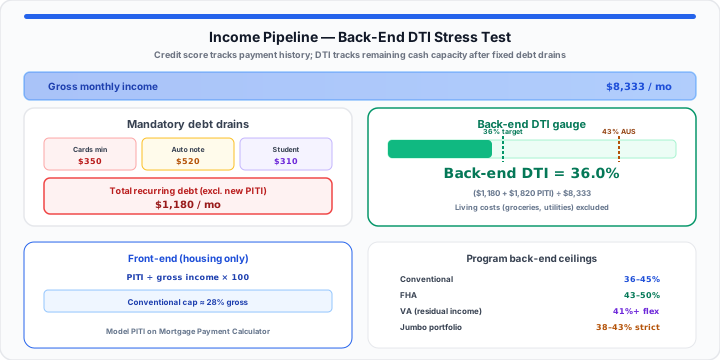
Think of your monthly earnings as a localized water storage pipeline hooked up to an agricultural field zone. Your gross monthly earnings represent the total continuous volume of water pumped into the main pipeline block. Your recurring monthly liabilities—minimum credit card payments, auto finance notes, student loan obligations—function as fixed puncture holes or bleed valves tapped straight into the side of the casing. If these drains bleed away more than 36% to 43% of the pressurized fluid before it reaches the end of the line, the remaining trickle is not powerful enough to nourish a heavy new crop, which is your future housing payment. Underwriters do not just gauge the total volume of your water tank; they calculate the net internal pressure grid after the drainage holes take their cut.
A credit score merely measures your historical fidelity in paying back borrowed money on time. It tells an underwriter nothing about your current operational cash capacity to take on additional financial obligations. You can maintain a flawless 800 credit score while allocating 60% of your gross monthly paycheck to servicing existing debt lines.
In portfolio risk testing, high leverage remains the leading driver of early payment default across consumer loans. When mortgage algorithms analyze your file, they evaluate your recurring debt liabilities against your top-line gross income to ensure you have a structural buffer against unexpected cash disruptions. If your existing liabilities consume too much of your gross income, automated underwriting channels flag the loan as a high-risk liability regardless of your spotless payment track record.
Run your ratios now: Enter gross income, housing costs, and monthly debts in our Debt-to-Income Ratio Calculator, then model proposed PITI on the Mortgage Payment Calculator.
Four Steps to Calculate Baseline DTI Before You Apply
Learning how to calculate DTI ratio for mortgage underwriting requires isolating your true recurring liability baseline from everyday operational living costs. Underwriting guidelines follow strict rules regarding what counts as a recurring debt versus a basic living expense.
- Isolate your gross monthly income. Use total earnings before tax withholdings, health insurance deductions, or retirement contributions. For salaried workers, divide annual base earnings by 12.
- Sum your minimum monthly debt liabilities. Include minimum credit card payments, auto loan installments, student loan bills, personal loans, and court-ordered alimony or child support.
- Exclude non-debt monthly living costs. Omit groceries, fuel, cellular plans, utility bills, health insurance premiums, and streaming subscriptions. Automated underwriting systems do not count these as debt liabilities.
- Compute the baseline DTI ratio. Divide total recurring monthly debt obligations by gross monthly income, then multiply by 100 to yield your percentage baseline.
Core underwriting formulas
Back-End DTI Ratio % = (Total Mandatory Monthly Debt Liabilities / Gross Monthly Income) × 100
Front-End Housing Ratio % = (Proposed Monthly PITI Housing Cost / Gross Monthly Income) × 100
Front-end metrics isolate your housing load, while back-end limits cap your total debt obligations. For a full PITI breakdown—principal, interest, taxes, insurance, escrow, and PMI—see our PITI and escrow guide.
Normalizing Variable and Hourly Income
Calculating gross monthly income is straightforward if you earn a fixed annual salary, but variable pay schedules complicate the underwriting review. Hourly workers who experience fluctuating weekly hours or seasonal shift differentials often miscalculate their true baseline income, leading to unexpected processing stalls.
When auditors evaluate hourly wage earners, they calculate a normalized base rate over a 24-month historical window. Overtime hours, performance bonuses, and seasonal shift surcharges are excluded unless you can prove a continuous two-year earnings history with the same employer. If you switch from a salaried position to 1099 freelance contracting, underwriters generally require two full years of filed tax returns before that variable revenue can be credited toward your loan qualification capacity.
Instead of manually tracking multi-tiered percentage equations on scratch paper under a tight closing deadline, pass your fixed commitments into the Debt-to-Income Ratio Calculator to test baseline stability, then normalize variable or contract income on the Salary to Hourly Calculator or follow the step-by-step walkthrough in How to Convert an Hourly Wage Offer into a Realistic Gross Annual Salary.
What Is a Good Debt-to-Income Ratio by Loan Program?
Understanding what is a good debt to income ratio depends heavily on the specific loan program you select. Different mortgage capital structures apply different risk thresholds based on government backing and portfolio guidelines.
| Loan Capital Tier | Target Front-End Housing Cap | Maximum Back-End DTI Limit | Portfolio Cushion & Underwriting Notes |
|---|---|---|---|
| Conventional Conforming | 28.00% gross income | 36.00% to 45.00% (with automated approval) | Strong credit reserves if back-end exceeds 36.00%. AUS approval often required above 43.00%. |
| FHA Government Backed | 31.00% gross income | 43.00% to 50.00% (with compensating factors) | Flexible debt caps for lower credit tiers. Model payments on the FHA Loan Calculator. |
| VA Guaranteed | No fixed front-end cap | 41.00% benchmark (flexible via residual income) | Focuses on residual income thresholds. Stress-test on the VA Mortgage Calculator. |
| Jumbo Private Portfolio | 28.00% gross income | 38.00% to 43.00% strict floor | Strict debt limits with limited flexibility. Often requires 6 to 12 months post-closing liquid reserves. |
Compare how a target payment fits your paycheck using the mortgage payment vs. monthly income guide, or reverse-engineer a price ceiling on the House Affordability Calculator and our home buying budget guide.
Compressing Back-End DTI Before Underwriting
If your initial math shows a back-end DTI above 43%, you do not need to abandon your loan plans. You can optimize your financial profile before submitting a formal application.
In practical environments, the fastest way to compress your back-end DTI ratio is to eliminate low-balance installment notes and high-interest revolving credit accounts that carry disproportionately high monthly minimum payments. Paying off a credit card with a $600 balance that requires a $75 minimum monthly payment removes $75 directly from your debt calculation. That reduction increases your home borrowing capacity far more than keeping the same $600 sitting idle in a low-yield savings account. Restructuring an auto loan to extend its repayment term can also reduce your monthly obligation, lowering your overall debt-to-income ratio before your loan application goes to underwriting.
Open Debt-to-Income Ratio Calculator
Frequently Asked Questions About Mortgage DTI
- How to calculate DTI ratio for mortgage applications accurately?
- Add all mandatory recurring monthly debt payments—such as credit cards, student loans, auto financing, and personal loans—plus your prospective mortgage payment (principal, interest, property taxes, and insurance). Divide this total monthly debt obligation by your gross monthly income (before taxes and deductions) and multiply the result by 100 to determine your back-end DTI percentage.
- What is a good debt to income ratio for getting approved on a house?
- A good debt-to-income ratio for a mortgage application is generally 36% or lower, with your housing costs taking up no more than 28% of your gross monthly income. While government-backed programs like FHA loans may approve applicants with DTI ratios up to 43% or even 50% when supported by strong compensating factors, keeping your overall DTI below 36% secures the best interest rates and loan terms.
- Does DTI ratio include household utilities, groceries, and cellular bills?
- No, DTI ratios do not include daily living expenses such as groceries, utility bills, gas, health insurance premiums, or cell phone plans. Mortgage underwriters only include contractual debt obligations, revolving credit lines, installment loans, and court-ordered financial commitments like child support or alimony.
- Can I get approved for a mortgage with a back-end DTI over 45%?
- Yes, you can get approved for a mortgage with a back-end DTI over 45% under specific loan programs. FHA and Fannie Mae or Freddie Mac automated underwriting engines can grant approvals up to 50% if the borrower has compensating factors, such as a high credit score, significant liquid cash reserves post-closing, or strong residual income.