
A strong hourly rate on the offer letter can still under-deliver once unpaid holiday weeks hit your deposit schedule. Listings highlight $/hr; handbooks hide shutdown policies. Before you sign, annualize the number against paid hours only—start with RapidRatio’s Salary Calculator (holiday and vacation adjustments) and Take-Home Paycheck Calculator for gross-to-net checks.
Think of hourly pay as a meter that runs only while you are on the clock. Unpaid factory closures stop the meter; paid PTO keeps your annual hour baseline intact.
Quick check: Enter hourly rate, hours per week, and time off in the Salary Calculator to see annual, monthly, and bi-weekly gross side by side.
Step 1: Baseline hourly pay and unpaid leave
Your hourly wage is the price for one billable hour. Advertised rates are almost always gross (pre-tax). Employers may still schedule unpaid weeks that never hit your timesheet.
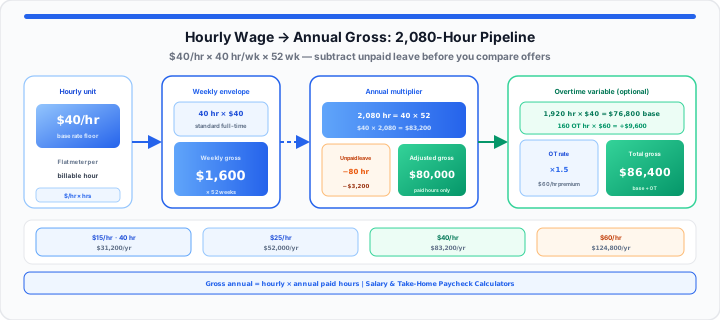
Example: $40/hr with a two-week unpaid shutdown removes about 80 hours (40 × 2). That is $3,200 off a naïve annual total. Paid vacation does not cut hours the same way—those hours stay in your compensation model.
Gross baseline pay = Hourly rate × Standard weekly hours
Adjusted baseline = Hourly rate × (Annual paid hours − Unpaid hours)
Track shift lengths accurately with the Time Card Calculator or Hours Calculator when your schedule is not a flat 40 hours. Split-shift hour math applies the same discipline for variable weeks.
Step 2: The 2,080-hour annual engine
Full-time corporate baselines use 2,080 paid hours: 40 hours × 52 weeks. Part-time schedules scale down:
- 30 hr/wk → 1,560 hr/yr
- 20 hr/wk → 1,040 hr/yr
Gross annual salary = Hourly rate × Annual working hours
Weekly gross = Hourly rate × Standard weekly hours
At $40/hr and 2,080 hours: $83,200 gross before unpaid adjustments. After 80 unpaid hours: $80,000. The Salary Calculator’s adjusted column spreads pay across actual working days when you enter holidays and vacation.
Step 3: Overtime and shift differentials (variable pay)
Contracts may add overtime pools or night-shift premiums. Model guaranteed base separately from variable OT you cannot count on for rent.
- Baseline wage floor: $40.00 per standard hour.
- Standard annual hours: 1,920 regular shift hours.
- Overtime pool: 160 hours at $60/hr (1.5× base).
- Standard base earnings: $76,800.
- Overtime premium: $9,600.
- Consolidated gross: $86,400 (before shift bonuses).
Overtime rate = Baseline hourly × 1.5
Double time = Baseline hourly × 2.0
For budget planning after gross is settled, tie monthly cash flow to household budget breakdowns and Budget Calculator targets.
Hourly-to-annual reference grid (40 hr/wk, paid year)
Assumes full-time 40-hour weeks and no unpaid leave. Monthly figures divide annual gross by 12.
| Hourly rate | Weekly gross | Monthly gross | 52-week annual |
|---|---|---|---|
| $15.00 / hr | $600.00 | $2,600.00 | $31,200.00 |
| $25.00 / hr | $1,000.00 | $4,333.33 | $52,000.00 |
| $40.00 / hr | $1,600.00 | $6,933.33 | $83,200.00 |
| $60.00 / hr | $2,400.00 | $10,400.00 | $124,800.00 |
Common mistakes when comparing hourly offers
- Assuming 52 paid weeks when the plant closes unpaid for two.
- Mixing gross hourly with net deposit expectations after tax withholding.
- Banking on overtime to cover fixed housing costs.
- Ignoring semi-monthly vs bi-weekly check frequency when budgeting monthly bills.
Before you sign: gross first, then net
Compare offers on consistent gross annual hours, then run withholding scenarios. For tax-aware net estimates, use the Income Tax Calculator alongside the Take-Home Paycheck Calculator.
FAQ
- How do you calculate gross annual salary from an hourly wage manually?
- Multiply hourly rate by weekly hours and by 52, or multiply hourly rate by total annual paid hours. Subtract unpaid leave hours first.
- Why does corporate payroll use a 2,080-hour annual multiplier?
- Forty hours per week times fifty-two weeks equals 2,080 hours—a standard full-time baseline for hourly-to-salary conversions.
- How do unpaid holidays affect your calculated yearly income?
- Each unpaid hour removes hourly rate × 1 from your annual gross. Two 40-hour unpaid weeks remove 80 × your rate.
- What is the difference between gross salary and net pay?
- Gross is before deductions; net is take-home deposit. Evaluate offers on gross, then model net for monthly budgeting.