
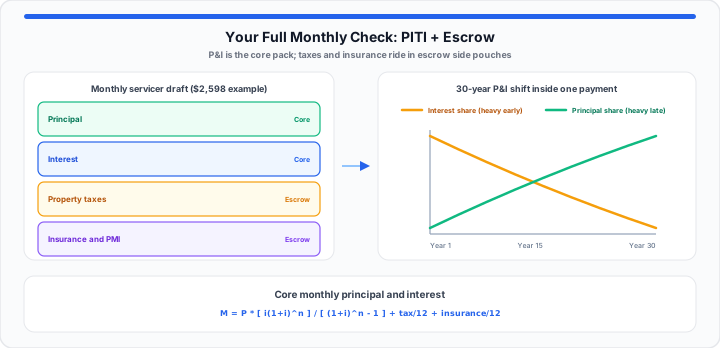
When I’m reviewing pre-approval files, the single most common moment of friction happens when a borrower sees their final settlement breakdown for the first time. The initial loan estimate might quote a principal and interest figure of $1,896 per month on a $300,000 loan. But when the escrow sheet arrives, the actual monthly withdrawal from their checking account jumps to $2,580. That $684 surprise leaves many first-time buyers feeling blindsided right before closing.
Think of a complete mortgage payment as a heavy multi-compartment survival backpack. The main pack body holds your baseline shelter—the Principal and Interest that steadily buys down your home’s physical frame. But when you take that loan out onto the homeownership trail, you are forced to strap on external side pouches for essential provisions: Property Taxes, Homeowners Insurance, and local Homeowners Association (HOA) fees. If you only budget for the main pack frame, the weight of those side attachments will pull you backward on your financial journey.
Inside the Monthly Check: Deconstructing PITI
Every monthly mortgage draft you send to a loan servicer is split across four distinct compartments, universally known in the banking world as PITI:
- Principal: The raw portion of your cash that directly reduces your outstanding loan balance, building hard equity in your property.
- Interest: The fee charged by the lender for risking capital over a 30-year amortization timeline, calculated monthly based on your remaining balance.
- Taxes: Local real estate property taxes collected by your county or city municipality, held by your lender in a dedicated escrow account, and paid out annually on your behalf.
- Insurance: Hazard coverage to protect the physical dwelling, alongside flood insurance or specialized rider policies required by your underwriting conditions.
In our loan stress testing, we frequently see buyers mistake the initial principal and interest quote for their total monthly obligation. Your lender acts as a collection clearinghouse, bundling these four streams into one single monthly draft to protect the physical asset securing their lien. The Mortgage Payment Calculator models P&I with optional annual tax and insurance converted to monthly lines, and the Mortgage Calculator adds the same escrow-style estimates on a classic payment breakdown.
For how the interest-to-principal ratio shifts inside that fixed P&I payment over decades, see our guide on calculating monthly principal vs. interest on a fixed loan, or open the Amortization Calculator for a full schedule.
Step-by-Step: The Underwriter’s Method for Manual Payment Calculation
When I’m auditing residential terms, calculating the exact monthly principal and interest payment requires running a standard amortization formula. To get started calculating your core monthly obligation, follow these five steps:
- Isolate your net principal loan amount (P): Subtract your down payment from the final purchase price (e.g., $400,000 purchase price minus $80,000 down payment equals a $320,000 principal balance).
- Convert your annual interest rate to a monthly decimal fraction (i): Divide your quoted Annual Percentage Rate by 12 months, then divide by 100 (e.g., a 6.5% rate becomes 0.065 ÷ 12 = i = 0.0054167).
- Calculate total periodic payments (n): Multiply your loan term in years by 12 months (e.g., a 30-year term equals n = 360 monthly payments).
- Execute the core compounding amortization formula: Compute the exact monthly principal and interest payment using: M = P [ i(1 + i)n ] / [ (1 + i)n − 1 ].
- Layer in monthly escrow liabilities: Divide annual property taxes and hazard insurance premiums by 12, then add them directly to your calculated base monthly payment (M).
M = P × [ i(1 + i)n ] / [ (1 + i)n − 1 ]
For example, on a $320,000 loan at 6.5% interest over 30 years, your core monthly principal and interest payment calculates to $2,022.61. When you layer on $450 in monthly property taxes and $125 in homeowners insurance, your true out-of-pocket monthly check becomes $2,597.61.
The Hidden Costs: Tracking Private Mortgage Insurance (PMI) and Escrow Buffer Requirements
When buyers put down less than 20% equity at purchase, federal underwriting guidelines mandate Private Mortgage Insurance (PMI). PMI does not protect you—it protects the lender against default risk.
In my experience underwriting residential terms, PMI usually adds between 0.5% and 1.5% of your total loan balance in annual costs, broken down into monthly installments on top of your standard PITI payment. Mortgage servicers also require an escrow cushion buffer, holding up to two extra months (or 1/6th) of your total annual tax and insurance liabilities in reserve. This buffer absorbs localized tax assessment increases or insurance premium spikes without forcing the servicer into an instant deficit. Low-down-payment scenarios often overlap with FHA loan math—model MIP and payment totals there before you compare to conventional PITI.
Timeline Comparison: The Real Cost of a 15-Year vs. a 30-Year Horizon
Moving onto long-term loan strategy, choosing between a 15-year fixed mortgage and a 30-year fixed mortgage dramatically alters your total lifetime interest burden. While a 30-year loan keeps your required monthly outlay lower, the extended timeline allows interest to compound continuously over three decades.
| Loan Parameter / Component | 30-Year Fixed Mortgage | 15-Year Fixed Mortgage |
|---|---|---|
| Home Purchase Price | $400,000 | $400,000 |
| Down Payment (20%) | $80,000 | $80,000 |
| Total Principal Borrowed (P) | $320,000 | $320,000 |
| Sample Annual Interest Rate | 6.50% | 5.75% |
| Monthly Principal & Interest (M) | $2,022.61 | $2,656.40 |
| Estimated Monthly Escrow (Taxes/Ins) | $575.00 | $575.00 |
| Total Monthly Out-of-Pocket Outflow | $2,597.61 | $3,231.40 |
| Total Lifetime Interest Paid | $408,139.60 | $158,152.00 |
| Total Lifetime Principal + Interest Outflow | $728,139.60 | $478,152.00 |
As the comparative data demonstrates, selecting a 15-year term increases your core monthly payment by $633.79, but saves a staggering $249,987.60 in total lifetime interest charges.
In practical environments, instead of guessing your final out-of-pocket settlement amounts or trying to manually calculate compounding monthly fraction brackets on a desk pad while reviewing home offers, input your purchase terms directly into our interactive Mortgage Calculator to map out your 30-year payment timeline instantly. Stress-test whether that total draft fits your paycheck using the mortgage payment vs. monthly income guide, and model extra principal paydown with the Mortgage Payoff Calculator.
Open Mortgage Calculator Open Mortgage Payment Calculator
Frequently Asked Questions
What is the difference between principal and interest in a standard monthly mortgage payment?
Principal is the actual cash amount that directly reduces the outstanding loan balance you borrowed from the bank, incrementally building equity in your home. Interest is the financial service fee charged by the lender for borrowing that capital, calculated every month as a percentage of your remaining balance. In the early years of a 30-year mortgage, the vast majority of each payment goes toward interest, while in later years, the balance shifts heavily toward principal paydown.
How do local property taxes and homeowners insurance alter your monthly escrow calculations over time?
Your mortgage servicer re-evaluates your escrow account annually through an official escrow analysis. If your local county increases property tax assessments or your insurance carrier raises annual home coverage premiums, your monthly escrow contribution will increase to cover the shortfall. If your account falls below mandatory cushion requirements, the servicer will adjust your monthly draft upward to recover the deficit over the next 12 months.
Can making an extra principal payment every year significantly reduce a 30-year mortgage timeline?
Yes. Making just one additional full principal payment per year—or adding a fixed extra amount directly toward the principal balance every month—shortens your total repayment timeline drastically. Because extra payments skip interest compounding entirely and directly shrink the underlying balance (P), a single extra payment per year on a standard 30-year fixed mortgage can shave four to five years off your term and save tens of thousands of dollars in lifetime interest.
How does Private Mortgage Insurance (PMI) get removed from my monthly payment?
Under federal law (the Homeowners Protection Act), your loan servicer must automatically cancel Private Mortgage Insurance once your remaining principal balance reaches 78% of the home’s original purchase price, provided your account is current. You can also proactively request PMI cancellation once your loan-to-value (LTV) ratio drops to 80% through scheduled payments or verified market appreciation confirmed by an official appraisal.