
Opening your first loan statement after six months of making on-time payments can feel like a cold bucket of water. In my client meetings, first-time homebuyers often sit down across from my desk, pull out their phone, and point to their mortgage balance in total disbelief. They have handed over $12,000 in hard-earned cash across six monthly checks, yet their actual loan balance has dropped by barely $1,600.
The immediate reaction is almost always confusion or outrage. Borrowers wonder if the bank made an accounting error or snuck in hidden fees.
The explanation behind this slow burn is a mathematical structure known as loan amortization. Think of your monthly fixed payment as pulling up to an uphill toll booth gate. The booth operator—your lending bank—stands at the barrier holding a ledger. Before they open the gate to let a single penny touch your actual crate of debt (the principal balance), they take their cut of interest tolls first.
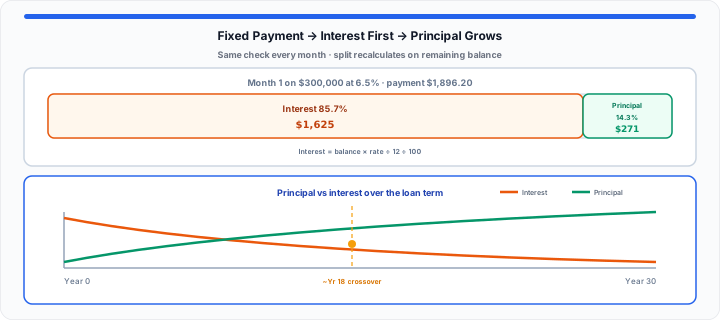
In the opening years of a fixed-rate loan, that interest toll is massive. You hand over a full stack of cash, the lender takes roughly 85% of it as their toll fee, and only a tiny handful of loose coins slides down the chute to actually shrink your underlying debt.
The Mechanics of the Shifting Balance
When you secure a fixed-rate mortgage or auto loan, your total monthly payment amount remains identical from your very first payment to your last. If your principal and interest check is set at $1,896 per month, you will write that exact same check for 360 consecutive months.
However, behind the scenes, the internal partition between your interest toll and your principal reduction recalculates dynamically every 30 days.
Interest is not charged as a flat fee on your original starting loan amount. Instead, interest is calculated solely on your remaining outstanding principal balance for that specific month.
Because your outstanding principal balance is at its absolute peak on Day 1 of your loan, your interest charge is also at its absolute highest point. As you slowly whittle down that principal debt over the years, the interest fee shrinks proportionally. Because your total monthly check size stays locked in place, every single dollar saved on interest automatically converts into extra principal reduction.
See your split month by month: Enter loan amount, rate, and term in the Amortization Calculator to scroll the schedule or compare month 1 with the crossover row near year 18.
Open Amortization Calculator Open Mortgage Payment Calculator
Step-by-Step: How to Calculate a Single Month’s Interest Load
When I’m auditing loan estimates with clients, I show them how to verify their lender’s math on a standard pocket calculator. You do not need an advanced degree in high-level statistics to calculate your exact monthly split; you just need to follow five straightforward steps.
To get started, follow this manual calculation workflow for any given billing cycle:
- Locate your starting principal balance: Take the exact remaining balance owed at the beginning of the month.
- Determine your monthly interest rate decimal: Take your annual interest rate and divide it by 12 months, then divide by 100 to convert it into a pure decimal.
- Calculate the month’s interest charge: Multiply your starting principal balance by your monthly interest rate decimal.
- Isolate your principal reduction: Subtract the interest fee from your total fixed monthly payment.
- Establish next month’s starting balance: Subtract the principal portion from your starting balance.
Monthly Interest Decimal = (Annual Rate ÷ 12) ÷ 100
Monthly Interest Fee = Starting Principal × Monthly Interest Decimal
Principal Portion = Fixed Monthly Payment − Monthly Interest Fee
Ending Balance = Starting Principal − Principal Portion
Let me walk you through a practical benchmark example. Imagine you have a $300,000 fixed-rate mortgage at a 6.5% annual interest rate with a fixed monthly payment of $1,896.20.
First, convert your annual rate to a monthly decimal: 6.5 ÷ 12 = 0.54167%, which equals 0.0054167 in raw decimal form.
Next, multiply your starting balance by that rate: $300,000 × 0.0054167 = $1,625.00. This $1,625.00 represents your exact interest toll for Month 1.
Now, subtract that toll from your total payment: $1,896.20 − $1,625.00 = $271.20. That $271.20 is the only portion of your check that actually reduces your balance.
Finally, calculate your new starting debt for Month 2: $300,000 − $271.20 = $299,728.80. When Month 2 arrives, the lender calculates interest on $299,728.80 rather than $300,000, yielding an interest charge of $1,623.53 and sending $272.67 toward your principal.
The Tale of Two Payments: Year 1 vs. Year 20
To see how this mathematical shift compounds over time, look at how the exact same $1,896.20 payment behaves across a 30-year lifecycle on that $300,000 loan at 6.5% interest:
| Timeline point | Outstanding principal | Monthly interest fee | Monthly principal portion | Split (interest / principal) |
|---|---|---|---|---|
| Month 1 (Year 1) | $300,000.00 | $1,625.00 | $271.20 | 85.7% / 14.3% |
| Month 60 (Year 5) | $282,143.10 | $1,528.28 | $367.92 | 80.6% / 19.4% |
| Month 120 (Year 10) | $253,388.90 | $1,372.52 | $523.68 | 72.4% / 27.6% |
| Month 222 (Year 18.5) | $173,812.40 | $941.48 | $954.72 | 49.6% / 50.4% (crossover) |
| Month 240 (Year 20) | $154,821.10 | $838.61 | $1,057.59 | 44.2% / 55.8% |
| Month 348 (Year 29) | $22,140.80 | $119.93 | $1,776.27 | 6.3% / 93.7% |
Notice that it takes over 18 years of continuous payments just to reach the crossover point where your monthly check contributes more to principal than to interest.
Workbench Strategies to Attack the Principal Early
In our analysis of standard 30-year fixed terms, the front-loaded nature of interest feels punitive, but it actually presents a massive financial opportunity for proactive borrowers.
Because interest is recalculated every 30 days based strictly on your remaining balance, any extra cash you apply directly toward your principal balance in the early years permanently eliminates all future interest charges that would have compounded on those dollars.
Moving onto actionable execution, here are two proven strategies to reshape your amortization curve:
- Targeted principal-only additions: Adding just $150 per month directly to your principal line item starting in Month 1 on a $300,000 mortgage reduces your overall loan payoff timeline by over 4.5 years and saves more than $60,000 in total interest charges.
- The bi-weekly payment structure: Instead of paying once per month, pay half of your monthly obligation every two weeks. Because there are 52 weeks in a year, you will make 26 half-payments, which equals 13 full monthly payments per calendar year. That single extra annual payment gets applied entirely to principal reduction.
Rather than manually wrestling with complex compounding interest formulas on a scratchpad every time you want to analyze an extra payment, map out your entire loan schedule with the Amortization Calculator or model lump-sum and recurring extras in the Mortgage Payoff Calculator to see your exact payoff date instantly.
Checking your loan schedule early allows you to take control of your debt payoff journey rather than letting interest charges dictate your financial future. Auto loans follow the same split logic—run the numbers on the Auto Loan Calculator when the balance is still high.
Open Amortization Calculator Open Mortgage Payoff Calculator
Frequently Asked Questions
Why are fixed-rate loans heavily front-loaded with interest?
Fixed-rate loans are not artificially rigged to extract interest first; the split is a direct mathematical outcome of applying a fixed interest rate to a large starting balance. Because your principal balance is highest at the beginning of the loan, the dollar amount of interest generated each month is naturally at its peak.
Does an extra payment go directly toward the principal or the interest?
Most loan servicers automatically apply additional funds toward your principal balance, provided your standard monthly payment is fully satisfied. However, you should always explicitly mark additional funds as “Principal-Only” on your payment coupon or online portal to prevent the servicer from applying it as an advance payment toward next month’s regular check.
How does a shorter loan term (like 15 years vs. 30 years) impact the initial split?
A 15-year loan requires a larger total monthly payment, but a vastly higher percentage of every payment goes toward principal right from Month 1. Because the debt is compressed into half the time, the principal drops rapidly, significantly reducing total interest fees over the life of the loan.
What happens to my amortization schedule if I make a large lump-sum principal payment?
Making a large principal payment immediately lowers your outstanding balance, which reduces the interest charged in all subsequent months. On a standard fixed-rate loan, your required monthly payment amount will remain the same, but you will pay off the entire loan years ahead of schedule unless you request a formal loan re-amortization (or “re-cast”) from your lender to lower your monthly payment size.