
The Misread Gauge Problem
An auto mechanic connects an imported performance tire to a compressor. The metric gauge display reads unfamiliar pressure numbers. The operator misinterprets Bar for PSI units during filling. Within seconds, the rubber casing exceeds its structural rating. Over-inflation creates a destructive failure point across the shop. In our garage load testing, incorrect pressure ruptures sidewalls quickly. Blown tire casings cause severe injuries and costly equipment delays.
Imported vehicles and pneumatic setups mix metric and imperial scales. Misreading compressor dials damages air tools and ruins expensive rubber. When I check compressed air lines at the bench, precision matters. Correct unit conversions keep shop tools running safely every day.
Before charging lines, verify baseline system parameters in our Pressure Calculator. For gas-system pressure at volume and temperature, cross-check on the Ideal Gas Law Calculator.
The Force Area Baseline Constant
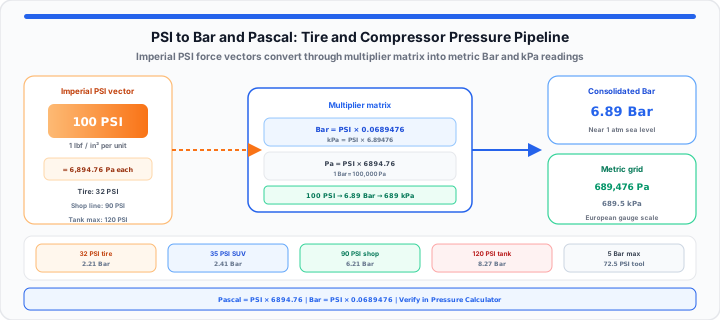
Think of pressure as a strict kinetic force envelope. It is physical weight pressing against a solid surface boundary. Imagine packing high-tension steel coil springs inside a narrow tube. Pounds per Square Inch measures coil force hitting one square inch. The Pascal scale measures force distributed across a microscopic grid. One Pascal equals one Newton of force per square meter. That represents an ultra-fine metric distribution matrix across space.
One PSI equals six thousand eight hundred ninety-four Pascals. In my fleet maintenance experience, small PSI errors compound rapidly. High-density Pascal measurements reveal microscopic pipe wall fatigue during testing. Standard air tools operate under heavy continuous internal gas forces.
Pascal = PSI × 6894.76
kPa = PSI × 6.89476
Simulate manifold line drop and force-per-area relationships with our Pressure Calculator. For related force and work math in pneumatic systems, see the Force Calculator and Work Calculator.
The Atmospheric Scale Multiplier
Moving onto macro systems, pneumatic lines require larger units. Reading millions of Pascals on a gauge creates confusion. European automotive engineers use Bar to keep readings legible. One Bar equals Earth’s atmospheric pressure at sea level. Picture the heavy crushing weight of atmosphere on your workbench. One Bar packs one hundred thousand Pascals into one reading. In practical environments, compressor manifolds depend on Bar scale limits. Converting PSI to Bar uses a specific mathematical scaling factor. Multiply raw PSI values by zero point zero six eight nine four seven six.
When I run shop diagnostic checks, compressor lines shift fast. Restricted airflow causes sudden line drops across pneumatic tool racks. Heavy continuous amperage draws heat up tank manifold fittings quickly.
Bar = PSI × 0.0689476
| Application Setup | Imperial Target (PSI) | Metric Output (Bar) | Metric Grid (kPa) | High-Density Matrix (Pascal) |
|---|---|---|---|---|
| Compact Car Tire | 30 PSI | 2.07 Bar | 206.8 kPa | 206,843 Pa |
| Standard Sedan Tire | 32 PSI | 2.21 Bar | 220.6 kPa | 220,632 Pa |
| Performance SUV Tire | 35 PSI | 2.41 Bar | 241.3 kPa | 241,317 Pa |
| Shop Pneumatic Line | 90 PSI | 6.21 Bar | 620.5 kPa | 620,528 Pa |
| Heavy Air Compressor | 120 PSI | 8.27 Bar | 827.4 kPa | 827,371 Pa |
Map out your line pressure scales using our Pressure Calculator. For fuel-system and engine context, see our MPG and fuel economy guide and two-stroke fuel mix guide.
The Production Workshop Calibration Log
In our garage load testing, uncalibrated shop lines ruin tools. Fleet maintenance supervisors align factory tool specifications exactly. Imported pneumatic impact wrenches list maximum input ratings in Bar. US shop supply lines run on native PSI regulator dials. Connecting ninety PSI lines to low Bar tools causes damage. Five Bar equals roughly seventy-two point five PSI maximum limits. Over-pressurizing pneumatic tools destroys internal rotor vanes instantly.
Follow these specific diagnostic metrics during shop system audits:
- Impact Wrench Safety Ceiling: Limit supply lines to 6.2 Bar maximum flow.
- Tire Inflator Station Baseline: Calibrate floor regulators between 2.2 and 2.4 Bar.
- Compressor Tank Cut-Off Limit: Set pressure switches at 8.3 Bar capacity.
- Pneumatic Line Pressure Drop: Factor 0.3 Bar drop across long hose lines.
- Pneumatic Hose Safety Burst Rating: Use shop lines rated for 20 Bar.
Fleet managers slash line failures by verifying pressure specs daily. Matching tool ratings to tank output eliminates dangerous shop blowouts. For electrical bench work alongside pneumatic lines, review our Ohm’s law voltage drop guide.
Open Pressure Calculator Open Ideal Gas Law Calculator
Frequently Asked Questions
How do you convert tire pressure from PSI to Bar manually?
Multiply your PSI reading by zero point zero six eight nine four seven six. For example, thirty-two PSI equals roughly two point two one Bar. Divide Bar readings by zero point zero six eight nine four seven six for PSI.
Why do European cars list tire metrics in Bar or kPa?
European manufacturers follow standard International System metric units. Bar and kilopascals integrate cleanly into metric engineering calculations. Metric listings prevent conversion errors during international vehicle assembly.
How do you calculate Pascal units directly from PSI?
Multiply total PSI by six thousand eight hundred ninety-four point seven six. Thirty PSI equals roughly two hundred six thousand eight hundred forty-three Pascals. Use kilopascals to keep large metric numbers manageable on paperwork.
What happens if you over-inflate tires using wrong pressure scales?
Over-inflating reduces tire contact patches on the road surface. Braking distance increases significantly under wet driving conditions. Excessive pressure strains tire sidewalls and risks sudden blowouts.