
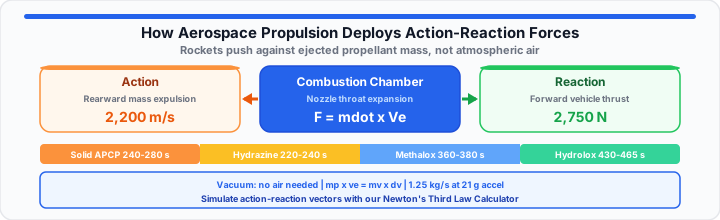
In engine test fires, static stands hold rockets tight. Rockets do not push against atmospheric air. A vacuum offers zero external air to push. Yet, engines ignite perfectly in deep space. The exhaust bell contains extreme internal gas pressure.
Unclamping an inflated rubber balloon releases high pressure. Air rushes out fast through the neck opening. The balloon snaps hard in the opposite direction. Firing a heavy shotgun kicks into your shoulder. The recoil comes from accelerating projectile mass forward. Think of rocket thrust like throwing weight off a boat — ejecting heavy cargo rearward surges the hull forward.
A chamber exerts force on gas molecules inside. Those gas molecules exert equal force backward. Gas expands through a converging throat geometry. Internal gas collisions accelerate molecules rearward. The vehicle reacts by surging straight ahead. Internal gas dynamics drive total vector acceleration.
| Propellant Class | Specific Impulse (s) | Exit Velocity (m/s) | Core Thrust Vector Behavior |
|---|---|---|---|
| Solid APCP | 240 – 280 | 2,350 – 2,740 | High mass flow, immediate peak reaction force |
| Hydrolox (LOX/LH2) | 430 – 465 | 4,200 – 4,550 | Max kinetic momentum exchange per unit mass |
| Methalox (LOX/CH4) | 360 – 380 | 3,500 – 3,700 | Balanced density impulse and high velocity |
| Monopropellant Hydrazine | 220 – 240 | 2,150 – 2,350 | Low mass flow, precision attitude reaction control |
The Momentum Exchange Constant
Static Vector Analysis
When calibrating nozzle throat pressures, conservation holds. Total momentum in an isolated system remains constant. Initial momentum equals zero on launch pads. Combustion forces propellant mass out the aft nozzle. Equal force accelerates the rocket structure forward.
mp × ve = mv × Δv
Here, mp represents ejected propellant mass. ve tracks effective exhaust velocity. Vehicle dry mass is marked by mv. The resulting speed change is Δv.
Notice how vehicle mass decreases during burns. Lighter vehicles gain higher forward acceleration fast. Fighting gravity wells demands precise vector balancing. Linear momentum conservation dictates closed system behavior. Ejected mass carries negative linear momentum backward. The rocket airframe gains positive linear momentum forward. Center of mass remains fixed in zero-gravity space.
Internal chemical combustion breaks molecular bonds rapidly. High temperature generates immense gas pressure forces. Chamber walls absorb radial outward gas pressure. Only the nozzle exit allows axial gas expansion. Unbalanced axial pressure pushes against forward chamber domes. This dome pressure imbalance generates true forward thrust force. Rocket engines push against their internal chamber structures. Airframes translate internal dome pressure into vehicle motion.
Instant Tool: Simulate your vector balances with our interactive Newton's Third Law Calculator. You can verify your momentum ratios instantly using specialized tools on RapidRatio.
Static balance testing requires exact force sensors. Load cells measure exact force on test stands. Equal reactions push against structural mounting frames.
The Exhaust Velocity Vector
Mass Flow Mechanics
To get started with nozzle design, velocity dominates thrust math. Squeezing gas through converging nozzles increases speed. Supersonic expansion converts thermal energy into kinetic speed. Two critical variables govern total reaction forces. First, we track mass flow rate ṁ. Second, we isolate effective exit velocity Ve.
F = ṁ × Ve
In a vacuum, ambient pressure drop adds thrust. Exhaust velocity dictates overall fuel efficiency. Higher exit speed generates more forward force per kilogram.
In propulsion design, small throat shifts matter. Throat constriction accelerates gas to local speed of sound. Downstream bell expansion accelerates gas past Mach 3. Thermal kinetic conversion efficiency relies on nozzle ratio. Area ratio compares exit area against throat area. Higher area ratios suit high-altitude space vacuum burns. Lower area ratios suit dense sea-level atmospheric launches. Mismatched area ratios reduce exit gas velocity significantly. Ambient air pressure pinches exhaust plumes at sea level. Vacuum environments allow exhaust gas to fan out widely.
Mass flow rate depends on chamber pressure and throat size. Higher chamber pressure increases mass throughput per second. Higher exit velocity increases overall vehicle specific impulse. Specific impulse measures thrust delivered per weight flow rate. Rocket engineers optimize specific impulse to cut propellant mass. A wider nozzle exit lowers pressure differential losses. Over-expanded nozzles create dangerous shock diamonds inside flow. Under-expanded nozzles waste potential kinetic pressure energy.
Thrust Parameters: Map out your thrust parameters using our free Force Calculator. Easily test your engine velocity limits in real time. For chamber pressure analysis, try the Pressure Calculator.
Gas density drops rapidly during outward throat expansion. Kinetic energy transfers directly into structural forward momentum.
The Real-World Propulsion Crucible
Practical Amateur Calculation
In practical environments, rocketry hobbyists encounter tight mass constraints. Consider a high-power amateur flight vehicle on launch pad alpha. Target climb profiles require specific kinetic acceleration. Let us analyze the required reaction force directly.
Here are raw target parameters for this test case:
- Initial total vehicle mass: 12.5 kg
- Solid motor propellant mass: 2.5 kg
- Active motor burn duration: 2.0 seconds
- Average effective exit velocity: 2,200 m/s
Divide propellant mass by burn time for mass flow. The resulting mass flow rate ṁ equals 1.25 kg/s. Now multiply mass flow rate by exit velocity. Multiply 1.25 kg/s by 2,200 m/s for raw thrust. The resulting kinetic thrust reaction force is 2,750 N.
Initial vehicle weight under gravity equals 122.6 N. Net upward acceleration force equals 2,627.4 N. Initial launch acceleration reaches over 210 m/s². This equals more than 21 times Earth gravity. As propellant burns off, vehicle mass shrinks rapidly. Vehicle acceleration increases steadily toward burnout.
Dynamic pressure peaks mid-flight during dense atmosphere transit. Aerodynamic drag opposes forward kinetic vehicle reaction force. Gravity losses consume portion of generated kinetic thrust. Thrust-to-weight ratio measures engine performance during active burn. Minimum thrust-to-weight ratio for liftoff must exceed 1.20 value. High thrust-to-weight ratio reduces total gravity loss duration.
Burnout mass determines final velocity vector achievements. Staging discards empty propellant tanks to boost efficiency. Discarding dead structural mass increases effective payload ratio. Reaction control systems use tiny cold gas thrusters. Cold gas thrusters deploy simple action-reaction pulse vectors. Small mass expulsion yields precise spacecraft orientation control.
Quickly calculate rocket thrust momentum for custom motor builds, or use the Newton's Second Law Calculator to model acceleration from thrust force and vehicle mass.
Open Newton's Third Law Calculator Open Force Calculator
Frequently Asked Questions
Does a rocket work more efficiently in a vacuum?
Yes, rockets operate with higher efficiency inside space vacuums. Atmospheric air creates back-pressure against expanding exhaust gases. In space, exhaust gas expands fully without external friction. Full expansion yields maximum exit velocity and optimal thrust.
How does nozzle shape alter action-reaction velocity?
Nozzle geometry converts heat into kinetic exhaust speed. Converging sections compress gas, reaching sonic speeds at throat. Diverging sections expand gas, accelerating flow to supersonic speeds. Proper expansion maximizes exhaust velocity and forward reaction force.
Why doesn't a rocket need atmosphere to push against?
Rockets push strictly against ejected internal propellant mass. Newtonian momentum balances between internal mass flow rates. The vehicle frame receives forward force as gas pushes rearward. External atmospheric air only adds aerodynamic drag resistance.
What happens to reaction force when propellant runs out?
Mass expulsion stops immediately when propellant burn ends. Without mass flow rate, kinetic thrust drops to zero. Vehicles continue coasting at their maximum achieved speed. Gravity and atmospheric drag then decelerate the flight vehicle.