
When I evaluate a vehicle in the garage, the instant MPG readout on the dash is the first number I ignore. It smooths your driving into one friendly average and rarely matches what the pump receipts say. Your wallet runs on gallons bought, not pixels on a screen.
MPG and miles per gallon are the same thing — no conversion trick sits between the abbreviation and the words. Think of fuel economy as a simple budget: every mile you drive spends from a fixed pool of gallons you purchased at the last fill-up. Two inputs you control — distance and fuel volume — feed one division. That result is the number worth logging.
Why Your Dash MPG Is Not the Full Story
Your fuel lines behave like a drinking straw, not a garden hose. Stab the throttle and the engine pulls more liquid per mile. Idle in a drive-through and gallons disappear while the odometer barely moves. Dashboard computers blend highway cruising with parking-lot creep, then display one rolling average that hides both behaviors.
Pinpoint accuracy comes from the fill-up log: reset your trip meter at the nozzle click, drive your normal routes, fill again to the same click, then divide. That tank-cycle figure includes the coffee-run traffic you forgot about — which is exactly why it beats the dash.
The Fill-Up Log Method
Treat every stop at the pump like a lab sample. In our testing across commuter sedans and loaded crossovers, sloppy pump habits swing MPG more than a few PSI of tire pressure ever does. The ritual is short but non-negotiable.
Fill until the nozzle clicks off once — no bounce, no top-off. Reset Trip A or Trip B before you leave the station (main odometer subtraction works too; the Mileage Calculator accepts start and end readings if that is how you keep records). Drive until the next fill on your usual mix of city and highway — a full tank, often 250 to 400 miles, averages out one-off detours. At the second fill-up, write down the gallons on the receipt. That receipt total is your denominator.
I watched a fleet client lose weeks of data because drivers topped off chasing round numbers on the display. The extra half-gallon shifts with tank angle and temperature, which poisons the math in the next section.
One Formula, One True Number
Manual MPG is a single division — drivers overcomplicate it with month-long averages or partial-tank guesses that bury a bad week inside a smooth blur.
MPG = Miles Driven ÷ Gallons Added
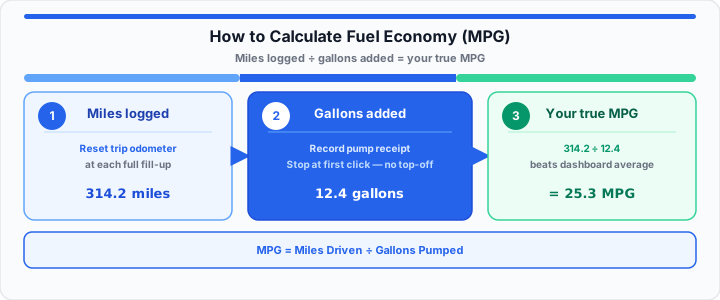
A recent tank cycle in my log: trip meter 314.2 miles, pump receipt 12.4 US gallons. 314.2 ÷ 12.4 = 25.3 MPG. Run those same two numbers through our Gas Mileage Calculator and you also get UK MPG, km/L, and L/100 km without hand conversions — useful when you are comparing a US window sticker to a European review.
Converting metric pump receipts
Cross a border or import a log from a metric gauge? Divide liters by 3.785 for US gallons before you divide miles. Imperial UK gallons use 4.546 liters — same consumption, higher MPG number on paper.
| Liters pumped | US gallons | MPG at 300 mi driven |
|---|---|---|
| 40 L | 10.57 gal | 28.4 MPG |
| 45 L | 11.89 gal | 25.2 MPG |
| 50 L | 13.21 gal | 22.7 MPG |
| 55 L | 14.53 gal | 20.6 MPG |
Reading L/100 km alongside MPG
European drivers often plan trips in liters per 100 kilometers — fuel needed for a fixed distance instead of distance per gallon. Lower L/100 km means better economy, the inverse of MPG. At 25 US MPG you sit near 9.4 L/100 km. Plug your measured MPG into the Fuel Cost Calculator when you want the trip priced in dollars, not liters.
Real-World Drags on Your Tank Average
Same formula, different result week to week? Something physical changed. Short checklist before you blame the engine computer:
- Tires a few PSI low — squirming rubber adds rolling resistance; highway MPG drops 1–3 points fast.
- Trunk weight — every 100 pounds hurts more in stop-and-go, but steady cruising still pays the bill.
- Roof boxes and crosswinds — drag spikes above 55 mph; a rack can shave double-digit economy on the interstate.
- Two-mile cold-start errands — rich warm-up fuel with almost no miles logged craters a tank average.
- Winter idle and blend — scraping the windshield burns gallons while Trip A sits frozen at zero.
Log three consecutive tank cycles before and after any change — tire pressure, removed roof box, new commute route. One tank is a snapshot. Three tanks show a trend you can trust when comparing vehicles or negotiating a tune-up.
Common MPG Questions
Does air conditioning lower your MPG?
Yes. A/C loads the engine and can drop economy roughly 5 to 25 percent depending on speed, heat, and vehicle size. Measure with A/C on if that matches how you actually drive.
How often should you calculate fuel economy?
Monthly works for most drivers. Recalculate after any change — new tires, roof rack, seasonal fuel, tune-up. One fill-up is a snapshot; three consecutive cycles show a reliable trend.
Why should you never top off when tracking MPG?
Forced fuel after the click varies with temperature and tank angle. Your gallon count becomes inconsistent, which throws off the division. Stop at the first shutoff every time.
Is MPG the same as miles per gallon?
Yes — same metric, same math. US MPG uses US gallons; UK MPG uses larger imperial gallons, so the number runs higher for identical consumption.
How do I convert liters to US gallons for MPG?
Divide liters by 3.785. A 47-liter fill-up is about 12.4 US gallons. Pair that with trip miles in the calculator or on scratch paper.