
Floating at eighty feet along a sheer wall, watching your submersible pressure gauge needle drop faster than expected produces a distinct sense of urgency. Every open-water diver learns gas management basics, but seeing your supply contract under the physical weight of the ocean turns abstract physics into a real-time safety priority.
When I am sketching a gas mix profile or briefing students on the boat deck, the confusion usually is not the multiplication—it is picturing how fluid weight scales with depth. Think of atmospheric pressure like mattresses stacked on your chest. At the beach you carry one air mattress of weight above you. Submerge, and dense water fills the column above your head. Because seawater is far denser than air, about thirty-three feet down feels like another fluid-filled mattress landed on the first. Flexible air spaces shrink, lung volume compacts, and each regulator breath can pull twice the gas molecules from your cylinder compared with the surface.
Unit cross-check: Multiply ATA by 14.7 to get total ambient PSI, or compare atm, bar, and psi scales in the Pressure Calculator. For shop-style PSI, Bar, and Pascal conversions on gauges, see our PSI to Bar and Pascal guide.
The Weight of the Ocean: Atmospheres vs. PSI
Terrestrial pressure changes slowly with elevation; marine environments climb much faster. At sea level, baseline air pressure is one atmosphere (1 atm), which equals about 14.696 PSI (field math rounds to 14.7 PSI).
In seawater, pressure stacks quickly. Salt water weighs roughly 64 lb per cubic foot, so a vertical column 33 feet deep exerts about 14.7 PSI—the same increment as one atmosphere of air at the surface.
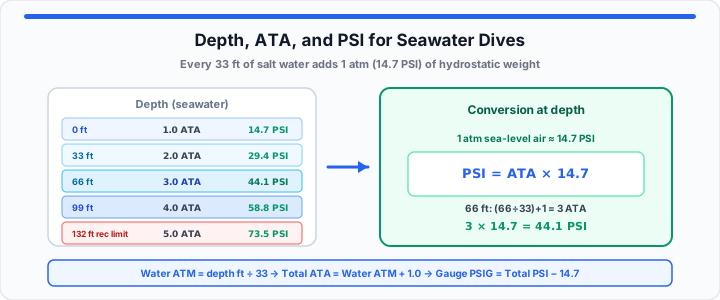
Underwater you feel two combined forces: atmospheric pressure from the air above the water line, plus hydrostatic pressure from the water column. Divers and marine engineers call that combined value atmospheres absolute (ATA). At the surface: 1 ATA (14.7 PSI). At 33 feet seawater (fsw): 2 ATA (29.4 PSI). At the common recreational ceiling of 132 feet: 5 ATA (73.5 PSI).
PSI = ATA × 14.7
How to Use This Depth-to-Pressure Workflow
To get started mapping a profile or verifying a target depth pressure on a wet slate, run this sequence. It separates water pressure from total absolute ambient force.
- Record target depth in feet of seawater (fsw). Use your maximum planned depth—for example, a 66-foot reef ledge.
- Find water atmospheres. Divide depth by 33: Water ATM = Depth ÷ 33. At 66 fsw, water contributes 2.0 atm.
- Add the surface air column. Total ATA = Water ATM + 1.0. That yields 3.0 ATA at 66 feet.
- Convert to PSI. Total PSI = Total ATA × 14.7. Three ATA becomes 44.1 PSI absolute.
- Isolate gauge pressure when needed. Mechanical test rigs often read PSIG: PSIG = Total PSI − 14.7. At 66 feet, gauge pressure is 29.4 PSIG.
One atmosphere at sea level is the anchor constant in that chain—the same 14.7 PSI relationship covered in our tire and compressor pressure guide, applied here to depth instead of inflation specs.
Saltwater vs. Freshwater Density
In boat testing and alpine lake surveys, divers switching from ocean charters to inland quarries often forget water density. Seawater runs about 64 lb/ft³, so 33 fsw = 1.0 atm of hydrostatic pressure.
Freshwater lakes weigh about 62.4 lb/ft³. Because that column is lighter, you must descend slightly deeper for the same pressure step: 34 feet of freshwater (ffw) ≈ 1.0 atm of hydrostatic pressure. Use 34 in the divisor for mountain lakes and springs so you do not underestimate ATA and gas compression.
Dive Plan Reference Grid
Use this table when you need ambient pressure, gauge pressure, and gas density multipliers in one view. Gas density scales with ATA—the same lungful at depth pulls more molecules from the tank.
| Depth (seawater) | Water ATM | Total ATA | Total PSI | Gauge PSIG | Gas density |
|---|---|---|---|---|---|
| 0 ft (sea level) | 0.0 | 1.0 | 14.7 | 0.0 | 1.0× |
| 33 ft (10 m) | 1.0 | 2.0 | 29.4 | 14.7 | 2.0× |
| 66 ft (20 m) | 2.0 | 3.0 | 44.1 | 29.4 | 3.0× |
| 99 ft (30 m) | 3.0 | 4.0 | 58.8 | 44.1 | 4.0× |
| 132 ft (40 m rec limit) | 4.0 | 5.0 | 73.5 | 58.8 | 5.0× |
| 165 ft (50 m tech) | 5.0 | 6.0 | 88.2 | 73.5 | 6.0× |
Surface Air Consumption at Depth
These conversions directly feed gas planning. Suppose you consume 30 PSI per minute from an aluminum 80 at the surface. At 99 feet (4.0 ATA / 58.8 PSI ambient), the same lung volume needs four times the molecules. Tank pressure can drop near 120 PSI per minute even though your breathing rhythm feels unchanged.
Depth PSI/min ≈ Surface SAC (PSI/min) × ATA
Partial-pressure problems on enriched air tie back to the same ATA multiplier. For ideal-gas style pressure–volume checks at constant temperature, use the Ideal Gas Law Calculator alongside your depth ATA from this table.
Frequently Asked Questions
- What is the difference between ATM and ATA in diving calculations?
- ATM describes a pressure unit near 14.7 PSI. ATA is total ambient pressure: one atmosphere of sea-level air plus water pressure. At 33 fsw, hydrostatic pressure is 1.0 atm but total ambient pressure is 2.0 ATA.
- Why does saltwater pressure rise one atmosphere every 33 feet?
- Seawater weighs about 64 lb/ft³. A 33-foot column over one square inch weighs about 14.7 lb, equal to one atmosphere. Each additional 33 fsw adds another atmosphere of liquid pressure.
- How do you use ATA to estimate tank air consumption?
- Measure Surface Air Consumption in PSI per minute at 1 ATA. Divide planned depth by 33, add 1.0 for ATA, and multiply SAC by ATA to estimate PSI per minute at depth.
- How does PSIG differ from absolute pressure on a dive computer?
- Gauge pressure (PSIG) ignores the 14.7 PSI air column and shows added water pressure only. Absolute pressure (PSIA or ATA) includes that baseline, which computers need for tissue loading and partial pressure limits.