
The Misread Winch Rating
A field technician mounts an imported metric winch line. The housing plate lists maximum force ratings in Newtons. The technician misinterprets the metric rating as imperial force. They over-tighten the entire cable rig during setup. Under heavy tension, the main shear bolt snaps violently. Steel fragments fly across the active rigging floor. In my site design experience, metric conversion mistakes destroy hardware. Mixing up load metrics causes catastrophic structural failure instantly.
Rigging crews face tight build schedules and heavy stress daily. Cross-referencing imported components with local specs creates extreme panic. Think of your Newton rating as a directional vector. It is a pure energy push awaiting safe load assignment. A single Newton feels like one apple resting on your hand. It exerts a light, downward force against your palm. Pound-force gathers roughly four and a half apples together. They form a tight, solid block in your hand. That bundle shows concentrated force hitting a mechanical joint.
The Mass Acceleration Baseline
Metric Vector Mass Impact and Tensile Limits
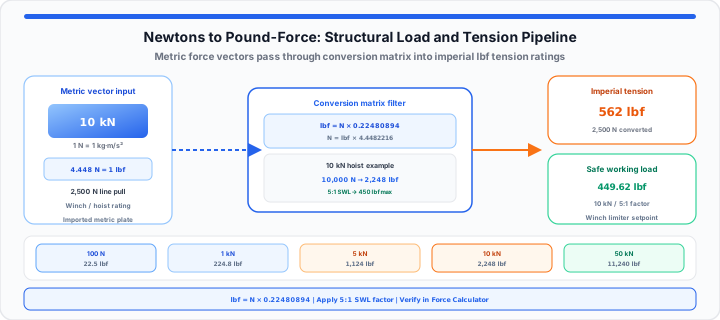
Metric force vectors rely on mass accelerated through space. One Newton accelerates one kilogram at one meter per second squared. In our load cell testing, vector forces hit joints directly. Imperial systems measure force through pound-force units instead. One pound-force accelerates one pound mass under Earth gravity. Gravitational acceleration creates a constant force multiplier on site. Standard gravity accelerates objects at 9.80665 meters per second squared. This creates an exact constant ratio between metric and imperial scales. Four point four four eight Newtons equal one pound-force precisely.
To get started, isolate your raw metric vector inputs cleanly. Always check baseline vector values before calculating joint tension. Cable connections must maintain structural integrity under full load. Incomplete unit conversions degrade tensile limits across steel trusses. Unchecked vector forces twist connection plates out of alignment. Yield strength defines the upper limit of elastic material deformation. Exceeding yield thresholds causes permanent structural distortion in steel. Tensile stress measures internal pulling forces across material cross-sections. Proper unit conversion prevents unexpected structural failure during load shifts.
Verify baseline vector parameters in our Force Calculator and Newton’s Second Law Calculator. For stress across bolt cross-sections, use the Stress Calculator.
lbf = N × 0.22480894
N = lbf × 4.4482216
The Gravitational Field Multiplier
Dynamic Shear Constraints and Safe Working Load Coefficients
Moving onto dynamic tension, gravity creates constant structural pull. Crane cables experience both static mass and sudden acceleration spikes. Rapid motor starts multiply raw vector forces across support lines. Unchecked dynamic spikes shear steel fasteners and split welds. Shear stress measures lateral forces slicing through structural bolts. Dynamic loads double the static stress felt by winch cables. When I evaluate raw cable tension at the winch, precision matters. Safe working load coefficients require accurate unit scaling factors.
Safety factors usually double or triple baseline tension limits. A five-to-one safety ratio protects overhead crane operators daily. Converting metric line pull to imperial tension preserves design margins. Miscalculating force vectors reduces your built-in safety cushion. A ten kilonewton hoist line requires careful imperial conversion. Ten kilonewtons equal two thousand two hundred forty-eight pounds-force. Applying a five-to-one safety factor reduces working capacity. The safe working load drops to four hundred forty-nine pounds-force. Overloading support lines causes catenary curves to flatten dangerously. Flat catenary curves increase tension exponentially at anchor points.
Map out structural load lines using our Force Calculator. For bolt pressure ratings in psi, cross-check the Pressure Calculator and our PSI to Bar conversion guide. For work done over a lift distance, see the Work Calculator.
The High-Load Rigging Manifest
Practical Site Safety Verification and Conversion Benchmark Lookup
A structural safety chief inspects an imported overhead crane framework. The metric hoist plate lists a ten-kilonewton line limit. Local site regulations mandate imperial safe working load specs. The chief calculates line thresholds before approving site lifts. Site safety protocols require complete documentation of all load lines. Converting raw values eliminates guessing during heavy crane operations. Structural engineers verify connection bolt specs against shear limits. Imperial hardware ratings must match or exceed metric forces. In-line load cell sensors send real-time tension data to displays. Telemetry systems flag sudden dynamic force spikes during rapid hoisting.
| Metric Vector Benchmark (N / kN) | Imperial Tension Output (lbf) | Structural Safety Interpretation |
|---|---|---|
| 100 Newtons | 22.48 lbf | Light rigging cable hand-tension threshold |
| 500 Newtons | 112.40 lbf | Moderate winching line setup capacity |
| 1,000 Newtons (1 kN) | 224.81 lbf | Baseline structural tie-down rating |
| 5,000 Newtons (5 kN) | 1,124.04 lbf | Heavy truss support cable limit |
| 10,000 Newtons (10 kN) | 2,248.09 lbf | Overhead crane hoist line capacity |
| 50,000 Newtons (50 kN) | 11,240.45 lbf | Main bridge stay cable anchor threshold |
- Imported Hoist Rating: 10,000 Newtons (10 kN) maximum line pull.
- Calculated Imperial Vector: 2,248.09 pounds of force active.
- Mandated Safety Factor: 5:1 safe working load coefficient required.
- Maximum Permissible Load: 449.62 lbf continuous lifting capacity.
- Winch Limiter Calibration: Calibrate automatic shutoff at 445 lbf.
- Anchor Bolt Tensile Limit: Grade 8 bolts rated above 150,000 psi — verify on the Pressure Calculator.
- Dynamic Shear Constraint: Maintain lateral shear below 300 lbf.
Calibration logs record baseline cable tensions prior to full operation. Proper documentation protects site contractors during regulatory safety audits. Inspectors check rigging shackles for micro-cracks under load pressure. Matching metric hardware ratings to imperial standards prevents line snapping. For pulley tension lab math, see our connected masses pulley lab guide. For energy units on heating coils, read our Joules to calories conversion guide.
Open Force Calculator Open Stress Calculator
Frequently Asked Questions
How do you accurately convert Newtons to Pound-Force manually?
Multiply total Newtons by zero point two two four eight zero eight nine four. Alternatively, divide total Newtons by four point four four eight two two one six. Both calculations yield accurate pound-force values for engineering specs.
Why do rigging specs list tension in both kilonewtons and lbf?
International equipment manufacturers use metric kilonewton ratings on plates. Domestic building codes require imperial pound-force documentation for safety audits. Listing both units prevents dangerous conversion errors on job sites.
What is the physical difference between mass pounds and pound-force?
Mass pounds measure the total amount of matter in an object. Pound-force measures gravitational pull acting on that mass. On Earth, one pound mass exerts one pound-force downward.
How does dynamic movement affect tension load calculations?
Accelerating a load increases effective force on cables and winches. Fast lifts create dynamic spikes above static mass weight. Engineers apply safety factors to absorb these dynamic force spikes.