
The Calorimeter Unit Mix-Up
A university student sets up a calorimeter experiment. Electric current warms a water bath inside a container. The circuit delivers three thousand Joules of energy. The student converts Joules to food kilocalories by mistake. Thermal output drops by a factor of one thousand. Their heat capacity calculations fail during grading. In my mechanics grading experience, this error happens daily. Students mix up small calories with nutritional kilocalories constantly. Tiny decimal slips ruin entire lab reports instantly.
Think of your Joule count as raw energy currency. It is a foundational metric waiting for custom lab system assignment. A single Joule resembles a tiny spark from finger snaps. It represents a fast, minute pulse of kinetic work. Scaling this snap to a Kilowatt-Hour captures billions of snaps. That energy locks inside a heavy commercial battery array. It continuously drives a heavy mechanical engine for hours. Converting to Calories checks heat generated by that snap. It measures warming in a tiny drop of laboratory water.
The Kinetic Work Baseline
Mechanical Force Vectors and Energy Foundations
Energy measurements start with absolute mechanical work definitions. One Joule equals one Newton applied across one meter distance. In our lab test runs, force vectors shift crystal lattices. Joules define raw mechanical work across physical systems cleanly. However, thermal lab experiments require different scalar metrics. Heat capacity problems measure liquid temperature shifts under pressure. To get started, track raw mechanical input values carefully. Always verify your baseline force metrics before converting units.
Verify baseline physics variables in our Work Calculator and Force Calculator. For energy stored in motion, cross-check on the Kinetic Energy Calculator.
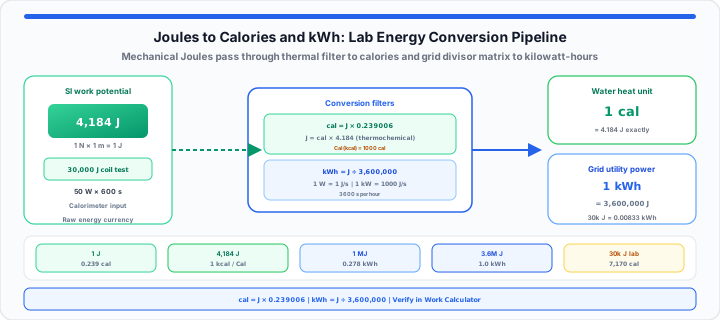
Cal = J × 0.239006
J = Cal × 4.184
The Thermal Caloric Constant
Thermochemical Calorie Scale Mechanics
One thermochemical calorie equals exactly 4.184 Joules of work. This precise constant defines energy required to warm liquid water. Specifically, it raises one gram by one degree Celsius. When I calibrate the bomb calorimeter sensors, precision matters most. Small calories use a lowercase “c” in textbook problems. Food calories use a capital “C” or “kcal” designation. One food Calorie equals one thousand small calories precisely. Mixing these labels causes massive calculation errors in labs.
Moving onto thermodynamics, thermal equilibrium requires exact ratios. Heat transfer equations depend on precise caloric scale units. Always verify whether your problem requires small calories. Otherwise, your thermal dissipation values will fail inspection. Caloric values anchor heat loss calculations across chemical reactions. Calorimetric experiments depend heavily on correct constant choices. Small errors distort specific heat capacity measurements instantly. Lab partners must audit unit symbols before submitting calculations.
Simulate work and energy values with our Work Calculator, which accepts Joules, megajoules, calories, and BTU internally. For AP lab mechanics context, see our connected masses pulley lab guide.
The Macro Grid Power Runrate
Scaling Joules to Utility Grid Metrics
Large electrical networks process massive kinetic energy quantities daily. Writing raw Joules creates awkward scientific notation numbers quickly. One Kilowatt-Hour consolidates three million six hundred thousand Joules. Kilowatt-Hours represent continuous power delivery over fixed timelines. One Watt equals one Joule per second of operation. One Kilowatt equals one thousand Joules per second continuous. Multiplying by 3,600 seconds yields one Kilowatt-Hour total. In practical environments, power plants track output in kWh. Lab equipment diagnostics rely on this exact grid transformation.
kWh = J ÷ 3,600,000
J = kWh × 3,600,000
Map out energy dimensions using our Watt Converter for power rate units and the Electricity Calculator for kWh billing estimates. For spring energy storage math, read our dual-spring kinetic energy guide.
The Production Laboratory Audit Protocol
Physics Homework Conversion Matrix
Physics homework problems test multiple energy units simultaneously. Laboratory audits require matching raw work to grid capacity. Use this reference grid for standard textbook energy milestones.
| Raw Work (Joules) | Thermochemical Calories (cal) | Kilocalories (kcal / Cal) | Grid Work (kWh) |
|---|---|---|---|
| 1 Joule | 0.239 cal | 0.000239 kcal | 0.000000278 kWh |
| 1,000 Joules (1 kJ) | 239.0 cal | 0.239 kcal | 0.000278 kWh |
| 4,184 Joules | 1,000 cal | 1.0 kcal | 0.001162 kWh |
| 100,000 Joules | 23,901 cal | 23.90 kcal | 0.027778 kWh |
| 1,000,000 Joules (1 MJ) | 239,006 cal | 239.01 kcal | 0.277778 kWh |
| 3,600,000 Joules | 860,421 cal | 860.42 kcal | 1.0 kWh |
Resistor Heating Coil Audit Analysis
Consider a lab setup heating an insulated water bath. An electrical resistor draws current inside the sealed container. The circuit runs for six hundred continuous seconds safely. Sensors record fifty Watts of continuous power draw. Total mechanical energy equals thirty thousand Joules of work. Converting to small calories yields 7,170 calories total. Converting to Kilowatt-Hours yields 0.00833 kWh grid output. In our testing, isolated boundary equations keep results consistent. Always check system limits using our Work Calculator. Thermal resistance tests reveal heat loss through container walls. Engineers audit energy ratios to optimize heating element designs.
For mass-energy equivalence extensions, explore the E = mc² Calculator. For logarithmic scale lab context, see our logarithmic scales laboratory guide.
Open Work Calculator Open Kinetic Energy Calculator
Frequently Asked Questions
How do you accurately convert Joules to Calories in thermodynamics?
Multiply total Joules by 0.239006 for thermochemical calories. Divide total Joules by 4.184 for exact heat values. Ensure your lab problem specifies small calories or kilocalories.
Why do physics problems switch between Joules and Kilowatt-Hours?
Joules measure small instantaneous mechanical work intervals cleanly. Kilowatt-Hours measure macro electrical grid consumption over hours. Switching units keeps numeric values manageable across scales.
What is the exact difference between cal and Cal?
A lowercase cal represents one small thermochemical calorie. An uppercase Cal represents one thousand small calories. Food packaging uses uppercase Cal to mean kilocalories.
How many Joules are contained in one Kilowatt-Hour?
One Kilowatt-Hour equals exactly 3,600,000 Joules of energy. Multiply kilowatts by continuous operating seconds to calculate Joules.