
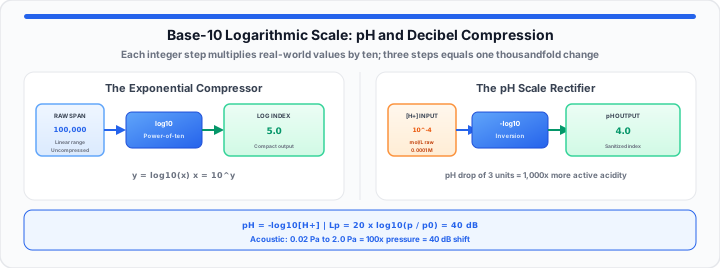
Environmental lab technicians face subtle analytical pitfalls daily. A wastewater sample drops from pH 6 down to pH 3. This change looks like a simple three-unit shift. In reality, active acidity exploded by one thousand times. Misinterpreting this metric ruins chemical treatment processes completely.
In my production laboratory experience, scale confusion causes costly failures. Staring at raw negative exponents mid-workflow drains critical mental energy. Think of your log scale as a data compression compressor. It acts as a strict mathematical lens for exploding spans. Consider climbing a giant corporate ladder with expanding rungs. Moving from rung 4 to 5 jumps ten stories. Slipping from rung 4 to 6 vaults one hundred stories. Base-10 logarithms convert explosive exponential growth into manageable steps.
Review our conversion lookup table for common laboratory chemical profiles. This table links raw ion concentration to logarithmic output categories.
| Solution Profile | Hydrogen Ion [H⁺] (mol/L) | Base-10 Log Output | Final pH Category |
|---|---|---|---|
| Battery Acid | 1.0 × 10⁻¹ | −1.0 | Strongly Acidic |
| Black Coffee | 1.0 × 10⁻⁵ | −5.0 | Weakly Acidic |
| Pure Water | 1.0 × 10⁻⁷ | −7.0 | Neutral Standard |
| Household Bleach | 1.0 × 10⁻¹³ | −13.0 | Strongly Alkaline |
The Exponential Compressor
To get started, linear scales fail across massive chemical ranges. Acids release hydrogen ions in wildly varying numeric amounts. One sample contains billions of free ions per liter. Another sample contains only a few thousand active ions. Plotting these values on standard graphs creates extreme visual distortion. Base-10 logarithms compress these massive numeric spans with ease. Base-10 logarithms simplify huge data ranges smoothly. Linear graphs compress tiny variations into unreadable lines.
In our titration testing, subtle chemical changes matter greatly. A single logarithmic step multiplies the baseline value ten times. Two steps expand the magnitude by one hundred times. Three steps multiply the true value by one thousand. Four steps boost the total signal by ten thousand. Exponent math powers this fundamental scaling relationship:
y = log₁₀(x)
x = 10y
Manual calculations slow down busy analytical testing routines. You can simulate your metric transitions with our interactive Log Calculator online. Automated digital processing eliminates human calculation errors instantly. You can also verify your baseline algebraic parameters instantly with the Exponent Calculator on screen. For lab-report notation parsing, see our guide on converting scientific notation to decimal numbers or use the Scientific Notation Calculator directly.
Negative Logarithms and pH
Moving onto operational mechanics, negative logarithms turn fractions into positive integers. Chemical acidity measures free hydrogen ion molarity in solution. Pure water contains zero point zero zero zero zero zero zero one moles. Writing endless zeros causes frequent recording errors in lab books. The negative logarithm converts tiny fractions into clean whole numbers. The standard chemical pH equation is rendered as:
pH = −log₁₀[H⁺]
When I calibrate sound-pressure meters at the bench, acoustics follow similar rules. Human ears perceive sound pressure along an extreme logarithmic curve. A quiet room produces zero point zero zero zero zero two Pascals. A jet engine produces over two hundred Pascals of sound pressure. We convert vast sound ratios into manageable decibel metrics. The acoustic sound pressure level equation is written as:
Lp = 20 × log₁₀(p ÷ p0)
In this formula, p represents measured sound pressure in Pascals. Symbol p0 represents the baseline human hearing threshold reference. To test your dataset value limits, use precise mathematical tools. You can map out your logarithmic scales using the Log Calculator online, or open the Scientific Calculator for full expression entry.
Negative Logarithm Thresholds
Negative multipliers invert fractional exponential terms smoothly. Higher free hydrogen ion counts generate lower pH values. A pH reading of one represents concentrated hydrochloric acid. A pH reading of seven represents pure neutral water. A pH reading of fourteen indicates concentrated sodium hydroxide. Every single pH drop increases active hydrogen ion density.
Relative Acoustic Thresholds
Acoustic calculations require specialized pressure reference values. Sound pressure levels depend on measured force per area. We compare measured values against twenty micropascals baseline. A twenty-decibel increase multiplies acoustic sound pressure ten times. A forty-decibel increase multiplies acoustic pressure one hundred times. A sixty-decibel shift multiplies acoustic pressure one thousand times.
Mantissa Decimal Precisions
Logarithmic notation splits numbers into two distinct structural parts. The integer before the decimal point is the characteristic. The numbers after the decimal point form the mantissa. The characteristic identifies the specific power-of-ten scale magnitude. The mantissa preserves the true precision of lab measurements. A pH value of 4.15 contains two decimal digits. Those two decimal digits dictate your actual scientific accuracy.
Industrial Monitoring Walkthrough
In practical environments, accurate signal tracking prevents laboratory errors. I evaluate acoustic and chemical shifts using strict reference checks. Our production audit protocol eliminates measurement drift completely. Review these raw metrics from an active industrial monitoring test:
- Initial Water Sample Input: Zero point zero zero seven five Molar.
- Exponential Scientific Notation: Seven point five times ten minus three.
- Raw Calculated Logarithm: Minus two point one two five.
- Converted Negative Log Output: Plus two point one two five pH.
- Base Acoustic Input Pressure: Zero point zero two Pascals.
- Peak Measured Sound Pressure: Two point zero Pascals.
- Total Calculated Acoustic Shift: Forty decibels increase recorded.
Now execute the logarithmic shift calculation for acoustic signals. Consider an industrial exhaust system test in a sound chamber. Initial pressure measures zero point zero two Pascals at rest. Peak operational pressure reaches two point zero Pascals under load. Apply the standard acoustic pressure level ratio equation:
Lshift = 20 × log₁₀(2.0 ÷ 0.02)
Lshift = 20 × log₁₀(100)
Lshift = 20 × 2 = 40 dB
Acoustic pressure increased by forty decibels total during testing. Physical sound pressure expanded by one hundred times original levels. The calculated logarithmic scale shift matches physical sensor measurements. Streamline your laboratory workflow using our Log Calculator today. Instant mathematical conversions keep engineering projects running on schedule.
Open Log Calculator Open Exponent Calculator
Frequently Asked Questions
How do you convert a chemical concentration to a logarithmic pH scale manually?
Calculate the base-10 logarithm of hydrogen ion molarity. Multiply that resulting logarithm value by negative one. A concentration of 0.01 Molar yields a pH of 2.
Why does a small shift in a logarithm scale mean a massive change in real-world values?
Logarithmic scales compress massive power-of-ten expansions into compact numbers. Each integer step multiplies real-world values by ten. A three-unit shift equals a one-thousand-fold physical change.
What is the difference between sound intensity decibels and sound pressure decibels?
Sound pressure calculations use a multiplier constant of twenty. Sound power calculations use a multiplier constant of ten. Pressure measures force per unit area in Pascals. Power measures total acoustic energy output in Watts.
Can a pH value or decibel reading fall below zero?
Yes, logarithmic values drop below zero in special situations. Extremely concentrated strong acids produce negative pH readings. Sound pressures below human hearing thresholds yield negative decibel values.