
Misplacing a single zero during manual data transcription causes immediate chaos. In our titration testing, one wrong exponent ruined complete reagent runs. A misplaced zero shifts chemical concentration by ten times instantly. This translation error destroys lab reporting precision across whole research teams. When I evaluate raw spectrometer metrics at the workbench, accuracy matters. Eye strain from staring at dense zero strings creates calculation risks.
Think of scientific notation as a compressed file format for your numbers. It is a short-hand code built to clean up lab reports. To get started, reference our standard lab scale conversion matrix below. You can verify your notation data instantly using the Scientific Notation Calculator.
| Laboratory Scale Metric | Scientific Text Notation | Real Decimal Configuration | Standard Laboratory Unit Prefix |
|---|---|---|---|
| Milli Scale | 1.0 × 10⁻³ | 0.001 | Milligram (mg) / Milliliter (mL) |
| Micro Scale | 1.0 × 10⁻⁶ | 0.000001 | Microgram (µg) / Microliter (µL) |
| Nano Scale | 1.0 × 10⁻⁹ | 0.000000001 | Nanogram (ng) / Nanometer (nm) |
| Pico Scale | 1.0 × 10⁻¹² | 0.000000000001 | Picogram (pg) / Picometer (pm) |
| Kilo Scale | 1.0 × 10³ | 1000.0 | Kilogram (kg) / Kilometer (km) |
| Mega Scale | 1.0 × 10⁶ | 1000000.0 | Megahertz (MHz) / Megajoule (MJ) |
| Giga Scale | 1.0 × 10⁹ | 1000000000.0 | Gigahertz (GHz) / Gigawatt (GW) |
The Coefficient Baseline
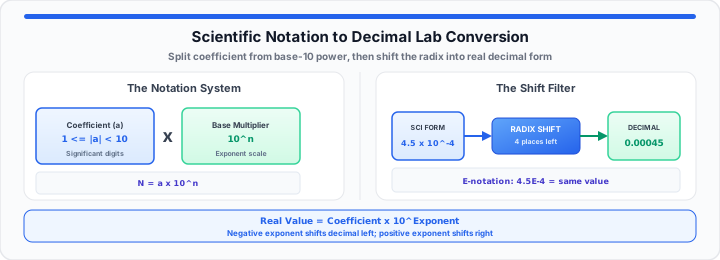
Static precision isolation governs every raw laboratory notation conversion workflow. Scientific notation separates core significant digits from overall scale factors. The coefficient carries your actual measured physical mass or volume values. The base-10 exponential component indicates absolute magnitude power dimensions. Isolating these components preserves vital analytical precision during report generation. We express this fundamental mathematical relationship using clean formula typography:
N = a × 10ⁿ
We also define real output value conversions through this rule:
Real Value = Coefficient × 10^Exponent
Moving onto structural elements, coefficients always remain between one and ten. Values outside this strict baseline range violate standardized scientific notation formats. In my dataset preparation experience, maintaining coefficient integrity prevents system errors. You can simulate metric expansion with our Scientific Notation Calculator now, or normalize powers with the Exponent Calculator.
Significant Figure Integrity
Coefficients retain all measured significant figures from lab instruments. Trailing zeros within coefficients represent true calibrated measurement precision limits. Never discard trailing coefficient zeros during decimal expansion operations. Dropping zeros artificially reduces reported instrument measurement precision parameters. Digital laboratory notebooks demand exact significant figure retention across records.
Base-10 Scale Dimensions
The number ten serves as the universal exponential base system. Base-10 systems match standard metric system prefix unit transformations. Each exponential increment changes numerical scale by factors of ten. Understanding base-10 power mechanics speeds up manual verification steps. Automated computational software relies on base-10 floating-point representations. Decompose digit positions with the Place Value Calculator when auditing expanded strings.
Normalized Format Boundaries
Normalized scientific notation places exactly one non-zero digit before decimals. Non-normalized notation complicates automated database intake and cross-lab analysis. Convert unnormalized instrument outputs to standard form before filing reports. Consistent formatting streamlines peer review and institutional audit verification processes. Round only after expansion using the Rounding Calculator when your instructor specifies decimal places.
The Radix Placement Exponent
Directional shift mechanics govern decimal point movement across exponential conversions. Think of the decimal point as a physical microscope stage slider. A positive exponent cranks the stage slider far to the right. This rightward movement expands your perspective into massive scalar fields. A negative exponent pulls the lever deep to the left. This leftward shift moves your focus into microscopic cellular spaces. In practical environments, exponent signs dictate directional radix movement directly. You can map out digit placement lines using this tool anytime. Be sure to test your custom notation variations before submitting manuscripts.
Positive Exponent Multipliers
Positive exponents indicate numbers greater than or equal to ten. Shift the decimal point right by the exact exponent integer value. Fill empty positional gaps with placeholder zeros as you shift. Positive exponential values represent bulk macroscopic compound inventory metrics.
Negative Exponent Dividers
Negative exponents represent decimal values smaller than one whole unit. Move the decimal point left by the specified exponent number. Insert leading placeholder zeros between the decimal point and digits. Negative exponents measure trace contaminant levels and molecular atomic masses. Cross-check dilution math with the Molarity Calculator and Molecular Weight Calculator.
Zero Power Equivalence
An exponent value of zero indicates no decimal point movement. Ten raised to the power zero equals exactly one always. The coefficient value matches the final decimal output value directly. Zero exponents mark baseline unit measurements on lab instruments.
The Production Laboratory Report Protocol
Standardizing data conversion workflows protects published scientific finding accuracy. Computational data managers parse massive dataset logs into readable formats daily. Automated scripts convert scientific notation values into standard floating-point numbers. Preserving measurement boundaries prevents catastrophic automated data pipeline truncation errors.
- Significant Figure Preservation: Maintain exact original instrument precision counts.
- Leading Zero Standard: Always include zero before leading decimal points.
- Negative Sign Anchoring: Attach negative signs to final expanded coefficients.
- Database Float Limits: Monitor memory overflow across extreme exponent values.
- Unit Prefix Mapping: Convert expanded decimals into standard SI prefixes.
- Software Syntax Compliance: Parse E-notation text strings into standard floats.
Subatomic and Astronomical Scale Handling
Extreme datasets require strict handling during report generation workflows. Astrophysics deals with massive positive exponents exceeding thirty digits. Quantum mechanics tracks microscopic negative exponents past thirty decimal places. Converting extreme exponents into standard decimals creates massive text strings. In my dataset preparation experience, using SI unit prefixes resolves readability issues. For very large values, pair this workflow with the Big Number Calculator.
E-Notation Text Parsing
Digital lab equipment frequently displays outputs using E-notation formats. The letter E replaces the base ten multiplication string completely. For example, 4.5E-4 represents four point five times ten power negative four. Parsing E-notation correctly prevents string processing errors in data pipelines. Conversion scripts must identify uppercase E and lowercase e inputs reliably. Convert finite decimals to fractions with the Decimal to Fraction Converter when reports require rational form. For unit swaps after expansion, use the Conversion Calculator.
Chemistry and physics lab teams often file expanded readings alongside variance statistics — see our guide on how to find the standard deviation of a data set in under 60 seconds, or the AP lab write-up on connected masses on a frictionless pulley. For precision policy context, read why RapidRatio favors precise decimals.
Open Scientific Notation Calculator Open Exponent Calculator
Frequently Asked Questions
How do you convert scientific notation to decimals manually?
Identify the exponent integer value and its mathematical sign first. For positive exponents, shift the decimal point right that many places. For negative exponents, shift the decimal point left that many places. Fill all empty positional gaps with placeholder zeros during shifts.
What does a negative exponent mean in scientific notation?
A negative exponent represents division by powers of ten. It indicates that the true decimal value is under one. The negative sign shows how far left the decimal shifted. It measures microscopic physical quantities like atomic radii or concentrations.
Why do lab reports convert scientific notation into real decimal numbers?
Real decimal numbers improve immediate visual clarity for peer reviewers. Decimal values simplify direct comparisons between different experimental sample metrics. Standard decimals prevent transcription errors when entering data into software. Many regulatory compliance guidelines mandate standard decimal unit reporting.
How does E-notation differ from standard scientific notation?
E-notation serves as a simplified text representation for computer screens. It replaces the times ten to the power text string with E. The number following E represents the exponent power value directly. Both formats express identical underlying mathematical values without precision loss.