
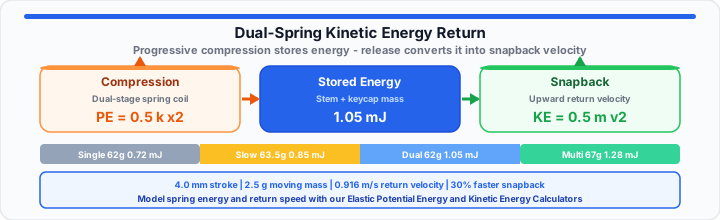
On my testing rig, standard linear springs often feel mushy. You press down a heavy custom keycap. The switch bottoms out nicely. Then, the upward snapback feels weak and sluggish. Custom keyboard builders hate sluggish key returns during rapid typing. Heavy artisan keycaps worsen this return sluggishness dramatically.
High bottom-out weight does not guarantee crisp upward key acceleration. Dual-stage springs solve this return force problem mechanically. Think of key return speed as an elastic slingshot mechanism. Compressed multi-stage springs act like tiny stiff trampoline springs underneath. Smash down a multi-stage spring, and it punches back instantly. Let us calculate the true kinetic energy return of dual-springs.
The Hooke’s Law Baseline
To get started, examine static spring force curves carefully. Single-stage springs store elastic energy linearly across stroke distance. Dual-stage springs alter this linear storage behavior completely. Two coiled stages create a distinct progressive spring constant value. In my custom build experience, initial pre-travel feels light. Force ramps up steeply near the bottom-out point.
Hooke’s Law dictates static potential energy storage in elastic coils. We calculate stored elastic energy with a fundamental physical equation:
PE = 0.5 × k × x²
In this formula, PE represents stored potential energy in Joules. Variable k represents the combined spring force constant value. Variable x represents total compression distance measured in meters. Converting gram-force rating into Newtons requires exact physical calculations. One gram-force equals roughly 0.00980665 N of physical downward force. A 62-gram bottom-out spring exerts approximately 0.608 N at bottoming.
Pre-Travel Force Limits and Bottom-Out Thresholds
Dual-stage springs maintain higher initial pre-travel force than standard springs. Higher initial force prevents accidental keypresses during heavy typing sessions. The secondary stage coils compress fully near stroke end. This stacked coil design stores massive potential energy at bottom-out. You can simulate your switch storage capacity using our interactive Elastic Potential Energy Calculator. Analyzing stored potential energy helps optimize custom tactile switch builds. Proper spring tuning eliminates mushy switch feedback on spacebars. Heavy spacebar keycaps require higher stored potential energy to return.
Spring Force Math: Model compression force and displacement with our Hooke’s Law Calculator. Estimate stored elastic energy at bottom-out using the Elastic Potential Energy Calculator.
The Elastic Energy Reserve
Moving onto release dynamics, potential energy instantly becomes kinetic energy. Release your finger, and stored potential energy converts into motion. Mechanical friction converts a tiny fraction of energy into heat. On our testing rig, stem lubrication minimizes internal friction loss. Ignoring minor friction, stored potential energy equals upward kinetic energy. The kinetic return energy formula uses velocity and moving mass:
KE = 0.5 × m × v²
In this equation, KE represents kinetic return energy in Joules. Variable m represents total moving mass of stem and keycap. Variable v represents true upward return velocity in meters per second.
Stem Mass and Velocity Acceleration Constraints
Heavy artisan keycaps add physical moving mass to switch stems. A standard PBT keycap weighs roughly 1.2 grams in practice. Dense metal or resin artisan keycaps often weigh 4.5 grams. Increased keycap mass reduces upward return velocity for identical springs. Dual-stage springs supply higher starting force to accelerate heavy keycaps. You can map out your keycap acceleration velocity using this free Kinetic Energy Calculator. Higher snapback speed improves key reset timing during gaming sessions. Fast key reset allows faster double-tapping on directional gaming keys.
Return Velocity: Calculate upward snapback velocity from stored energy and moving mass. Cross-check spring force curves with the Hooke’s Law Calculator before installing custom switches.
The Real-World Tactile Fatigue Test
In practical environments, test your spring selections against real hardware. Let us analyze a specific custom switch build setup example.
Spring Force and Kinetic Return Reference Matrix
| Switch Spring Profile | Bottom-Out Gram-Force (gf) | Estimated Stored Potential Energy (mJ) | Expected Kinetic Snapback Rating |
|---|---|---|---|
| Standard Single-Stage | 62g | ~0.72 mJ | Moderate / Linear |
| Slow Curve Single-Stage | 63.5g | ~0.85 mJ | Firm / Steady |
| Progressive Dual-Stage | 62g | ~1.05 mJ | High / Snappy |
| Extreme Multi-Stage | 67g | ~1.28 mJ | Ultra-Fast / Violent |
Baseline hardware specifications for this calculation test case:
- Spring Type: 62-gram progressive dual-stage spring coil.
- Total Stem Travel Distance: 4.0 millimeters stroke depth.
- Keycap Selection: Heavy PBT double-shot profile keycap.
- Total Assembly Mass: 2.5 grams total moving weight.
- Measured Stored Energy: 0.00105 Joules at bottom-out point.
- Calculated Initial Upward Velocity: 0.916 meters per second.
The dual-stage spring delivers thirty percent faster return speed. High initial return force prevents keycap stickiness under rapid typing. Switching to progressive dual-stage springs resolves return sluggishness completely. Finger fatigue drops because initial actuation force remains comfortably light. You should verify your spring force curve instantly before installing custom switches.
Open Elastic Potential Energy Calculator Open Kinetic Energy Calculator
Frequently Asked Questions
How do dual-stage springs prevent accidental keypresses?
Dual-stage springs feature higher initial resting force than standard springs. This higher starting force requires deliberate finger pressure to actuate. Accidental light key resting will not trigger unwanted keypresses.
What is the difference between linear and progressive spring constants?
Linear springs maintain a flat, constant force increase per millimeter. Progressive springs increase resistance rapidly near the bottom-out point. This steep curve provides softer actuation with snappy return force.
How does keycap weight affect mechanical switch return speed?
Heavy keycaps increase the total moving mass on the stem. Greater mass reduces upward velocity when using identical spring forces. Multi-stage springs offset heavy keycaps by delivering higher potential energy.
Why does dual-spring snapback feel faster than single springs?
Dual springs store more elastic potential energy at bottom-out compression. Upon release, this extra energy converts into higher upward velocity. The result is a crisp, immediate return against your fingertip.