
There are few things more stomach-churning on a job site than watching a commercial ready-mix truck driver swing out his discharge chute, rev the drum engine, and empty the last drop of concrete while you still have three empty sonotubes staring back at you. On pour days, running short is not just an inconvenience—it is an operational disaster. You either pay a short-load penalty to rush a half-yard dispatch back to the site, or you get stuck with a weak cold joint right in the middle of a load-bearing deck pier.
Calculating three-dimensional cylinder volume causes endless confusion for apprentices and DIY builders because cardboard concrete form tubes are sold in inches of diameter, but commercial concrete is sold in cubic yards.
To make sense of cylinder geometry before you order a truck, think of a round pier form like a massive takeout coffee cup or a tall steel oil drum. The total volume inside the container is simply the flat circular area at the bottom multiplied by how high the liquid—or concrete—fills the cylinder from base to rim. Once you master that simple height multiplier, you will never get caught short on a pour day again. For flat pads and sidewalks, pair this pier math with our Concrete Pour Blueprint guide and the Concrete Calculator.
Instant pier yardage: Enter radius and depth in your preferred units in our Volume Calculator (cylinder mode) to skip hand conversions on muddy gloves.
The Anatomy of a Structural Cylinder: Radius, Diameter, and Height
When I am calculating truck orders for deep pier footings, the single most common mistake I catch on site plans is swapping the outer tube diameter for the radius required by geometry formulas.
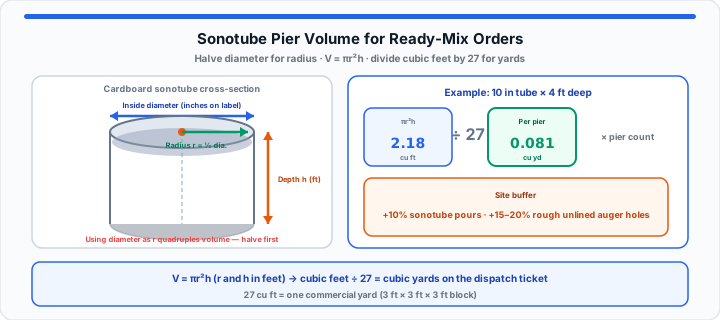
Cardboard sonotubes come stacked in standard trade sizes labeled by inside diameter—typically 8-inch, 10-inch, 12-inch, or 18-inch sizes. If you plug a 12-inch diameter measurement directly into your volume calculation as your radius, your final yardage number will end up four times larger than what the hole actually holds. When you are verifying the opening against a tape, our Circle Calculator keeps diameter-versus-radius straight on circular layouts.
To set up your structural math correctly, break your cylinder down into three primary dimensions:
- Diameter: The straight-line distance measured edge-to-edge across the top opening of your cardboard tube.
- Radius: The distance from the absolute center point of the circle out to the cardboard wall (exactly half of the total diameter).
- Height (or Depth): The vertical distance measured from the flat bottom of your excavated hole or footing pad straight up to the finished top pour line of the tube.
Step-by-Step: Calculating the Volume of Your Concrete Tube
To get started with manual site calculations, you must run your measurements through a six-step unit conversion flow. Because sonotube diameters are measured in inches while depth is measured in feet, converting everything into feet before multiplying is critical for accuracy.
The foundational mathematical rule for finding cylindrical volume is written as V = πr²h, where V is total volume, π is Pi (approximately 3.14159), r is the radius in feet, and h is the depth in feet.
Follow these practical steps on site to resolve the geometry manually:
- Find your tube radius in inches: Take your cardboard tube’s inner diameter and divide it by two (e.g., a 10-inch sonotube has a 5-inch radius).
- Convert the radius from inches to feet: Divide your radius in inches by 12 (e.g., 5 ÷ 12 = 0.4167 feet).
- Square your radius value: Multiply your radius in feet by itself (e.g., 0.4167 × 0.4167 = 0.1736 square feet).
- Calculate the base circle area: Multiply your squared radius by Pi (e.g., 3.14159 × 0.1736 = 0.5454 square feet of surface area).
- Multiply by total pier depth: Multiply your base circle area by the total height of the pier in feet (e.g., for a 4-foot deep pier: 0.5454 × 4 = 2.1816 cubic feet).
- Convert cubic feet into commercial cubic yards: Divide your total cubic feet by 27 to find your final yardage requirement (e.g., 2.1816 ÷ 27 = 0.0808 cubic yards per pier).
The 27 Rule: Cubic Feet to Dispatch Yards
Ready-mix batching software thinks in cubic yards, not field cubic feet. Picture a concrete block measuring 3 feet long, 3 feet wide, and 3 feet deep—that perfect cube holds exactly 27 cubic feet, which equals one cubic yard on the dispatch ticket. Whenever your pier math finishes in cubic feet, divide by 27 before you phone the plant. The same divisor appears in slab pours; our Concrete Pour Blueprint walks through it for flat work.
The Quick Reference Bench Guide: Common Sonotube Volume Estimates
To speed up job site planning, use this direct reference bench guide to look up single-pier volume outputs across standard trade diameters and depths:
| Tube Inside Diameter | Radius in Feet | Pier Depth (Feet) | Volume in Cubic Feet | Volume in Cubic Yards | Piers per Cubic Yard |
|---|---|---|---|---|---|
| 8 Inches | 0.333 ft | 3.0 ft | 1.05 cu ft | 0.039 cu yd | ~25.7 piers |
| 8 Inches | 0.333 ft | 4.0 ft | 1.40 cu ft | 0.052 cu yd | ~19.3 piers |
| 10 Inches | 0.417 ft | 3.0 ft | 1.64 cu ft | 0.061 cu yd | ~16.4 piers |
| 10 Inches | 0.417 ft | 4.0 ft | 2.18 cu ft | 0.081 cu yd | ~12.3 piers |
| 12 Inches | 0.500 ft | 4.0 ft | 3.14 cu ft | 0.116 cu yd | ~8.6 piers |
| 12 Inches | 0.500 ft | 6.0 ft | 4.71 cu ft | 0.175 cu yd | ~5.7 piers |
| 18 Inches | 0.750 ft | 4.0 ft | 7.07 cu ft | 0.262 cu yd | ~3.8 piers |
| 18 Inches | 0.750 ft | 6.0 ft | 10.60 cu ft | 0.393 cu yd | ~2.5 piers |
Multiply any row’s cubic yards by your pier count, then add your waste buffer. Three 10-inch tubes at 4 ft deep without buffer need about 0.24 yd³ raw—still below many truck minimums, so bag counts from the Concrete Calculator may beat a short-load fee until you batch piers with a small slab.
Real-World Adjustments: Accounting for Soil Spillage and Extra Waste
In practical environments, concrete volumes calculated on clean paper rarely match what actually goes into the ground.
When augering pier holes through rocky clay or loose sand, the bottom of the excavation often flares out into an irregular bulb. If your cardboard form stops a foot above the bottom of the hole and you let wet slurry pour down into an unlined earth footing below, that raw excavation will consume significantly more material than the cardboard cylinder alone. In my experience handling deep pier footings, you must add a mandatory 10% safety margin for clean tube pours, and up to 15% or 20% for rough, unlined earth holes. Scale buffers quickly with our Percentage Calculator once you have raw yardage on paper.
Furthermore, factor in form deflection and top spillage around the wheelbarrow transfer line. An extra quarter-yard sitting in the truck drum gives you peace of mind when placing mud around heavy rebar cages.
When you are standing out on a muddy grade with dirty work gloves, instead of guessing your truck order numbers or manually dividing complex decimal fractions with a muddy pencil out in the field, plug your exact tube dimensions directly into our interactive Volume Calculator (cylinder) to determine precise cubic yardage instantly, then cross-check dispatch totals against the Concrete Calculator when you are mixing slabs and piers on the same pour day.
Frequently Asked Questions
- How many cubic feet are in a standard yard of concrete?
- There are exactly 27 cubic feet in one cubic yard of concrete. To visualize this, picture a concrete block measuring 3 feet long, 3 feet wide, and 3 feet deep. Whenever you calculate your structural pier volume in cubic feet, divide the total sum by 27 to find the exact yardage to request from your ready-mix supplier.
- How do you figure out concrete yardage for a round column if you only know the diameter in inches?
- First, divide the diameter by 2 to get the radius in inches, then divide by 12 to convert it to feet. Square that radius value, multiply it by 3.14159 to get the surface area in square feet, and multiply by the total depth in feet. Finally, divide the total cubic feet by 27 to calculate your total cubic yards.
- What is the best waste factor percentage to use for deep, unlined hole pours?
- For unlined augered holes poured directly against raw earth, add a 15% to 20% waste buffer. Native soil caves in, absorbs slurry moisture, and creates irregular cavern pockets along the hole walls. For smooth, rigid cardboard sonotubes held securely in place, a standard 10% waste buffer is sufficient to cover site spillage and form line deflection.
- How many 8-inch sonotubes can you pour with one 60-pound bag of pre-mixed concrete?
- A standard 60-pound bag of pre-mixed concrete yields roughly 0.45 cubic feet of mixed material. An 8-inch diameter sonotube filled to a depth of 4 feet requires approximately 1.40 cubic feet of concrete. Therefore, you will need roughly 3.1 bags of 60-pound pre-mix to pour a single 4-foot deep pier.