
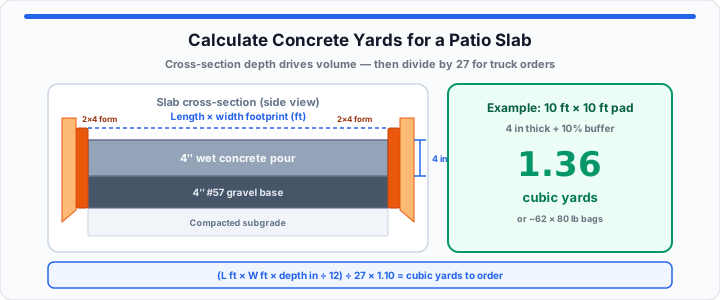
Nothing halts a backyard build faster than watching a 10-yard ready-mix truck pull away while your patio form sits three-quarters full, leaving a dry, jagged ridge of curing mud right down the middle of your project. On our morning screed runs, ordering concrete is one of the highest-stress steps of a hardscape install.
Think of pouring a wet concrete slab like filling a massive, broad baking pan with heavy cake batter. If your subgrade dirt is not scraped perfectly flat, or if your timber formwork bows outward even half an inch under the raw hydrostatic push of wet cement, that heavy batter instantly pools into the low spots. That hidden depth shift eats up your raw material volume much faster than your chalk-line measurements predicted.
Understanding how aggregate volumes translate into real-world orders keeps your crew moving, saves your back, and protects your project budget. For a broader pour checklist, pair this walkthrough with our Concrete Pour Blueprint guide and the Concrete Calculator.
The Cost of a Short Pour: Why Guessing Aggregate Volume Breaks Budgets
When you miscalculate a concrete order, you get hit from both ends of the financial spectrum. Under-ordering forces a pause in your pour while you call the batch plant for an emergency dispatch. By the time that second truck arrives, your initial pour has already set, creating a weak structural line known as a cold joint. Cold joints allow groundwater penetration, freeze-thaw cracking, and eventual shear failure under patio furniture loads.
On the flip side, wildly over-ordering leads to short-load fees for small delivery drops or leaves you staring at a mountain of hardening excess slush on your driveway that you must pay to haul away.
Step-by-Step: The Contractor’s Method for Manual Yardage Sizing
To avoid jobsite disasters, we use a simple four-step volumetric conversion pipeline on our site surveys. Here is how to find your raw volume before placing your plant order:
- Measure footprint surface area. Multiply the total length of your form boards by the total width in feet to establish raw square footage. Irregular pads can be split into rectangles; our Square Footage Calculator sums multi-zone footprints when the outline is not a clean rectangle.
- Convert target thickness to feet. Divide intended slab depth in inches by 12. A standard 4-inch residential patio becomes 0.333 feet (4 ÷ 12), while a heavy-duty 6-inch slab equals 0.50 feet (6 ÷ 12).
- Calculate total cubic feet. Multiply footprint square footage by decimal depth to get internal volume in cubic feet.
- Apply the 27 volumetric constant. Ready-mix plants batch and sell by the cubic yard. One cubic yard contains 27 cubic feet (a 3 ft × 3 ft × 3 ft cube), so divide total cubic feet by 27 for cubic yardage.
Cubic Yards = (Length in Feet × Width in Feet × (Depth in Inches ÷ 12)) ÷ 27
Always convert dimensions into feet before multiplying, then divide total volume by 27. The same pipeline powers the Volume Calculator when you want a second pass on rectangular solids.
The 10% Spillage Cushion: Factoring in Form Flex and Rough Grades
In practical environments, no earthwork excavation is laser-flat. When we dig out turf, crushed aggregate sub-bases settle unevenly, wheelbarrows spill material during transport, and 2×4 form boards flex under the weight of wet concrete. Size your gravel base separately with the Gravel Calculator when your spec calls for compacted stone under the slab—it does not replace measuring finished concrete depth from the top of that base to your string line.
Always multiply your calculated baseline volume by 1.10 to add a mandatory 10% safety cushion. If your raw math yields 2.5 cubic yards, order 2.75 cubic yards from the batch plant. That minor extra margin prevents cold joints for a fraction of the cost of an emergency short-load delivery fee.
Moving onto smaller builds, home handymen often struggle to weigh the break-even point between calling in a mixer truck and hauling individual paper sacks from the lumberyard. Instead of guessing truck order numbers or manually dividing complex decimal fractions with a muddy pencil out in the field, plug your exact slab dimensions into our Concrete Calculator to determine precise cubic yardage and bag counts instantly.
Instant yardage check: Enter length, width, and thickness with units handled for you—cubic feet, cubic yards, and 80 lb bag counts in one pass. Open the Concrete Calculator.
The Quick Reference Material Sheet: Truck Yards vs. Retail Bags
If your project sits below 1.5 cubic yards, buying pre-mixed dry sacks from a home improvement store is often more cost-effective than paying ready-mix truck environmental surcharges. Standard 80-pound sacks yield approximately 0.60 cubic feet of cured material, whereas 60-pound sacks yield roughly 0.45 cubic feet.
Here is a breakdown of common residential slab footprints, showing total bulk cubic yards alongside required bag counts (including a 10% jobsite waste buffer):
| Slab Footprint (Ft) | Target Thickness | Total Footprint (Sq Ft) | Bulk Truck Target (Cu Yds w/ 10% Buffer) | 80 lb Bag Count (0.60 cu ft/bag) | 60 lb Bag Count (0.45 cu ft/bag) |
|---|---|---|---|---|---|
| 10 × 10 | 4 in | 100 sq ft | 1.36 cu yds | 62 bags | 82 bags |
| 10 × 10 | 6 in | 100 sq ft | 2.04 cu yds | 93 bags | 123 bags |
| 12 × 12 | 4 in | 144 sq ft | 1.96 cu yds | 88 bags | 118 bags |
| 12 × 12 | 6 in | 144 sq ft | 2.93 cu yds | 132 bags | 176 bags |
| 12 × 15 | 4 in | 180 sq ft | 2.44 cu yds | 110 bags | 147 bags |
| 12 × 15 | 6 in | 180 sq ft | 3.67 cu yds | 165 bags | 220 bags |
| 14 × 20 | 4 in | 280 sq ft | 3.80 cu yds | 171 bags | 228 bags |
| 14 × 20 | 6 in | 280 sq ft | 5.70 cu yds | 257 bags | 342 bags |
Round pier and sonotube footings use cylinder math instead of this flat-slab table. See our cylinder foundation pour guide for πr²h yardage on deck posts and column forms.
Frequently Asked Questions
- How many bags of concrete for a 10×10 slab at 4 inches deep?
- To pour a 10×10 patio slab at a standard 4-inch depth, you need 62 bags of 80 lb concrete or 82 bags of 60 lb concrete. This calculation includes a 10% safety buffer to account for subgrade dips and form board bowing under hydrostatic pressure. Without the safety buffer, the raw volume equals 56 bags (80 lb) or 74 bags (60 lb).
- What is the exact mathematical formula to calculate cubic yards of concrete?
- The standard formula is Cubic Yards = (Length in Feet × Width in Feet × Depth in Feet) ÷ 27. To convert depth from inches to feet first, divide the inch thickness by 12 (4 inches ÷ 12 = 0.333 feet).
- Why do you divide total cubic feet by 27 when ordering from a ready-mix concrete truck?
- Ready-mix plants measure and sell concrete in cubic yards. One cubic yard is a three-dimensional cube that measures 3 feet long by 3 feet wide by 3 feet tall (3 × 3 × 3 = 27). Dividing total cubic feet by 27 converts your raw residential volume into standard commercial truck units.
- When should I order a ready-mix truck instead of mixing pre-bagged concrete by hand?
- In our crew workflows, any pour exceeding 1.5 cubic yards (roughly 68 bags of 80 lb mix) warrants calling a ready-mix truck. Hand-mixing 70 or 80 heavy sacks in a drum mixer takes hours, leading to cold joints between batches and physical exhaustion before you even start floating the surface flat.