
Ordering concrete feels simple until the truck arrives. You scribbled length times width on scrap plywood, guessed at thickness, and called the yard. Then the chute runs dry halfway across the pad while the crew stares at empty wheelbarrows. In my years on residential pours, that mid-pour stall almost always traces back to one skipped measurement—not bad luck.
The opposite mistake hurts too. Over-ordering leaves you paying dump fees for wet concrete nobody can reuse. A single short-load penalty or a second truck dispatch can wipe out whatever you saved by rounding down on the phone.
Think of a slab like a frozen pizza box laid flat on the ground. Length and width tell you the footprint sitting on top of the dirt. Thickness tells you how deep that box sits once you fill it with wet mix. You need all three numbers before you translate the job into cubic yards the supplier actually sells.
Instant Volume Estimate: Skip hand conversions and inch-to-foot mistakes. Run your pad dimensions through our Concrete Calculator to get cubic feet, cubic yards, and 80 lb bag counts in one pass.
How to Use This Concrete Pour Blueprint
To get started, treat the pour like a three-pass site walk—not a single napkin calculation. I have watched experienced finishers lose an entire cubic yard because they measured the slab outline on grass but never probed the low corner where the subgrade dipped an extra inch.
- Stake and tape the footprint. Drive corner stakes, pull mason line, and record length and width to the nearest inch. If the shape is irregular, break it into rectangles and add the areas. Our Square Footage Calculator handles multi-zone footprints when the pad is not a clean rectangle.
- Measure thickness at the deepest point. Set a laser or string line at finished slab height, then probe subgrade depth in at least five spots. Your order must cover the lowest dip—not the high ridge where the tape looks generous.
- Convert to cubic yards and add waste. Ready-mix suppliers in the US quote by the cubic yard. Divide your cubic feet by 27, then multiply by 1.10 so spillage and form bow do not leave you short.
- Cross-check bag count for small pours. Under one cubic yard, bagged premix from the home center often beats a truck minimum. The Concrete Calculator returns both truck yardage and 80 lb bag counts so you can compare quotes apples-to-apples.
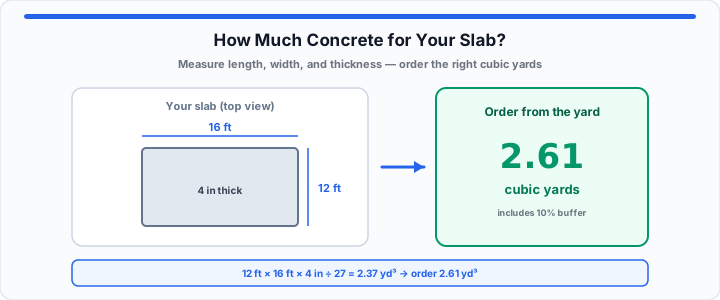
In practical environments, a homeowner pouring a 12 ft × 16 ft patio who stakes first, probes the low spot, and adds 10% waste typically orders once and finishes once. Skipping the depth check is where most DIY estimates quietly fail.
Concrete Slab Volume Formulas and Worked Examples
Moving onto the math, slab volume is flat-box arithmetic once every dimension sits in feet internally. In our testing with the calculator engine, the most common error is leaving thickness in inches while length and width stay in feet—that alone can double or halve your order.
Step 1: Volume in cubic feet
V = Length × Width × Thickness
Convert thickness from inches by dividing by 12. A 10 ft × 10 ft pad at 4 in thick becomes 10 × 10 × (4 ÷ 12) = 33.33 cubic feet. For round pier and sonotube footings, see our cylinder volume guide for foundation pours and the Volume Calculator (cylinder mode). Most patio and driveway jobs stay rectangular.
Step 2: Cubic yards for the ready-mix ticket
Cubic Yards = Cubic Feet ÷ 27
One cubic yard equals 27 cubic feet—picture a cube three feet on each side. That 33.33 cu ft patio pad converts to 1.23 yd³ before waste. Suppliers on many routes enforce a minimum load around one yard, so rounding up slightly can cost less than a second delivery fee.
Step 3: The 10% safety buffer
Order Volume = Calculated Volume × 1.10
Spillage at the chute, wheelbarrow splash, and form boards bowing outward under wet pressure all eat volume your clean math never captured. In my experience, 10% covers typical residential slabs on graded base. Rough subgrade or irregular forms push you toward the high end. The same 1.23 yd³ raw estimate becomes 1.36 yd³ on the ticket with buffer applied.
The Thickness Trap Most Estimates Miss
Surface area alone will short your order every time. Subgrade under a driveway or patio rarely sits perfectly flat—even after you scrape and compact. A one-inch dip across a 20 ft × 24 ft footprint adds roughly 1.5 extra cubic yards your length-and-width math never sees.
Before you lock thickness, lay a gravel base if your spec calls for one and run the base depth through our Gravel Calculator separately. Gravel fills low spots visually, but it does not replace measuring finished concrete depth from the top of that base to your string line.
Typical slab thickness references by use:
- 4 inches: Patios, sidewalks, and light foot-traffic slabs.
- 5–6 inches: Residential driveways, parking pads, and areas seeing vehicle loads.
- Post bases and small pads: Often 4 in minimum; check local code for frost depth and reinforcement.
If you are finishing the slab with tile or pavers on a separate mud bed, size the concrete pad first, then shift finish-layer math to the Tile Calculator for surface coverage.
Standard Pour Targets by Project Type
These reference rows assume rectangular pours on reasonably flat subgrade. Adjust upward when your probe readings show dips beyond one inch or when forms follow a curved edge.
| Project Type | Typical Size | Slab Thickness | Raw Volume | With 10% Buffer |
|---|---|---|---|---|
| Standard patio | 12 ft × 16 ft | 4 in | 2.37 yd³ | 2.61 yd³ |
| Sidewalk strip | 4 ft × 40 ft | 4 in | 1.98 yd³ | 2.17 yd³ |
| Heavy-duty parking pad | 20 ft × 24 ft | 6 in | 8.89 yd³ | 9.78 yd³ |
Plug any row into the Concrete Calculator with your actual field measurements before you call the yard. A short-load fee on a stalled pour still beats guessing from memory.
Frequently Asked Questions About Concrete Slab Volume
- How do I calculate how much concrete I need for a slab?
- Multiply length × width × thickness with all dimensions in feet, divide by 27 for cubic yards, then add 10% for waste. A 12 ft × 16 ft patio at 4 in thick equals 2.37 yd³ raw—order 2.61 yd³ with buffer.
- How thick should a concrete patio or driveway be?
- Standard patios and sidewalks: 4 inches. Residential driveways and heavier foot-traffic pads: 5–6 inches. Always measure at the deepest subgrade point, not the high spot.
- Why do contractors add 10% extra concrete?
- Spillage at the chute, form bowing under wet load, and uneven subgrade dips all consume volume your tape never captured. A 10% safety buffer prevents mid-pour shortages.
- When should I use bags instead of ready-mix?
- Bagged mix works for small pads, post holes, and repairs under about one cubic yard. Above that, a ready-mix truck saves labor and usually money.
- How do I convert inches of slab thickness to feet for the volume formula?
- Divide thickness in inches by 12. A 4-inch slab becomes 0.333 feet. Multiply that by length and width in feet to get cubic feet, then divide by 27 for cubic yards.