
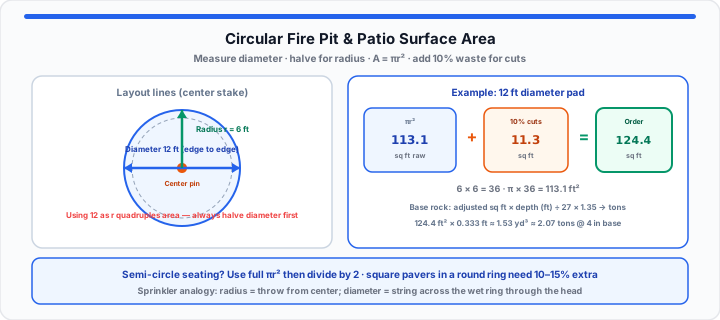
There is nothing quite like the sink-in-your-chest feeling when a bulk dump truck pulls away from your driveway, leaving behind a mountain of crushed base stone that is either four tons too light or twice as large as your actual yard excavation. On our job sites, circular outdoor features—whether a cozy 4-foot fire pit ring or a sprawling 18-foot flagstone patio zone—cause more material estimation headaches than almost any rectangular layout.
When you are standing in a dirt pit with a flex tape measure, curved edges trick your eyes. It is surprisingly easy to miscalculate square footage, run short on concrete bedding sand midway through a Saturday installation, or over-spend by thousands on custom stone pavers that end up sitting stacked on a pallet behind the garage.
To ground the geometry before pulling your tape, think of a circle’s core measurements through a simple yard design analogy. Imagine a standard rotating lawn sprinkler sitting fixed in the middle of your yard. The radius is the exact distance the water stream shoots from that center pivot pin out to the wet outer grass ring. The diameter, on the other hand, is a string stretched completely across the absolute widest belly of the circular area, passing directly through that center sprinkler head. Mastering these two values is the key to ordering correct hardscape materials every single time.
The Yard Layout Basics: Measuring Radius vs. Diameter
When I am estimating paver counts or sketching yard layouts for clients, the single biggest error I see DIYers make is confusing the outer diameter line with the radius required for geometric calculations.
To lay out a circular fire pit seating wall or paver ring, your baseline measurements must always anchor back to your center stake. If you stretch your tape measure across the wide belly of your excavated ring, you have measured the diameter. While the diameter is often the easiest line to mark physically on a dirt pad using a long tape, standard area formulas require the radius.
Using the wrong line breaks your math instantly. If you accidentally plug a 12-foot diameter measurement into an area formula as your radius value, your calculated square footage will blow up to four times its actual footprint size, leaving you with enough excess stone to pave your neighbor’s driveway too. Enter diameter on the Circle Calculator and it returns radius and area together, or use the circle tab on the Area Calculator when you already know r.
Step-by-Step: Working the Math for Circular Hardscapes
To get started calculating the exact surface coverage of your circular project, follow this five-step layout procedure. This process translates simple tape measure readings into accurate square footage numbers for ordering natural stone, bedding sand, or geotextile fabric.
- Measure the widest line across the circle: Stretch your tape measure edge-to-edge through the exact center stake of your layout to find the diameter (for example, a 12-foot wide patio pad).
- Divide the diameter by two to find the radius: Divide your across-the-center measurement in half. For a 12-foot diameter, 12 ÷ 2 = 6 feet of radius.
- Square the radius value: Multiply your radius distance by itself. For a 6-foot radius, calculate 6 × 6 = 36 (square feet of radius squared, not final area yet).
- Multiply by Pi (3.14159): Multiply your squared radius by the constant Pi. Calculating 3.14159 × 36 yields an exact geometric surface area of 113.1 square feet.
- Apply your material depth and waste factor: Take your raw square footage and adjust for perimeter stone cuts, border overlap, or volumetric base depth depending on whether you are ordering dry-cast pavers or bulk gravel base.
The core mathematical rule for this surface calculation is written as A = πr², where A represents total surface area in square feet, π represents the mathematical constant Pi (approximately 3.14159), and r represents the radius line extending from your center pivot pin out to the perimeter.
Quick Reference Bench Guide: Common Patio Dimensions
Moving onto project planning, here is a quick reference ordering guide matching standard yard design dimensions with their required surface coverage footprints:
| Outer Diameter | Radius | Raw Area (Sq. Ft.) | Order (+10% Waste) | Typical Use |
|---|---|---|---|---|
| 3 ft | 1.5 ft | 7.1 | 7.8 | Compact metal fire bowl pad |
| 4 ft | 2.0 ft | 12.6 | 13.8 | Stacked-block fire pit ring |
| 8 ft | 4.0 ft | 50.3 | 55.3 | Small 2-chair bistro patio |
| 10 ft | 5.0 ft | 78.5 | 86.4 | 4-chair fire pit seating area |
| 12 ft | 6.0 ft | 113.1 | 124.4 | Medium family patio zone |
| 15 ft | 7.5 ft | 176.7 | 194.4 | Large entertainment patio with wall |
| 20 ft | 10.0 ft | 314.2 | 345.6 | Master outdoor living lounge space |
Real-World Adjustments: Calculating Stone Waste Boundaries and Gravel Depth
In practical environments, ordering hardscape supplies strictly based on raw geometric surface calculations will leave you stranded mid-project.
When you install square or rectangular paving stones inside a round perimeter ring, every single edge stone must be trimmed using a diamond-blade masonry saw. The triangular off-cuts from those outer edge pieces are rarely reusable elsewhere on the patio pad. In my experience estimating paver counts, you must add a mandatory 10% to 15% waste allowance onto your calculated surface square footage to account for perimeter saw scraps, accidental block splits, and border trimming. The Tile Calculator applies a similar overage mindset when you size rectangular units around an irregular footprint.
Beyond surface stone counts, circular outdoor spaces require deep sub-grade excavation. A typical paver patio installation requires 4 to 6 inches of compacted crushed limestone aggregate rock topped with 1 inch of washed masonry sand. To calculate how many cubic yards or tons of base aggregate rock you need to order from the supply yard:
- Multiply your adjusted surface square footage (+10% waste included) by your required excavation depth in feet (for example, 4 inches of aggregate base rock equals 4 ÷ 12 = 0.333 feet).
- Divide that total cubic feet number by 27 to calculate cubic yards.
- Multiply total cubic yards by 1.35 to convert the volume into estimated weight in tons for quarry truck hauling.
For example, an adjusted 124.4-square-foot circular patio footprint requiring 4 inches of aggregate base rock uses roughly 41.4 cubic feet of crushed stone. This translates to 1.53 cubic yards or roughly 2.07 tons of aggregate base delivered to your driveway. Run the depth and footprint through our Gravel Calculator and cross-check compaction buffers in the Gravel & Mulch Slab Guide.
Instead of guessing your square footage numbers or manually squaring decimals with pencil and paper while standing out in the dirt, you can plug your across-the-rim layout lines directly into our interactive Circle Calculator or Area Calculator (circle tab) to determine your precise surface sizing instantly. For mixed round-and-rectangular yard plans, the Square Footage Calculator helps total multiple zones before you merge waste factors.
Order-day shortcut: Enter diameter or radius in the Circle Calculator, read area in square feet, multiply by 1.10 for curved paver cuts, then feed adjusted square footage and base depth into the Gravel Calculator.
Open Circle Calculator Open Area Calculator
Frequently Asked Questions
How do you find the area of a round patio if you can only measure across the widest center point?
Stretch your tape measure across the widest belly of the circle to record the total diameter. Divide that measurement in half to find the radius, square the radius (multiply it by itself), and multiply the result by 3.14159. For example, a 10-foot wide patio has a 5-foot radius. Multiply 5 by 5 to get 25, then multiply by 3.14159 to arrive at 78.5 square feet.
How much extra material should you buy when laying square paving stones inside a circular layout?
Buy an additional 10% to 15% extra material above your raw calculated square footage. Installing rectangular pavers inside a curved radius creates significant saw waste along the outer soldier course or retaining wall border, as trimmed triangular block off-cuts can rarely be repurposed.
How do you find the area of a semi-circular or half-moon retaining wall seating zone?
Calculate the full circular area using the formula A = πr² using the distance from the flat back wall pin to the outer curved edge as your radius. Once you have the full circle area, divide that final square footage total by 2 to find the exact surface area of your half-moon layout.
How do you convert circular patio square footage into tons of base rock?
First, convert your base rock depth from inches to decimal feet (for example, 4 inches divided by 12 equals 0.333 feet). Multiply your patio square footage by that depth decimal to find cubic feet, divide by 27 to get cubic yards, and multiply by 1.35. A 100-square-foot circular patio with 4 inches of gravel base requires about 1.66 tons of crushed stone.