
Few moments in corporate treasury match the sick, sinking feeling of reviewing a high-growth sales chart on Friday afternoon, only to realize on Monday morning that your liquid bank balance cannot cover next month’s payroll and debt obligations. On paper, sales are booming. On the balance sheet, your company is sprinting directly toward a working capital brick wall. In portfolio stress testing, this exact cash flow mismatch destroys more early-stage and mid-market companies than product failure or competitive pressure ever does.
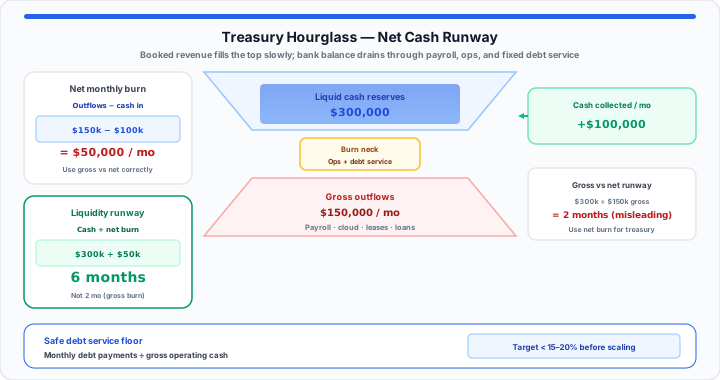
To understand why scaling turns cash-poor businesses into insolvent ones so quickly, picture your corporate cash reserves as an active hourglass flipped upside down on your desk. The pile of sand in the upper chamber represents your raw liquid cash reserves. The narrow neck of the glass is your monthly operational burn and debt-servicing commitments—the structural drain choke point. Taking on heavy debt or scaling operations prematurely is like using a drill bit to manually enlarge that neck hole so more sand drops through. If your incoming revenue stream does not pour fresh sand into the top at an equal or faster pace, the upper chamber empties rapidly, leaving your business completely dry.
Founders often mistake booked revenue for spendable liquidity. Accrual accounting allows you to record a sale the moment an enterprise contract is signed, but your vendors, landlord, and software providers do not accept accounts receivable as payment. When you scale marketing or hire engineering teams based on projected receivables, you widen your cash outflow gap long before the cash actually hits your bank account.
When auditing client balance sheets, enterprise clients frequently demand 60-day or 90-day payment terms. Meanwhile, payroll runs every two weeks, and debt service obligations are deducted automatically on the first of the month. Learning how to figure out startup cash runway requires looking past top-line billing figures and focusing strictly on liquid cash clearing your accounts.
Treasury snapshot: Map monthly cash inflows and operating outflows on the Budget Calculator, stress-test debt service against operating cash on the Debt-to-Income Ratio Calculator, and model new loan payments on the Business Loan Calculator before you widen the burn neck.
Five Steps to Calculate Net Burn From Bank Reality
Determining your true operational timeline requires isolating unrecoverable cash outflows from total reported expenses. Calculating burn rate manually involves five direct procedural steps:
- Audit historical bank statements. Gather cash-basis bank statements for the last 3 to 6 months to establish a baseline. Exclude paper gains, non-cash depreciation, and unrealized receivables.
- Isolate total monthly operating outflows. Tally every recurring cash payment, including payroll, contractor fees, cloud infrastructure, facility leases, and software licenses.
- Isolate fixed debt servicing commitments. Add mandatory monthly debt obligations, including term loan principal, interest payments, equipment lease installments, and credit facility fees. Cross-check installments on the Debt Payoff Calculator or Debt Consolidation Calculator when you are comparing refinance paths.
- Determine realized cash collections. Calculate the average cash actually deposited into your accounts each month from customer collections, ignoring uncollected invoices.
- Compute net monthly burn and capital lifespan. Subtract realized cash collections from total outflows to establish net monthly cash loss. Divide total cash reserves by this net burn figure to find your runway in months.
Core treasury formulas
Net Monthly Burn Rate = Total Cash Operating Outflows − Actual Cash Inflows Received
Liquidity Runway (Months) = Current Liquid Cash Balance ÷ Net Monthly Burn Rate
Corporate Debt-to-Income Ratio = Total Monthly Debt Service Payments ÷ Monthly Gross Operating Income
To calculate business debt ratio safely, keep total debt service well below 20% to 25% of gross operating cash flow so a sudden drop in revenue does not trigger a default. For household-style ratio math used in mortgage underwriting, see How to Calculate DTI Ratio for Mortgage Underwriting.
Gross Burn vs. Net Burn
Confusing gross burn with net burn can give you a false sense of financial security. Gross burn represents total monthly cash expenditure regardless of income. Net burn subtracts actual cash receipts from total expenditures to show the net cash loss each month.
If your company spends $150,000 per month (gross burn) and collects $100,000 in cash from customers, your net burn is $50,000. If you have $300,000 in the bank, your actual runway is 6 months based on net burn, not 2 months based on gross burn. However, relying on projected revenue that fails to materialize can quickly shorten that 6-month timeline.
In practical environments, instead of manually tracking multi-layered cash flow equations on scratch pads while evaluating an open funding term sheet under a tight deadline, enter recurring liabilities and realized collections on the Budget Calculator, lock baseline leverage on the Debt-to-Income Ratio Calculator, and stress-test equipment or working-capital loans on the Business Loan Calculator before you commit to a wider burn neck.
Runway and Debt Targets by Business Profile
Different business models carry distinct financial risk profiles and require tailored liquidity buffers before expanding headcount or taking on debt.
| Corporate Profile Category | Typical Monthly Burn Profile | Safe Max Debt Ratio (DTI) | Target Minimum Runway | Primary Financial Risk Factor |
|---|---|---|---|---|
| Lean Bootstrapped SaaS | Low ($10,000–$50,000) | < 15% | 12+ months | Single customer churn & slow organic conversion |
| Aggressive Venture Scale | High ($100,000–$500,000+) | < 10% | 18+ months | Tight funding markets & high fixed payroll |
| Inventory-Heavy Retail | Medium-high ($50,000–$250,000) | < 25% | 6 to 9 months | Unsold inventory & strict supplier credit terms |
| B2B Professional Services | Medium ($25,000–$150,000) | < 20% | 6 to 12 months | Extended 60-to-90-day enterprise payment terms |
Companies with runway above their profile minimum can expand sales channels without walking into liquidity traps. For visual cash mapping at the household level—useful when founders blend personal and business accounts—see How to Create a Clean Visual Household Budget Breakdown. If card balances or daily compounding are part of your working-capital stack, review How Daily Compounding Interest Impacts Credit Card Debt.
Extending Runway Without New Debt
Extending financial runway does not always require raising outside venture capital or taking on high-interest loans. Adjusting cash management workflows can significantly preserve working capital.
Negotiate longer vendor payment terms first. Moving suppliers from net-30 to net-60 keeps cash in your bank account an extra 30 days, creating a rolling liquidity buffer. Second, incentivize customers to pay upfront by offering a 2% discount for payments cleared within 10 days, or by requiring annual prepayments on software subscriptions. Finally, lease major capital equipment rather than making large upfront cash purchases—compare buy vs. lease math on the Lease Calculator alongside term-loan payments on the Business Loan Calculator.
Open Budget Calculator Open Debt-to-Income Ratio Calculator
Frequently Asked Questions About Cash Runway
- How do you accurately calculate a startup’s true net cash runway?
- Divide total liquid cash reserves by net monthly burn rate. Calculate net monthly burn by taking total operating cash outflows (including payroll, rent, software, and debt payments) and subtracting the cash actually collected from customers during the same period.
- What is universally considered a safe or healthy debt ratio for a scaling business?
- A healthy corporate debt-to-income ratio keeps monthly debt service payments below 15% to 20% of gross operating cash flow. Keeping debt obligations under 20% helps your business handle seasonal revenue swings without risking loan default or missing payroll.
- Why should a business separate fixed debt service requirements from variable operational burn rates when planning expansion?
- Variable operational expenses—like ad spend, contractor fees, and software tiers—can be quickly cut during a revenue slowdown. Fixed debt service obligations cannot be reduced without lender approval. Separating debt payments from operational spend gives you a clear view of your unbreakable financial commitments during a market downturn.