
Opening your monthly credit card statement to discover that a $150 payment only reduced your actual balance by $25 is an infuriating experience. In my credit review sessions, clients often sit across from me in complete disbelief, staring at statements where their balance seems frozen despite months of faithful payments. They haven’t made a single new purchase, yet the total debt stubbornly refuses to shrink.
The primary culprit behind this financial quicksand is the 24-hour compounding clock used by major card issuers.
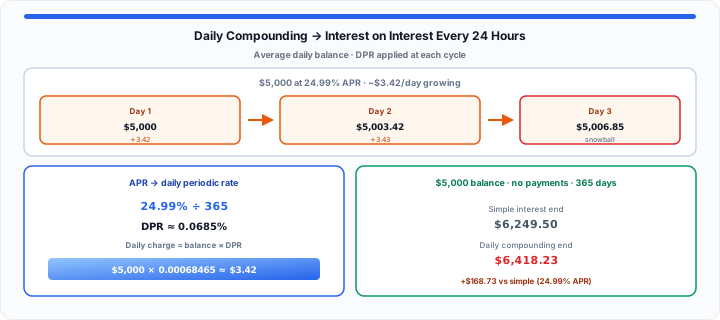
Think of daily compounding interest as a digital snowball rolling down a steep hill made of wet snow. The bank doesn’t wait until the end of the month to measure the size of your debt. Instead, every single night at midnight, that snowball completes a full turn. It picks up a fresh layer of interest based on the exact weight it reached the day before. By the time morning comes, your new baseline balance includes yesterday’s interest—and tonight’s calculation will charge you interest on top of yesterday’s interest.
The 24-Hour Clock: What Daily Compounding Actually Means
Most consumers assume credit card interest works like a once-a-month fee added right before their billing cycle closes. In our analysis of standard revolving credit agreements, virtually all major credit card issuers operate on a daily compounding structure using your Average Daily Balance.
When you carry a balance past your grace period, the bank assesses interest charges every 24 hours. Because interest accrues daily, the dollar amount added to your account on Day 15 is slightly higher than the amount added on Day 1, even if you do not swipe your card a single time during those two weeks.
This relentless 24-hour clock is why carrying a balance on high-APR cards feels so heavy. The lender isn’t just charging you for borrowing their money; they are charging you every day for the interest you failed to pay off yesterday.
Model your statement path: Enter balance, APR, and payment plan in the Credit Card Calculator, or compare daily versus monthly compounding growth in the Compound Interest Calculator (set compounding to daily).
Open Credit Card Calculator Open Compound Interest Calculator
Step-by-Step: The Math Behind Your Daily Interest Charge
When I’m auditing credit card statements with clients, I walk them through the manual conversion process so they can see how their stated interest rate translates into an actual daily dollar fee.
To get started, follow this five-step calculation to determine how much interest your card accrues over a single 24-hour cycle:
- Identify your Annual Percentage Rate (APR): Locate the interest rate section on your billing statement (e.g., 24.99% APR).
- Calculate your Daily Periodic Rate (DPR): Divide your APR by 365 (or 360, depending on the specific issuer’s fine print) and convert it to a decimal.
- Determine your Average Daily Balance: Sum up your account balance at the end of each day in the billing cycle and divide by the total number of days in that cycle.
- Compute the single-day interest fee: Multiply your starting balance by your Daily Periodic Rate.
- Add the daily interest to the principal: Add that interest charge back to your principal balance to create the starting balance for the subsequent day.
Daily Periodic Rate = (APR ÷ 365) ÷ 100
Daily Interest Charge = Average Daily Balance × Daily Periodic Rate
Let me walk you through a benchmark example. Assume you carry a $5,000 balance on a card with a 24.99% APR.
First, calculate your Daily Periodic Rate: 24.99 ÷ 365 = 0.068465% per day (or 0.00068465 in decimal form).
On Day 1, your interest charge is: $5,000 × 0.00068465 = $3.42.
Your ending balance on Day 1 becomes $5,003.42. On Day 2, the bank multiplies that new $5,003.42 balance by 0.00068465, generating $3.43 in interest. By Day 30, your daily interest charge grows to $3.49 per day. While a difference of pennies seems small on paper, over a full statement cycle, these micro-increments create a compounding engine that eats away at your monthly payments. Cross-check APR math on the APR Calculator when offers quote promotional rates.
The Compounding Contrast: Daily vs. Monthly Growth
To understand why credit card debt accelerates faster than simple installment loans, compare how a static $5,000 balance at 24.99% APR grows over time when subjected to simple interest, monthly compounding, and daily compounding without any payments made:
| Timeframe | Simple interest (no compounding) | Monthly compounding | Daily compounding | Added cost of daily vs simple |
|---|---|---|---|---|
| 30 days | $5,102.70 | $5,104.13 | $5,103.56 | +$0.86 |
| 60 days | $5,205.40 | $5,210.42 | $5,209.28 | +$3.88 |
| 90 days | $5,308.10 | $5,318.90 | $5,317.13 | +$9.03 |
| 180 days | $5,616.20 | $5,658.11 | $5,654.34 | +$38.14 |
| 365 days | $6,249.50 | $6,400.22 | $6,418.23 | +$168.73 |
As shown in the table, over a full year, daily compounding adds $168.73 in pure compounding interest on top of the standard annual rate. This mathematical acceleration is why carrying balances long-term severely penalizes your personal finances. For renovation debt traded on plastic, see our HELOC vs. credit card renovation guide.
Practical Workbench Strategies to Halt the Snowball
In practical environments, you do not have to accept daily compounding as an inevitable drain on your wealth. Because daily compounding calculates fees based on your balance every single night, any action that reduces your balance mid-cycle slows down the rate at which interest accumulates.
Moving onto actionable execution, here are three strategies you can implement immediately:
- Adopt the weekly micro-payment system: Instead of making one single payment on your due date, split your planned monthly payment into four weekly micro-payments. Paying $100 every Friday reduces your Average Daily Balance far faster than paying $400 at the end of the month, directly lowering the daily interest fees generated during the second, third, and fourth weeks of your billing cycle.
- Make payments immediately after payday: Do not hold funds in your checking account waiting for the official due date. As soon as your paycheck lands, submit a payment to your credit card company. Eliminating balance weight early in the 30-day window starves the compounding engine.
- Account for trailing interest: When you finally pay off a carried credit card balance in full, your next statement will almost certainly show a small residual charge. This is trailing interest—interest that accrued daily between the day your statement was printed and the exact day your payment was processed. Call your card issuer to request a full payoff quote to wipe out trailing interest completely.
To see how these strategies impact your specific timeline, plot your current APR and statement timeline in the Credit Card Calculator or stack multiple cards in the Credit Cards Payoff Calculator instead of manual trial-and-error with fractional percentages on a basic desk calculator.
Taking control of your daily compounding schedule is the fastest way to stop paying unnecessary interest and keep more of your hard-earned money.
Open Credit Cards Payoff Calculator Open Debt Payoff Calculator
Frequently Asked Questions
What is the difference between APR and the daily periodic rate?
Your Annual Percentage Rate (APR) represents the annualized cost of borrowing money expressed as a single percentage. The Daily Periodic Rate (DPR) is your APR divided by 365 days. The DPR is the actual fractional percentage that your credit card issuer applies to your account balance every night at midnight.
How does a grace period protect you from daily compounding interest?
A grace period is the window between the end of your billing cycle and your payment due date (typically 21 to 25 days). If you pay your statement balance in full before the due date, the credit card company waives all daily interest charges for that cycle. However, if you carry even a small balance past the due date, you lose your grace period, and daily compounding begins immediately on all existing and new purchases.
Can making two payments a month instead of one reduce daily interest charges?
Yes. Making two payments a month lowers your Average Daily Balance during the middle of your billing cycle. Because daily interest is calculated on the remaining balance at the end of each day, reducing your balance on Day 15 means you pay less interest for the remaining 15 days of the month compared to making a single payment on Day 30.
What is trailing interest on a credit card?
Trailing interest (also known as residual interest) is interest that builds up on your account between the date a statement is issued and the day your payment is received and processed. Even if you pay off the total balance shown on your monthly bill, trailing interest accrued during those intermediate days will appear on your subsequent statement.