
Sweating through an hour of high-intensity spin classes four days a week, feeling thoroughly drained, and stepping onto the bathroom scale only to watch the numbers stay completely frozen is infuriating. In my experience auditing cardiovascular thresholds for clients, this frustrating plateau rarely comes from a lack of effort. It comes from exercising completely blind. Most gym-goers assume that pushing their pulse to the absolute limit during every workout guarantees maximum calorie burn and fast body fat reduction. In reality, redlining your engine forces your body to abandon its stored fat reserves altogether, shifting into emergency survival mode.
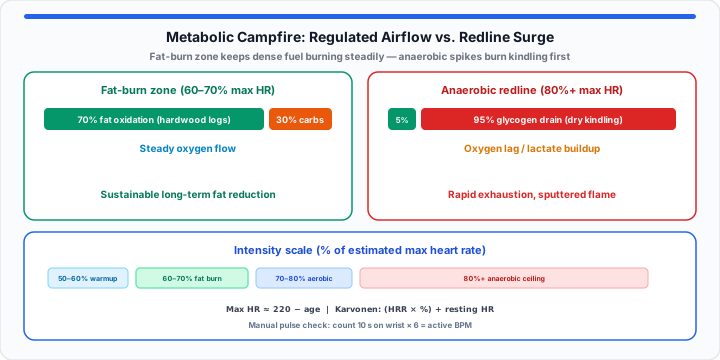
To understand how your body burns energy at different intensity levels, think of your cardiorespiratory system as a standard wood-burning campfire on a cold night. Your body fat reserves represent thick, dense hardwood logs, while your stored carbohydrates act as quick-burning dry kindling. The fat-burning zone works like keeping a steady, well-regulated airflow blowing gently over those hardwood logs—it creates a slow, reliable, incredibly hot flame that efficiently devours dense fuel over many hours. However, if you open the air valves completely and pump pure oxygen aggressively into the pit (entering the extreme anaerobic zone), you turn the logs into a wild, short-lived brushfire. That inferno consumes your immediate kindling in minutes, leaving the heavy hardwood logs barely charred before the flame sputters out entirely.
The Anaerobic Trap: Why Smashing Every Workout Into the Redline Halts Fat Loss
In our metabolic conditioning testing, we see athletes make this mistake constantly: they confuse feeling exhausted with burning body fat. When your heart rate surges beyond your aerobic threshold—typically above 80% of your maximum heart rate—your cells can no longer recruit enough oxygen to break down fatty acids through aerobic beta-oxidation. Fatty acids require substantial oxygen processing to convert into adenosine triphosphate (ATP), the chemical currency of muscular contraction.
When oxygen supply falls behind energy demand, your physiology undergoes a sharp metabolic pivot. Your muscles switch almost exclusively to anaerobic glycolysis, pulling fast-acting glucose directly from your bloodstream and muscle glycogen stores. While this process generates rapid explosive power, it yields very little actual fat oxidation and produces metabolic byproducts like hydrogen ions that cause acute muscle fatigue.
When you spend your entire workout in this redline zone, two things happen:
- You drain glucose rapidly: Depleting your glycogen stores triggers overwhelming post-workout hunger signals, making it significantly harder to maintain a dietary caloric deficit. Pair intensity with realistic intake using our Calorie Calculator and TDEE Calculator.
- You spike stress hormones: Sustained high-intensity effort elevates circulating cortisol levels, promoting systemic stress and water retention that masks body composition changes on the scale.
The infographic above contrasts steady fat-burn airflow with redline glycogen drain and maps where warmup, fat-burn, aerobic, and anaerobic brackets sit on a max-heart-rate scale. Optimal fat burning requires regulated oxygen flow, not maximum exhaustion.
Step-by-Step: The Classic Age-Based Method for Manual Zone Allocation
When I’m tracking heart rate data sheets for new trainees, establishing a baseline cardiovascular framework is our first operational priority. Learning how to find your fat burning heart rate zone starts with isolating your theoretical cardiac maximum and applying metabolic percentage brackets.
To get started, follow this simple three-step manual calculation:
- Calculate your estimated maximum heart rate: Subtract your current age from the baseline constant of 220 beats per minute (bpm). The standard formula uses 220 as its anchor point.
- Isolate your lower fat-burn boundary: Multiply your calculated maximum heart rate by 0.60 (60%) to establish the entry threshold of your steady-state aerobic zone.
- Establish your upper fat-burn boundary: Multiply your calculated maximum heart rate by 0.70 (70%) to define the upper ceiling where fat oxidation remains dominant before glucose reliance takes over.
Max HR = 220 − Age
Fat Burn Floor = Max HR × 0.60
Fat Burn Ceiling = Max HR × 0.70
For instance, a 40-year-old athlete calculates an estimated maximum heart rate of 180 bpm (220 − 40). Multiplying 180 by 0.60 gives a lower floor of 108 bpm, while multiplying 180 by 0.70 sets an upper ceiling of 126 bpm. Staying between 108 and 126 bpm keeps their metabolic campfire burning thick hardwood logs efficiently.
Instead of manually calculating decimal fractions on a sweaty gym notepad mid-workout, drop your age and optional resting pulse into our interactive Target Heart Rate Calculator to map Fox and Karvonen performance zones instantly. Estimate session burn at those intensities with the Calories Burned Calculator when you log steady-state cardio blocks.
The Advanced Baseline Shift: Factoring in the Karvonen Reserve Math
Moving onto higher-level conditioning, the simple age formula has an inherent flaw: it assumes every individual of the same age shares the same resting heart rate. A seasoned marathoner and a sedentary desk worker who are both 35 years old would receive identical target zones under the basic formula, despite having drastically different stroke volumes and recovery capacities.
In practical environments, using the Karvonen formula fixes this discrepancy by incorporating your Heart Rate Reserve (HRR)—the exact gap between your resting pulse and your maximum ceiling:
Heart Rate Reserve (HRR) = Maximum HR − Resting HR
Target Heart Rate = (HRR × Target Intensity %) + Resting HR
If a 35-year-old athlete has a maximum heart rate of 185 bpm and a conditioned resting heart rate of 55 bpm, their HRR is 130 bpm (185 − 55). Calculating their 60% fat-burn floor using Karvonen yields (130 × 0.60) + 55 = 133 bpm. Notice how incorporating baseline cardiac efficiency adjusts the target zone upward to match real physical capacity, ensuring training stimulus remains effective. The same Karvonen path is built into the Target Heart Rate Calculator when you enter resting heart rate.
The Quick Reference Age Grid: Safe Cardiovascular Brackets
To streamline your daily cardio tracking, calculate target heart rate by age using standard benchmark zones derived from the 60% to 70% fat oxidation window:
| Age Bracket | Estimated Max HR (bpm) | Warmup Zone (50%–60% Max HR) | Fat-Burn Zone (60%–70% Max HR) | Aerobic Zone (70%–80% Max HR) | Anaerobic Ceiling (80%+ Max HR) |
|---|---|---|---|---|---|
| 20 Years Old | 200 bpm | 100 – 120 bpm | 120 – 140 bpm | 140 – 160 bpm | 160+ bpm |
| 30 Years Old | 190 bpm | 95 – 114 bpm | 114 – 133 bpm | 133 – 152 bpm | 152+ bpm |
| 40 Years Old | 180 bpm | 90 – 108 bpm | 108 – 126 bpm | 126 – 144 bpm | 144+ bpm |
| 50 Years Old | 170 bpm | 85 – 102 bpm | 102 – 119 bpm | 119 – 136 bpm | 136+ bpm |
| 60 Years Old | 160 bpm | 80 – 96 bpm | 96 – 112 bpm | 112 – 128 bpm | 128+ bpm |
| 65 Years Old | 155 bpm | 78 – 93 bpm | 93 – 109 bpm | 109 – 124 bpm | 124+ bpm |
Long-distance runners often cross-check these brackets against sustainable race effort; see our marathon pacing guide for glycogen-aware splits that pair with zone-two cardio base building.
Workbench Workflows: Tracking Your Pulse Without Smart Watch Glitches
Optical wrist sensors on modern fitness watches frequently drop connection or experience cadence lock—a technical glitch where the watch mistakes your foot strikes per minute for your heart rate.
To verify your actual pulse during workouts, use a manual 10-second check on your carotid or radial artery:
- Stop moving briefly and place your index and middle fingers lightly over your radial artery on the thumb side of your wrist.
- Count the physical pulse beats for exactly 10 seconds on a clock. The Online Stopwatch lap log works well for repeatable 10-second windows.
- Multiply that 10-second tally by 6 to determine your active beats per minute (Beats in 10s × 6 = Active BPM).
If your 10-second count is 21 beats, your active heart rate is 126 bpm—right at the upper boundary of the 40-year-old fat-burn window. If you use integrated treadmill handle sensors, wait at least 15 seconds after gripping the metal contacts before taking a reading to allow the signal to stabilize.
Open Target Heart Rate Calculator Open Calories Burned Calculator
Frequently Asked Questions
How do you calculate your exact target heart rate zone for weight loss by age?
To calculate your fat-burning target zone for weight loss, subtract your age from 220 to estimate your maximum heart rate. Multiply that maximum number by 0.60 to find your lower floor and 0.70 to establish your upper ceiling. Staying within this 60% to 70% range optimizes fatty acid oxidation during steady-state cardio sessions.
What happens to your fat-burning efficiency if your pulse enters the anaerobic training zone?
When your heart rate climbs above 80% of your maximum capacity into the anaerobic zone, oxygen availability drops relative to muscular energy demand. Your body halts primary fat oxidation and switches to rapid carbohydrate combustion via anaerobic glycolysis, leading to fast muscle exhaustion and lactate accumulation.
How does your resting heart rate factor into finding your true target conditioning zones?
Your resting heart rate reflects your baseline stroke volume and overall cardiovascular fitness. Incorporating your resting heart rate via the Karvonen formula (Target HR = (Max HR − Resting HR) × % + Resting HR) creates a customized intensity target that accounts for your individual fitness level rather than relying solely on age averages.
Is working out in the fat-burning zone better than high-intensity interval training (HIIT)?
The fat-burning zone (60–70% Max HR) burns a higher percentage of calories from stored fat during the exercise bout itself and allows for longer, repeatable workouts without central nervous system fatigue. High-intensity interval training burns more total calories per minute and elevates post-workout oxygen consumption, making a hybrid approach combining both styles optimal for long-term health.