
Standing at mile 18 with locked quads while watching your target finish clock tick away is a unique form of athletic heartbreak. You felt incredible during the first five miles, riding the crowd energy out of the starting corral, only to realize too late that you banked speed at the expense of your physiology. In my experience handling hitting the wall at mile 20, almost every marathon collapse stems from a single tactical error: treating race day like an intuitive run rather than an audited metabolic calculation.
Think of your baseline marathon energy capacity like a limited, pressurized fuel tank inside a cross-country endurance car. If you slam the gas pedal down into drag-race speeds during the first twenty minutes, you vaporize your premium glycogen reserves instantly. You leave nothing but empty fumes for the final uphill stretches. Running pace splits act as your mechanical cruise-control settings, preserving your fuel injection rate mile after mile so you cross the finish line standing tall.
The Adrenaline Trap: Why Blindly Pacing by Feel Destroys Your Race
When I'm drafting pacing bands for athletes, I constantly warn them about the starting line adrenaline surge. When your legs are fresh from a two-week taper and the morning air is crisp, running 30 seconds per mile faster than your aerobic threshold feels deceptively easy. Your heart rate has not caught up to your muscle output yet, masking the real metabolic cost of your effort. Cross-check effort zones with our Target Heart Rate Calculator before race morning so you know where sustainable output lives.
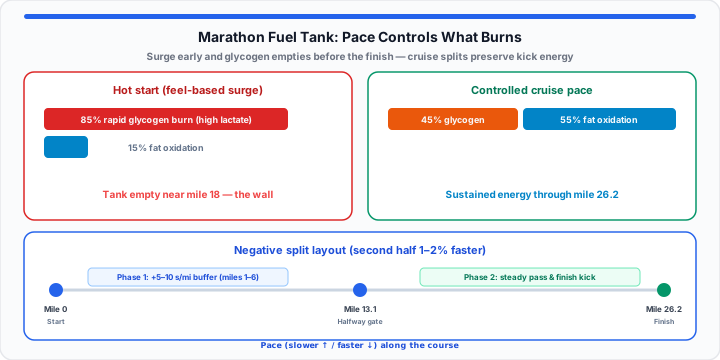
Your body relies on two primary fuel sources during endurance events: intramuscular glycogen and stored body fat. At lower heart rates, your engine burns a balanced mixture of fat and carbohydrate. The moment you surge past your lactate threshold, your muscle cells switch almost exclusively to burning glycogen. Human liver and muscle tissues store roughly 2,000 calories of carbohydrate—just enough to cover 18 to 20 miles of sustained movement. Burning through that fuel tank in the first hour creates a chemical bottleneck that no energy gel or sports drink can fix on the fly.
Controlled pacing preserves glycogen reserves for strong finish-line kicks. The infographic above contrasts a hot start with a cruise-controlled fuel mix and shows where a negative split fits on the course.
Step-by-Step: The Coach's Method for Manual Split Allocation
To map out a reliable race strategy, you need to understand how to calculate running pace splits manually before transferring those target numbers to your wristband. In our track speed testing, we break down target timing into a precise four-step workflow:
- Convert target finish time to total seconds: Take your goal finish clock (for example, 3 hours and 30 minutes) and convert the full duration into seconds. 3 hours, 30 minutes, and 00 seconds equals 12,600 total seconds.
- Account for real-world distance buffers: A standard marathon is officially 26.21875 miles (42.195 kilometers). To account for weaving around slower runners and taking wider turns on open roads, experienced coaches add a 0.8% distance buffer, calculating splits off 26.4 miles (42.48 km).
- Isolate baseline pace per unit: Divide your total target seconds by your target distance value to establish your required second-per-mile or second-per-kilometer output.
- Convert seconds back to minute-clocks: Divide your target second count per unit by 60 to establish your final minute-and-second split target.
The primary pacing equations look like this:
Total Target Seconds = (Hours × 3,600) + (Minutes × 60) + Seconds
Target Pace per Mile (in Seconds) = Total Target Seconds ÷ 26.21875
Final Mile Split = Target Pace in Seconds ÷ 60
For instance, aiming for a 3:45:00 target finish requires 13,500 total seconds. Dividing 13,500 by 26.21875 yields 514.89 seconds per mile. Dividing 514.89 by 60 gives 8 minutes and 34.8 seconds per mile (an 8:35/mi average pace). Use the Time Duration Calculator when you want to sanity-check hour-minute-second conversions without scribbling on a band.
To get started mapping out your personal race-day intervals without manual division errors on a sweat-stained scratchpad, drop your target finish time into our interactive Pace Calculator to map exact mile or kilometer intervals instantly. Track early miles on the course with the Online Stopwatch lap log if you prefer split timestamps over mental math at aid stations.
The Strategy Choice: Even Splits vs. The Negative Split Method
While holding a mathematically flat pace across all 26.2 miles sounds clean on paper, human biomechanics favors a slight negative split—running the second half of the race 1% to 2% faster than the first half.
During the opening six miles, your core body temperature rises, heart rate stabilizes, and thick crowd congestion naturally slows your progress. Intentionally holding back by 5 to 10 seconds per mile during this early phase protects your glycogen stores while your legs adjust to race rhythm. Once you pass mile 20, that conserved energy allows you to pick up speed smoothly while under-prepared runners fade backward.
The Marathon Finish Matrix: Core Pacing Milestones
When setting your training targets, having instant access to standard benchmark paces simplifies your race planning. The reference table below lists common target finish windows alongside required output rates for a full 26.21875-mile marathon:
| Target Finish Window | Target Mile Pace (min/mi) | Target Kilometer Pace (min/km) | 10K Passage Benchmark | Half-Marathon Gate (13.1 mi) |
|---|---|---|---|---|
| Sub-3:00:00 (Sub-3 Hour) | 6:52 / mi | 4:16 / km | 42:38 | 1:29:59 |
| 3:15:00 (Boston Qualifier Target) | 7:26 / mi | 4:37 / km | 46:12 | 1:37:30 |
| 3:30:00 (Solid Amateur Benchmark) | 8:01 / mi | 4:58 / km | 49:45 | 1:45:00 |
| 3:45:00 (Mid-Pack Target) | 8:35 / mi | 5:20 / km | 53:18 | 1:52:30 |
| 4:00:00 (4-Hour Milestone) | 9:09 / mi | 5:41 / km | 56:52 | 2:00:00 |
| 4:30:00 (Endurance Goal) | 10:18 / mi | 6:24 / km | 1:03:58 | 2:15:00 |
| 5:00:00 (Completion Track) | 11:26 / mi | 7:06 / km | 1:11:05 | 2:30:00 |
Moving onto course specifics, converting these baseline numbers onto actual roads requires adjusting for terrain and environmental conditions. Plug any row into the Pace Calculator to see matching speed in mph or km/h for treadmill or track sessions.
Factoring in Real Terrain: Elevation Skews and Weather Drops
In practical environments, race courses rarely present perfectly flat asphalt and zero wind. Course topography demands variable effort output rather than fixed mechanical speed.
When climbing elevated sections, maintain a steady heart rate and constant effort rather than forcing your target flat pace. You will naturally lose 10 to 20 seconds per mile on steep uphills, but you can safely recover that time on downhill sections by letting gravity carry your stride without over-striding.
Directly alongside elevation factors, warm weather plays a massive role in performance. High humidity or ambient temperatures above 60°F (15°C) elevate your heart rate, requiring you to dial back your baseline target pace by 1% to 3% for every 5°F increase in temperature to keep core heat manageable. For quick percentage tweaks on adjusted pace targets, use the Percentage Calculator on your revised split numbers.
Long-run fueling still matters: estimate training-day burn with the Calories Burned Calculator so gel and fluid plans align with weekly volume, not just race-morning adrenaline.
Open Pace Calculator Open Target Heart Rate Calculator
Frequently Asked Questions
How do you accurately calculate your required running pace splits for a full marathon?
To calculate your required running pace splits, take your total target finish time, convert it into raw seconds, and divide that number by 26.21875 miles (or 42.195 kilometers). Divide the resulting second count by 60 to find your baseline minutes-per-mile or minutes-per-kilometer target pace.
What is a good negative split strategy layout for a four-hour marathon target?
A 4-hour marathon requires an overall average pace of 9:09 per mile. A solid negative split strategy involves running the first 13.1 miles at roughly 9:15 to 9:20 per mile (a 2:02:00 first half) and accelerating to 9:00 to 9:05 per mile across the final 13.1 miles (a 1:58:00 second half).
How does converting miles to kilometers adjust how you track your split timing on a course?
Tracking race splits in kilometers gives you 42 feedback points instead of 26, allowing you to catch pacing errors early. Because a kilometer (0.621 miles) is shorter than a mile, pacing drift shows up sooner on your GPS watch, giving you time to adjust before burning extra energy.
Should I adjust my target marathon pace based on my 10K or half-marathon race results?
Yes. A standard endurance formula converts your half-marathon time to a realistic marathon target by multiplying your half-marathon time in minutes by 2.09 to 2.11. For example, a 1:45:00 half-marathon predicts a realistic full marathon finish time of roughly 3:39:00 to 3:41:00 with proper endurance training.