
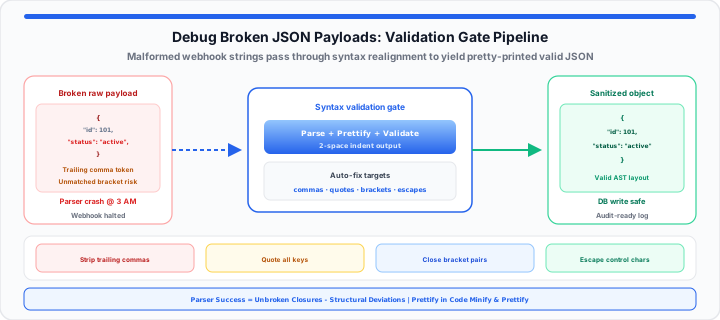
The Exploding Webhook Trigger
A production server crashes hard at three in the morning. An incoming third-party webhook dropped unescaped characters directly into memory. Your automated transaction pipeline halts unexpectedly. A single missing brace triggers cryptic syntax error logs. When I parse malformed webhooks at the console, panic spreads. In my API production deployment experience, malformed payloads break microservices. Frontend dashboards display blank screens to frustrated end users. Database transactions rollback due to invalid raw payload strings.
Think of your JSON array as an uncompromising digital blueprint. It is a strict bracket structure built to gate parsing engines. JSON nesting boundaries resemble a physical set of Russian nesting dolls. Every single inner doll needs a matching top and bottom. If you leave one bracket cracked open, assembly fails. An extra loose shell stuffs the box without a partner. The entire stack fails to fit inside the storage container. A cracked bracket shell jams your entire production conveyor system. You need an automated filter to sanitize raw payload strings.
To get started, paste suspect payloads into our Code Minify & Prettify tool with JSON selected, then hit Prettify to surface syntax failures before deploy. Let us examine isolated backend debugging categories now.
The Structural Syntax Boundary
Evaluate structural array boundaries inside payload responses first. Strict parsing engines require matching brace pairs for every object. Opening curly brackets must connect to corresponding closing curly brackets. Square array brackets demand identical structural symmetry across the stream. Unmatched bracket pairs cause immediate parser termination in modern runtimes. In our staging tests, a missing bracket breaks downstream serialization. You cannot pass fragmented byte streams to production databases safely.
Root level elements must remain completely sealed during transit cycles. A single structural deviation invalidates the entire HTTP response body. Network gateways reject malformed data packages before database writes occur. Memory buffers overflow when parsers search endlessly for missing closures. High throughput microservices exhaust thread pools during parsing failures. Stray string fragments corrupt structured log aggregator pipelines continuously. Validate structural boundaries before executing expensive database queries.
Total Data Weight = Raw Payload Bytes + Pretty-Print Indentation Spaces
Parser Success = Unbroken Closures − Structural Deviations
Parse your data arrays using our Code Minify & Prettify tool. Decode hidden syntax errors instantly before deploying production webhooks. When payloads embed URL-encoded fragments, verify decoded strings on the URL Encode / Decode tool before re-parsing.
| Corrupted JSON Error | Raw Broken State | True Valid Syntax | Automated Validator Fix |
|---|---|---|---|
| Trailing Comma in Object | {"id": 101, "status": "active",} |
{"id": 101, "status": "active"} |
Strip trailing delimiter token |
| Unquoted Key Strings | {name: "Production Gateway"} |
{"name": "Production Gateway"} |
Wrap key tokens in double quotes |
| Mismatched Bracket Closures | {"items": [1, 2, 3} |
{"items": [1, 2, 3]} |
Append missing array bracket |
| Single Quoted Value Strings | {"environment": 'staging'} |
{"environment": "staging"} |
Convert single quotes to double quotes |
| Unescaped Control Characters | {"notes": "Line1\nLine2"} |
{"notes": "Line1\\nLine2"} |
Escape raw newline control codes |
The Trailing Token Collision
Moving onto manual serialization flaws, trailing tokens destroy execution parameters. Developers often append extra commas after the last object property. Strict JSON specifications reject trailing commas inside objects and arrays. JavaScript object literals allow trailing commas without throwing syntax errors. JSON standards enforce strict compliance rules across all parsing engines. A trailing comma creates an unexpected token error in V8. Python native json loads calls reject trailing commas instantly. Legacy backend systems fail when processing extra trailing comma delimiters. Manual string concats frequently introduce rogue comma tokens at runtime.
Check your script boundaries with our free Code Minify & Prettify validator. Test custom string variables across edge case API scenarios.
Unescaped Control Codes
Raw ASCII control characters break string deserialization procedures without warning. Unescaped newlines inside string values terminate string tokens prematurely. Tab characters require explicit escape backslashes within valid JSON payloads. Binary payloads containing raw carriage returns fail standard schema checks. Control characters between byte values zero and thirty-one require escaping. Sanitize raw strings before injecting multiline text into API endpoints. For byte-level inspection of problematic characters, see our guide on converting text strings to hex for secure API request payloads and use the ASCII Converter to map code points.
Token Byte Offsets
Parser error messages point directly to specific token byte offsets. A syntax error at byte location 142 highlights exact failures. Multi-byte UTF-8 character sequences shift character position counts unexpectedly. Byte order marks at string beginnings confuse native parsing engines. Stripping hidden BOM headers restores clean payload parsing execution paths. Inspect raw byte streams when position markers seem off target. Base64-wrapped payloads can hide encoding issues — decode first on the Base64 Encode / Decode tool when vendors ship encoded bodies.
Array Root Constraint Blocks
Top-level JSON structures must evaluate to objects or arrays. Raw scalar values at root levels violate strict API contracts. Primitive numbers or booleans sent alone break client expectation models. Wrap naked primitives inside valid root object properties systematically. Enforce object root boundaries across all internal microservice response schemas.
The Production Pipeline Sanitation Protocol
In practical environments, systems developers manage incoming webhook payloads. Consider a microservice receiving malformed responses from third-party vendor APIs. The raw HTTP response body contains two hundred kilobytes of data. An unescaped control code breaks standard serialization at line fifty. System developers intercept raw payload buffers inside isolation proxy layers. The proxy scans incoming byte streams for structural boundary anomalies. It escapes raw control characters inside a sandboxed memory buffer. The sanitation script strips rogue trailing commas from object blocks. It normalizes single quotes to strict standard double quotation marks. Pretty-printing formats the clean payload stream with uniform two-space indentations. Engineers inspect formatted data blocks visually without causing layout shifts. Audit logs store pristine formatted JSON for rapid incident postmortems.
Review these core operational properties for production API payload sanitation:
- Buffer Interception Isolation: Intercept raw HTTP byte streams before calling native JSON parsers.
- Character Encoding Normalization: Convert non-standard character encodings directly into pure UTF-8 streams.
- Control Character Escaping: Replace raw newline and tab codes with explicit backslash escape sequences.
- Delimiter Token Scrubbing: Remove illegal trailing commas from arrays and key-value object blocks.
- Quote Token Alignment: Replace non-standard single quotes around keys with standard double quotes.
- Structural Indentation Prettifying: Apply uniform multi-level indentation to raw data strings for manual review.
- AST Tree Validation: Verify final sanitized strings against abstract syntax tree compiler rules.
- Schema Match Verification: Test sanitized JSON structures against OpenAPI schema definitions automatically.
Format and validate API responses with our Code Minify & Prettify tool. Eliminate runtime crashes across microservice deployment pipelines. For cleaning duplicate log lines pulled from error dumps, use the Duplicate Line Remover. When responses feed HTML dashboards, cross-check table markup rules in our clean HTML tables guide.
Open Code Minify & Prettify Open URL Encode / Decode
Frequently Asked Questions
How do you identify hidden syntax errors in an API JSON response?
Pass raw API payload strings into an abstract syntax parser. The validator highlights exact byte offset locations for syntax failures. Visual formatters display red indicators over missing brackets or quotes.
Why does a trailing comma cause web applications to throw fatal JSON parse errors?
Strict JSON standards prohibit trailing commas after final object attributes. Native parsing engines expect either closure brackets or new keys. Encountering a closing bracket after a comma breaks grammar rules.
What is the difference between JavaScript objects and valid JSON strings?
JavaScript objects allow unquoted keys, single quotes, and trailing commas. Valid JSON requires double-quoted keys, double-quoted strings, and strict closures. JSON serves as a strict data interchange format across systems.
How do unescaped control characters break JSON parsing pipelines?
Raw control characters interrupt string token boundaries during parsing procedures. Bytes between 0 and 31 violate strict JSON character specifications. Escaping control characters with backslashes restores valid payload formatting.