
Few things provoke the stomach-drop feeling of receiving an official state revenue notice claiming you under-collected thousands of dollars on past wholesale orders. When I’m auditing supply chain ledgers, I see bright, hardworking e-commerce merchants make devastating tax mistakes—not out of malice, but because business-to-business (B2B) tax mechanics operate on entirely different rules than direct-to-consumer retail carts. Whether you are battling audit threats or losing B2B clients because your cart engine accidentally double-charges tax on raw line items, mastering backward price parsing is essential for keeping your margins intact.
To understand how backward tax extraction works on a post-tax invoice total, compare an unparsed gross invoice to a factory-sealed shipping container packed tight with two distinct types of cargo: the actual heavy machinery inside (the raw price before tax) and the protective packing foam blocks surrounding it (the sales tax percentage). If you don’t use a clean mathematical custom blade to separate the two, you end up treating the disposable foam as part of your active structural machinery inventory. That mistake inflates your operational liabilities and forces you to pay out far too much cash from your net margins.
The Wholesale Nexus Trap: Why Overcharging Kills B2B Retention
In our corporate invoice testing, incorrectly applying sales tax to B2B transactions creates friction that damages commercial partnerships overnight. When a retail buyer places a $10,000 purchase order for inventory they plan to resell, adding a 7.5% sales tax charge on the raw line items forces them to tie up $750 in working capital. Because that retailer must collect sales tax again when selling those goods to the end consumer, charging them tax at the wholesale stage creates illegal double taxation.
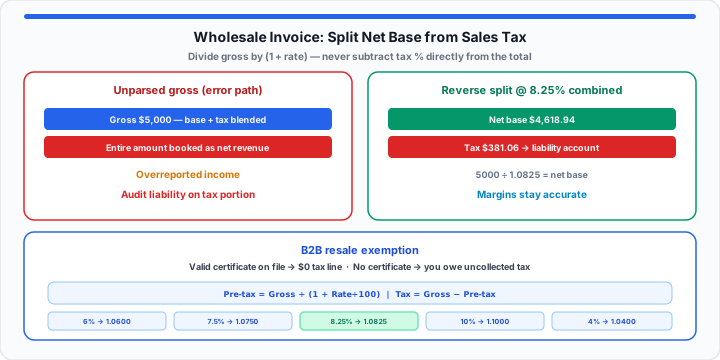
When a wholesale buyer catches that error on their receiving dock, they will stall payment, demand a revised invoice, or take their recurring supply chain orders to a competitor who handles resale exemptions properly. Conversely, if you absorb a gross payment that accidentally included tax without backing out the state’s cut properly, you will overreport your net revenue to tax authorities. That accounting slip causes you to overpay income tax on income you never actually earned. The infographic above contrasts bundled gross totals with a clean reverse split and maps common divisor brackets for high-volume invoicing.
For receipt-level splits and mixed taxable line items, see our reverse-engineer receipts pre-tax guide. Retail markup workflows pair with the percentage increases and margins for retail pricing guide.
Step-by-Step: The Auditor’s Method for Manual Reverse Tax Calculations
When I’m auditing supply chain ledgers, merchants often ask how to find price before tax when working backward from lump-sum payments. A common mistake is taking the gross total and simply subtracting the tax rate as a flat percentage (for instance, taking $1,000 and subtracting 8%). That math is incorrect because the tax percentage was applied to the smaller, original base price—not the larger, post-tax gross total.
To learn how to calculate sales tax backwards accurately, use this four-step manual division sequence:
- Identify the combined tax rate: Add all state, county, and municipal tax percentages together to find your total rate. For example, a 6% state tax plus a 2.25% city surcharge equals an 8.25% combined tax rate.
- Convert the percentage to a decimal anchor: Divide your combined tax rate by 100. For 8.25%, that yields 0.0825.
- Build the baseline divisor: Add 1.00 to your decimal tax rate. Adding 1.00 to 0.0825 yields a divisor of 1.0825.
- Isolate the base price: Divide the total gross invoice amount by your baseline divisor. The resulting number is your exact price before tax.
Baseline Divisor = 1 + (Combined Tax Rate / 100)
Price Before Tax = Gross Invoice Total / Baseline Divisor
Isolated Sales Tax Pool = Gross Invoice Total − Price Before Tax
For example, if a customer pays a gross total of $5,000 in a jurisdiction with an 8.25% sales tax rate, divide $5,000 by 1.0825. That calculation gives a base price before tax of $4,618.94. Subtracting $4,618.94 from $5,000 reveals that exactly $381.06 belongs in your state sales tax liability account.
Instead of manually tracking multi-layered percentage equations on a scratchpad under a tight shipping deadline, drop your gross figures into our interactive Sales Tax Calculator (Remove Tax mode) to extract your exact price before tax instantly. Cross-border value-added scenarios map cleanly through the VAT Calculator, and quick rate sanity checks run on the Percentage Calculator.
Dividing by (1 + Tax Rate) mathematically separates sales tax from the product’s base price.
The Resale Exemption Shield: Validating Certificates Natively
In practical environments, wholesale suppliers do not need to calculate or collect sales tax if the buyer provides a valid resale exemption certificate. These certificates confirm that the buyer is a registered re-seller who will collect sales tax when selling the items to the final consumer.
In my experience handling multi-state tax exemptions, dropping a tax line to zero without proper documentation leaves your business vulnerable during an audit. If state auditors discover zero-tax wholesale transactions without supporting documentation, they will charge you for the uncollected tax out of your own pocket—plus interest and penalty fees.
To protect your business, always establish a standardized validation routine:
- Verify exemption numbers: Check state revenue portals to confirm the buyer’s resale permit number is active before waiving tax.
- Match business scope: Ensure the items being purchased fit the buyer’s industry profile (for example, a retail bakery buying wholesale flour is exempt, but that same bakery buying office furniture is not).
- Archive certificates digitally: Store signed resale certificates in your cloud accounting system and update expired forms annually.
Freelance sellers reconciling mixed B2B and retail income can cross-check quarterly liability framing in our 1099 tax recovery playbook and side-hustle tax guide.
The Merchant Reference Matrix: Reverse Multiplier Brackets
When processing high-volume transactions, having instant access to standard decimal multipliers speeds up accounting workflows. The table below outlines common regional tax rates, their corresponding decimal divisors, and sample base price extractions for a $5,000 gross invoice:
| Regional Tax Rate | Decimal Reverse Divisor | Sample Gross Total | Extracted Price Before Tax | Isolated Sales Tax Pool |
|---|---|---|---|---|
| 4.00% (Base State Rate) | 1.0400 | $5,000.00 | $4,807.69 | $192.31 |
| 6.00% (Standard Regional Tier) | 1.0600 | $5,000.00 | $4,716.98 | $283.02 |
| 7.50% (Combined Metro Area) | 1.0750 | $5,000.00 | $4,651.16 | $348.84 |
| 8.25% (High-Density Commercial) | 1.0825 | $5,000.00 | $4,618.94 | $381.06 |
| 10.00% (Combined Municipal Ceiling) | 1.1000 | $5,000.00 | $4,545.45 | $454.55 |
Moving onto complex multi-state setups, managing regional tax variables requires applying these multipliers carefully to every order. Use the Sales Tax Calculator to spot-check each row before posting bulk journal entries, and the Margin Calculator when wholesale net base feeds into distributor markup decisions.
Open Sales Tax Calculator Open VAT Calculator
Frequently Asked Questions
How do you accurately calculate the original price before tax from a gross invoice total?
To calculate the original price before tax, convert the total sales tax percentage into a decimal by dividing it by 100, then add 1.00 to create a baseline divisor. Divide your total gross invoice by that divisor. The result is your exact base price before tax was added.
What is the step-by-step formula to calculate sales tax backwards manually?
The formula to calculate sales tax backwards requires two simple calculation steps:
Price Before Tax = Gross Invoice Total / (1 + (Sales Tax Rate / 100))
Extracted Tax Amount = Gross Invoice Total − Price Before Tax
Do wholesale orders always require a valid resale exemption certificate to bypass sales tax?
Yes. State tax authorities require a complete, legally valid resale exemption certificate on file for every business customer who claims a wholesale tax exemption. If you fail to collect and archive a valid certificate from a wholesale buyer, you remain legally responsible for paying that uncollected sales tax during an audit.
How do local or municipal surcharges affect backward tax calculations?
Local or city surcharges must be added directly to the state baseline rate before building your reverse divisor. For example, if a state tax rate is 6% and the local county adds a 1.5% district tax, your combined tax rate is 7.5%. Use a reverse divisor of 1.075 (1 + 0.075) to isolate your price before tax accurately.