
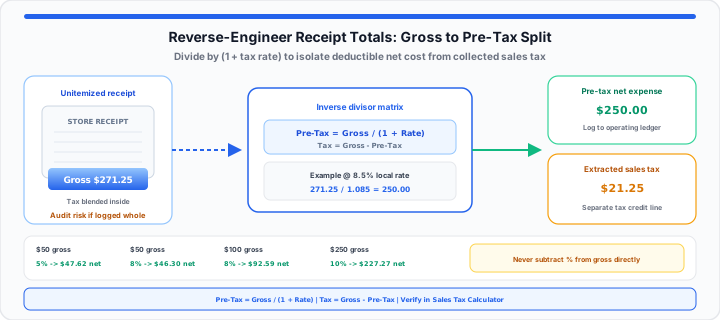
The Audited Write-Off Trap
A faded receipt sits on your desk at tax time. Tax filing deadlines arrive with overwhelming pressure. You stare at a single total dollar amount on paper. Unitemized store receipts trigger massive tax filing anxiety. In my contract tax reporting experience, contractors make costly mistakes. Log gross totals directly into write-off ledgers, and disaster strikes. You accidentally claim consumer sales tax as a business expense. Tax authorities flag these inflated deduction logs during routine audits. Improper expense classification leads to severe audit penalties and fines.
Think of your gross invoice total as a locked financial composite. It is a combined dollar value waiting to be parsed backwards. A gross receipt total resembles a pre-blended smoothie cup. Local sales tax acts like added protein powder mixed inside. You cannot reach in and scoop dry powder out manually. The additive powder bonded completely with the liquid fruit base. You need a mathematical filter to isolate original raw fruit costs. Reverse tax math separates tax additives from net product costs.
To get started, run your gross totals through our Sales Tax Calculator or VAT Calculator before you post ledger entries. Let us analyze core financial reconciliation categories today.
The Gross Invoice Baseline
Examine your final paid receipt total first. Gross figures combine underlying base prices and regional tax levies. In our reconciliation testing, unbundling totals restores strict audit compliance. Regional governments attach mandatory consumption taxes at retail checkouts. Merchants collect sales tax directly on behalf of state treasuries. Your actual expense deduction equals only the net item price. Claiming regional tax as direct asset cost inflates operating expenses. Proper ledger entries separate sales tax lines from net assets.
When I evaluate raw receipt drops at the desk, errors jump out. Many freelancers forget local sales tax rates vary across counties. A single purchase receipt might include municipal and state layers. Isolating pre-tax costs requires knowing the exact local percentage rate. Unitemized receipts hide underlying commercial asset values from bookkeepers. Forensic accountants look for clear separation between tax and assets. Misclassifying tax levies distorts gross profit margin metrics over time. Accurate baseline tracking establishes defensible cost basis accounting records.
Pre-Tax Price = Gross Total ÷ (1 + Tax Rate Percentage)
Extracted Tax Amount = Gross Total − Pre-Tax Price
Simulate your invoice splits with our Sales Tax Calculator or VAT Calculator. Verify baseline pre-tax numbers instantly before logging quarterly expenses. Cross-check percentage conversions on the Percentage Calculator when local rates use fractional decimals.
| Gross Receipt Total | Local Tax Rate | Pre-Tax Product Price | Extracted Sales Tax |
|---|---|---|---|
| $50.00 | 5.0% | $47.62 | $2.38 |
| $50.00 | 8.0% | $46.30 | $3.70 |
| $50.00 | 10.0% | $45.45 | $4.55 |
| $100.00 | 5.0% | $95.24 | $4.76 |
| $100.00 | 8.0% | $92.59 | $7.41 |
| $100.00 | 10.0% | $90.91 | $9.09 |
| $250.00 | 5.0% | $238.10 | $11.90 |
| $250.00 | 8.0% | $231.48 | $18.52 |
| $250.00 | 10.0% | $227.27 | $22.73 |
The Gross-to-Net Divisor Factor
Moving onto mathematical mechanics, direct percentage subtraction creates fatal errors. Many business owners multiply gross totals by tax rates directly. They subtract that result from the final receipt sum. This subtraction shortcut produces an incorrect, overly low pre-tax price. Sales tax applies to net base prices, not gross totals. Compounding forward percentages alters the underlying denominator base. You must divide by one plus the tax rate coefficient.
Convert an eight percent tax rate into zero point zero eight. Add one to build a one point zero eight divisor. Divide your gross receipt total by one point zero eight. This division reveals the true net cost before taxation occurred. Inverse calculation matrices reverse forward tax accumulation steps accurately. Map out your raw net returns using our Sales Tax Calculator. Test custom tax adjustments across complex multi-state receipts effortlessly.
Regional Sales Tax Percentages
Municipalities set wildly different consumption tax rates across jurisdictions. State sales taxes range from zero to over seven percent. Local county surcharges add extra percentage points at regional checkouts. Combined tax rates often reach ten percent in major urban centers. Always verify exact local rates before calculating net ledger values. Small rate discrepancies distort annual corporate expense reporting totals. Accurate regional tax tracking protects small businesses during state audits. Local tax jurisdictions update rates during spring and autumn sessions. Audit software checks historical tax rates against receipt transaction dates.
Fractional Tax Rates
Special district taxes create non-integer fractional tax rate percentages. Transit districts often impose a zero point two five percent levy. Combined rates become complex decimals like eight point three seven five percent. Convert fractional rates carefully to exact decimal divisor formats. Convert eight point three seven five percent to decimal form. The decimal coefficient becomes zero point zero eight three seven five. Add one to build your precise gross-to-net divisor matrix. Precision decimals prevent cumulative rounding errors across large expense ledgers. Truncating decimal coefficients introduces drift into long-term financial reporting. Maintain five decimal places during intermediate division steps for accuracy.
Multi-Item Invoice Splits
Single store receipts frequently combine taxable and tax-exempt items. Grocery purchases often blend tax-free food with taxable paper supplies. Applying a flat reverse divisor across entire mixed invoices fails. Isolate taxable line items before running backward division calculations. Sum the subtotal of taxable merchandise on the receipt first. Apply the gross-to-net divisor factor exclusively to taxable subtotals. Recombine tax-exempt items with calculated pre-tax values afterward. Proper line item isolation maintains pristine, audit-proof accounting records. Modern enterprise accounting software requires line-by-line tax attribute tags.
The Production Expense Line Audit
In practical environments, contract workers manage complex hardware receipt records. Consider a remote software developer buying workspace accessories on location. The gross receipt total equals two hundred seventy-one dollars and twenty-five cents. The local municipal sales tax rate equals eight point five percent. Convert eight point five percent to decimal zero point zero eight five. Add one to create a one point zero eight five divisor. Divide two hundred seventy-one dollars by one point zero eight five. The calculation reveals an exact pre-tax cost of two hundred fifty dollars. The extracted sales tax portion equals twenty-one dollars and twenty-five cents. Log the net two hundred fifty dollars as an operational expense. Record sales tax paid separately in your tax tracking journal. Forensic ledgers track tax credits independently from capital expenditures.
Review these core operational properties for freelance expense bookkeeping:
- Gross Invoice Isolation: Record total paid receipt values immediately upon checkout.
- Jurisdictional Rate Audit: Identify exact state, county, and city sales tax percentages.
- Divisor Coefficient Conversion: Add one to the local tax rate expressed in decimal form.
- Net Base Calculation: Divide gross total by the calculated divisor coefficient factor.
- Tax Line Extraction: Subtract pre-tax price from gross total to isolate exact tax paid.
- Mixed Invoice Sorting: Separate taxable line items from tax-exempt items before calculations.
- Ledger Account Separation: Post net costs to operational expense accounts and tax separately.
- Digital Audit Trail: Store physical receipts with calculated pre-tax values clearly marked.
Use our Sales Tax Calculator or VAT Calculator to verify baseline pre-tax numbers instantly. Eliminate manual math errors across all quarterly contractor tax returns. For broader 1099 filing context, see our 1099 Tax Recovery Playbook and Side-Hustle Tax Guide. Retail owners reconciling shelf prices can cross-check markup math in our guide on percentage increases and margins for retail pricing.
Open Sales Tax Calculator Open VAT Calculator
Frequently Asked Questions
How do you calculate the pre-tax price backwards from a total receipt?
Divide the total receipt price by one plus the tax rate. Convert your tax percentage into decimal form before adding one. The resulting quotient represents your true underlying pre-tax cost.
Why does subtracting a tax percentage from a total price give the wrong number?
Sales tax applies to the smaller net price, not gross totals. Subtracting percentages directly from gross totals creates mathematical distortion. Direct percentage subtraction yields an artificially low pre-tax estimate.
What is the formula to extract sales tax from a gross invoice?
First divide the gross total by one plus the tax rate. Subtract that calculated pre-tax price from your gross total. The remaining difference equals the exact sales tax amount collected.
How do you handle mixed receipts with taxable and non-taxable items?
Group all taxable items together and sum their subtotal first. Apply the reverse tax divisor factor exclusively to that taxable subtotal. Add tax-exempt item costs directly back to the calculated net base.