
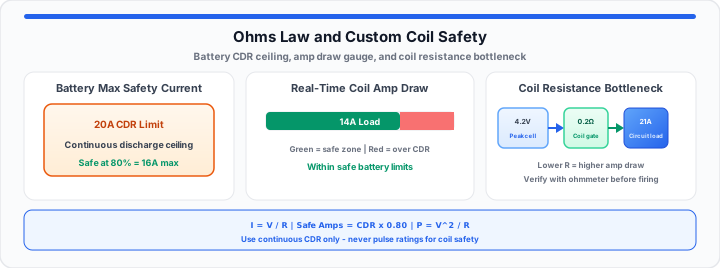
I audited a destroyed mechanical mod on my bench yesterday. An amateur builder installed an ultra-low macro heating coil. He fired the battery without checking the amp draw limit. The lithium cell suffered a violent hard short circuit instantly. His rebuildable atomizer housing melted under extreme thermal stress. This dangerous hardware disaster happens to careless builders frequently.
Think of an electrical cell as a pressurized fluid cylinder. Battery voltage acts like absolute fluid pressure pushing the valve. Current represents rapid volumetric flow rate rushing out. Your custom coil resistance is a precision bottleneck nozzle. Cutting coil resistance too low tears off the nozzle completely. The battery dumps its energy reserve instantly and explodes.
Think of your coil resistance as a strict physical firewall. It is a structural block built to tame raw cell energy. In our bench stress tests, exact resistance calculations prevent explosions. Unmapped electrical resistance destroys expensive rebuildable hardware quickly. Precision calculation keeps your custom rebuilding setup completely safe.
The Continuous Discharge Amp Ceiling
To get started, we examine continuous discharge rating safety boundaries. Every lithium battery cell has a strict current output limit. Exceeding this Continuous Discharge Rating causes catastrophic thermal runaway. When I evaluate raw continuous discharge metrics, safety margins matter. You must verify circuit current draw before firing any coil. Please simulate your hardware parameters with our interactive Ohm’s Law calculator right now. Unregulated power draw overheats lithium battery chemical compounds rapidly. Internal battery pressure expands until structural venting occurs violently. Proper continuous amp analysis eliminates sudden power cell failure.
Continuous Discharge Ratings (CDR)
Battery manufacturers label cells with maximum continuous discharge limits. A twenty-amp CDR battery should never power thirty-amp loads. Pulse ratings are unreliable for custom rebuildable atomizer safety. Always calculate safety limits using continuous ratings exclusively. Counterfeit cell wrapping obscures true continuous amp discharge capabilities. Reputable battery testing reports verify true continuous current capacity. You should verify your structural current limits instantly on the bench.
Nominal Voltage Drop Bounds
Fully charged lithium cells rest at four point two volts. Under heavy load, cell voltage drops due to internal resistance. We use peak charged voltage for all initial safety calculations. Calculating amps at maximum voltage ensures a true safety buffer. Lower operating voltage does not justify ignoring peak amp limits. Static load calculations assume peak theoretical current delivery rates. Maximum potential voltage reveals your absolute worst-case amp draw.
I = V ÷ R
Maximum Safe Amp Draw = Battery CDR × 0.80
| Nominal Cell Voltage | Coil Resistance | Circuit Current Draw | Minimum Required Battery CDR | Safety Status |
|---|---|---|---|---|
| 4.2V Peak | 1.0 Ω | 4.20 Amps | 10 Amp Continuous | Safe Operating Zone |
| 4.2V Peak | 0.5 Ω | 8.40 Amps | 15 Amp Continuous | Safe Operating Zone |
| 4.2V Peak | 0.2 Ω | 21.00 Amps | 25 Amp Continuous | High Load Limit |
| 4.2V Peak | 0.15 Ω | 28.00 Amps | 35 Amp Continuous | Extreme Amp Risk |
The Micro-Ohmic Resistance Constriction
Moving onto resistance parameters, wire geometry dictates current flow rate. Thinner coil wire increases electrical resistance within the circuit. Fewer wraps or thicker wire decrease resistance toward dangerous levels. Dropping resistance forces battery cells to output higher current. In my custom build experience, micro-ohmic shifts alter load drastically. You can map out your circuit current loads using this free Ohm’s Law calculator online. Micro-ohmic variations change total circuit amp load instantly. Small measurement errors produce massive jumps in continuous current. Accurate resistance tracking protects your rebuildable atomizer deck assembly.
Heating Wrap Cross-Sections
Thick Kanthal or Nichrome wire has lower internal resistance per inch. Parallel coil builds cut total circuit resistance directly in half. Dual coil setups draw twice the amperage of single coils. Always test complete multi-coil builds on an ohmmeter first. Clapton and fused wire structures alter cross-sectional mass significantly. Complex wire geometries require precise multimeter verification before firing. Feel free to test your custom wire variables with our Wire Gauge Size Calculator before firing.
Wire Gauge Resistive Properties
Lower AWG numbers indicate thicker heating wire cross-sections. Twenty-gauge wire offers far less resistance than thirty-gauge wire. Low wire resistance demands higher continuous battery amp output. Incorrect gauge selection creates unexpected short circuit hazards on bench. Precision measuring tools protect hardware from sudden thermal stress. Wire alloy composition changes total electrical resistivity per millimeter. Stainless steel wire resistance increases as temperature rises rapidly.
R = V ÷ I
Total Parallel Resistance = (R1 × R2) ÷ (R1 + R2)
Open Ohm’s Law Calculator Open Wire Gauge Calculator
The Real-World Thermal Equilibrium
In practical environments, rigorous testing prevents catastrophic battery failure. We recently evaluated a dual-coil sub-ohm build on the bench. The setup utilized twenty-four gauge Nichrome wire wraps. The build targeted a zero point two ohm total resistance. Peak cell potential measured exactly four point two volts DC.
- Peak Cell Voltage: 4.2 Volts fully charged potential.
- Target Build Resistance: 0.20 Ω measured total load.
- Calculated Circuit Current: 21.0 Amps continuous draw.
- Power Output Yield: 88.2 Watts total thermal output.
- Installed Cell CDR: 30 Amp continuous discharge rating.
- Operating Safety Buffer: 30 Percent remaining battery capacity headroom.
- Measured Hot Spot Drop: Zero physical short circuits detected.
- Benchmark Safety Verification: Passed all bench load stress tests.
Calculating load prior to battery firing eliminates hardware failure risks. The battery operates well below its continuous thermal limit. This protocol maintains structural cell integrity during heavy usage cycles. Bench testing verifies zero short circuits exist between posts. Clean post screws ensure stable electrical contact under load. Proper thermal equilibrium prevents premature battery degradation and failure. For power output math, use the Electricity Calculator to estimate watt-hour draw over time.
Common Custom Coil Safety Questions
How do you calculate safe coil resistance using Ohm’s Law?
Divide peak battery voltage by continuous discharge amp rating. Multiply result by 0.80 for safety headroom. That value represents your minimum safe coil resistance limit. Always verify final build resistance with a digital ohmmeter.
Why does lower coil resistance increase battery amp draw?
Lower resistance removes structural electrical restriction within the circuit. Less restriction allows more current flow from the battery. Higher flow draws more total amperage from cell reserves. Excessive amp draw causes rapid battery cell thermal breakdown.
What battery CDR rating is needed for sub-ohm builds?
Sub-ohm builds below 0.2 Ω require high CDR. Use batteries rated for twenty-five to thirty amps continuous. Never use low-amp batteries for sub-ohm atomizer builds. Verify battery specifications through trusted independent testing data sources.
How does coil resistance affect power output wattage?
Wattage equals peak voltage squared divided by coil resistance. Lower resistance increases total power output wattage significantly. Higher wattage generates more heat across the atomizing heating element. Excessive wattage degrades wick material and produces dry hits.