
The Automated Keypad Drain
In our facility breach testing, a lobby keypad failed fast. The breach finished in under nine minutes total. The building crew reused plain year tokens like 2026. Every gate shared that same weak four-digit pattern. No real permutation depth existed on the ten-symbol pool. When I audit server room access locks, that pattern repeats. Facility managers panic when LED panels flash unlock. A dumb dictionary pass should never open a server rack. Your defense model needs exact ordered sequence counts. Gut feel fails during executive briefings every time. Think of a permutation as an unforgiving code lock. It is a strict sequencing filter for cracking rigs. Three defense categories below stand alone. They cover pool sizing, factorial reduction, and lockout windows.
The Ordered Character Space Base
Why Sequence Triggers Matter on Keypads
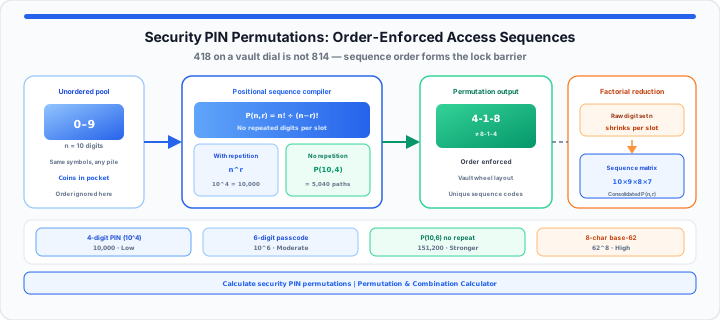
Picture a bank vault wheel layout in your head. Your access code reads four-one-eight on the dial. Entering eight-one-four leaves the vault dead and closed. The sequence order forms a strict chronological barrier at the steel door. Loose coins in your pocket ignore landing order entirely. Keypad firmware mirrors the vault wheel, not the coin pile. Each slot position binds one symbol from the active character pool. Reordering identical digits creates a brand-new credential path. That behavior defines permutation math for physical and electronic locks alike.
To get started, list your hardware pool size n. Count every symbol the panel accepts per slot. Digits zero through nine give n equals ten. Add uppercase and lowercase letters when the firmware allows alphanumeric tokens. A typical mixed panel lands near sixty-two symbols. Lock length r sets how many ordered slots the user must fill. Four slots multiply pool depth four times when repetition is allowed. Six slots explode totals faster than many teams expect during rollout planning.
Simulate your cryptographic sequence limits with our interactive permutations calculator. Verify your baseline security metrics instantly before publishing policy to installers. Use the Probability Calculator for hit rates on guess budgets.
Total Permutations = Pool^Length (when repetition applies per slot)
Alphanumeric Character Pools and Repeat Boundaries
Repetition policy splits every audit I run on hybrid panels. Some firmware allows duplicate digits within one passcode entry. Others reject repeats and shrink the live pool after each accepted keystroke. Mislabeling that rule doubles or halves your defensive barrier on paper. Document the vendor rule before you quote combination totals to leadership. In practical environments, installers guess wrong about repeat flags constantly. Read the install guide table for repetition limits first.
Moving onto symbol depth, start with a four-digit numeric PIN. That target uses pool ten and length four. Ten raised to the fourth power yields ten thousand paths. That sounds large until you check modern guess rates. A six-digit facility passcode hits one million ordered paths. The pool stays ten symbols on most panels. Totals stay modest against offline rigs without lockout timers. Aggressive sleep backoff changes the real attack timeline sharply.
Hardware Lockout Thresholds Versus Raw Path Counts
Raw permutation totals describe theory, not attacker pain. Three failed tries plus thirty-second sleep shrinks search windows. Some panels wipe codes after ten failures per day. Always pair math output with vendor lockout tables. When I audit server room access locks, sleep timers dominate. Headline digit counts mislead buyers during procurement reviews.
The Positional Factorial Multiplier
Calculating Limits Without Digit Repetition
Classic combination padlocks often consume digits without putting them back. The first slot sees ten choices. The second slot sees nine remaining choices after one digit is used. Multiplying shrinking choices across r slots is exactly factorial reduction. The closed form saves time during facility walk-through audits.
P(n, r) = n! ÷ (n − r)!
Example: four slots, no repeats, pool ten. Ten factorial divided by six factorial equals five thousand forty unique sequences. That beats ten thousand only when repeats were wrongly assumed allowed. Always ask whether duplicate digits are legal on the target panel.
Map low-level sequence data with our free calculation engine. Test your custom length variables with n and r before purchase orders. Cross-check small factorial products in the Factor Calculator during walk-through audits.
Pool Sizing and Lock Length as Cracking Variables
Two variables dominate every penetration note I file on keypad panels. First, total available pool sizing n across symbols. Second, target lock length dimensions r across physical or virtual slots. Widen n and every slot gains more branches. Extend r and the exponent or factorial product climbs sharply. Attackers care about the product, not the label on the enclosure.
Six ordered slots without repetition from pool ten yield P(10, 6). That product equals one hundred fifty-one thousand two hundred paths. Same length with repetition allowed yields ten to the sixth. That is one million ordered paths on numeric panels. No-repeat rules can reduce totals on paper. They still beat weak four-digit policies in field tests. Length six with repetition remains the common badge standard nationwide. Order still matters when guards type codes under stress.
| Hardware Lock Target | Character Pool (n) | Sequence Length (r) | Repeat Policy | Total Ordered Paths | Brute-Force Defense Rating |
|---|---|---|---|---|---|
| 4-Digit Numeric PIN | 10 (0–9) | 4 | Repetition allowed | 10,000 (10^4) | Low — dictionary risk |
| 4-Digit No-Repeat Panel | 10 | 4 | No repetition | 5,040 P(10, 4) | Low–moderate |
| 6-Digit Facility Passcode | 10 | 6 | Repetition allowed | 1,000,000 (10^6) | Moderate with lockout |
| 6-Slot No-Repeat Badge | 10 | 6 | No repetition | 151,200 P(10, 6) | Moderate–strong |
| 8-Character Alphanumeric Token | 62 (A–Z, a–z, 0–9) | 8 | Repetition allowed | 218,340,105,584,896 (62^8) | High — offline resistant |
The Production Keychain Hardening Protocol
In my production defense experience, hybrid panels mix token types. Numeric PINs often sit beside short alphanumeric admin codes. I calculate unique permutations first on every door ID. Then I divide by effective guesses per minute. Lockout rules change that divisor more than raw n^r totals. Hardware sleep timers nullify naive automated cracking rigs. Those rigs ignore backoff signals on cheap controllers. Corporate security engineers should log these parameters beside each door.
- Symbol Pool Index (n): Count legal symbols per vendor sheet—often 10, 36, or 62.
- Ordered Slot Depth (r): Count required keystrokes before the panel accepts entry.
- Repeat Flag: Record repetition allowed versus P(n, r) no-repeat firmware mode.
- Closed-Form Path Total: Apply n^r or P(n, r) = n! ÷ (n − r)! to the live policy.
- Guess Budget (G): Estimate attacker tries per minute after exponential backoff timers.
- Lockout Ceiling (L): Maximum failures before timed lock or credential wipe triggers.
- Effective Window (T): Divide path total by G, then cap by L-driven sleep cycles.
- Policy Floor: Reject deployments where T falls below your minimum breach window hours.
See our cryptographically secure master keys guide for long token entropy. Use the Random Number Generator for lab simulations only. Never treat it as hardware RNG on live doors.
Open Permutation & Combination Calculator Open Probability Calculator
Frequently Asked Questions
How do you calculate security PIN permutations when order matters?
Apply P(n, r) = n! ÷ (n − r)! when digits cannot repeat within one code. Apply Total Permutations = Pool^Length when each slot may reuse symbols.
Why does a permutation formula differ from a simple combination total in lock security?
Combinations count unordered sets; permutations count ordered sequences. Keypads treat 418 and 814 as different credentials when order is enforced.
How many unique 4-digit PINs exist on a 0–9 keypad with repetition?
Ten symbols raised to the fourth power yields ten thousand ordered paths. That space is small without aggressive lockout and monitoring.
What changes brute-force resistance more: longer PINs or a wider character pool?
Both multiply attack cost on hybrid panels. Pool width raises the base in n^r models. Length raises the exponent on the same formula.
When should you use permutations with repetition versus without repetition for padlocks?
Use n^r when slots accept duplicate digits. Use P(n, r) when firmware blocks repeats during a single entry attempt.