
The Automated Credential Drain
I watched a credential-stuffing script tear through forty-seven employee accounts overnight. Every login reused a predictable company name plus the year 2026. When I audit firewall credentials, weak master keys trigger breach cascades. Think of your master key as a strict mathematical wall. A randomized string built to exhaust malicious processing rigs completely.
An eight-character lowercase password acts like a flimsy luggage padlock. Two dials fall to a paperclip attack inside two minutes flat. A sixteen-character symbol-packed string anchors a solid steel vault door. Shifting deadbolt cylinders shatter a drilling rig before the first breach. Managing dozens of portals drains mental energy fast without strong keys. Three independent defense categories define production-grade master key architecture below.
The Character Space Base
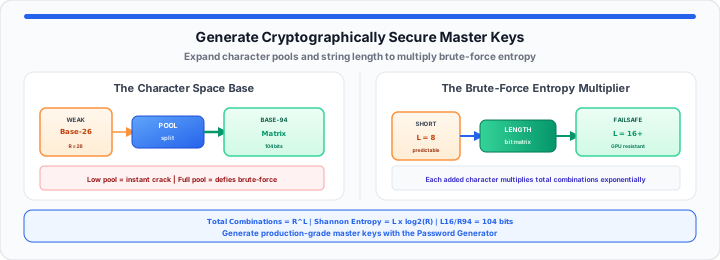
To get started, isolate the raw diversity of your active character pool. Every index position draws from a fixed alphabet size labeled R. In our cracking tests, lowercase pools cap entropy at thirty-eight bits. Expanding to ninety-four printable characters multiplies combinatorial space per slot dramatically.
You calculate total search space using:
Total Combinations = RL
You calculate Shannon entropy bits using:
Shannon Entropy Bits = L × (log2(R))
Substituting @ for a on a short string barely shifts the gauge. Pool expansion drives real defensive gains across every index slot. You can simulate your cryptographic entropy with our interactive Password Generator online. You can also verify baseline security metrics before production vault rollout.
Base-26 Lowercase Pool Size
Twenty-six letters yield roughly four point seven bits per character. Eight positions produce about two hundred eight billion total combinations. Modern GPU hash rigs exhaust that space in seconds during offline attacks.
Base-62 Alphanumeric Pool Size
Mixed case and digits add roughly six bits per character slot. Twelve positions deliver roughly seventy-one bits of Shannon entropy. That threshold resists casual dictionary attacks but not dedicated hardware farms.
Base-94 Symbol-Extended Pool Size
Full printable ASCII sets exceed six point five bits per slot. Sixteen positions cross one hundred four bits of total entropy. That range aligns with NIST guidance for high-value credential stores.
| Key Length (L) | Character Pool (R) | Entropy Bits | Est. GPU Crack Time (RTX 4090 class) |
|---|---|---|---|
| 8 characters | Lowercase only (R = 26) | ~38 bits | Seconds to minutes |
| 8 characters | Alphanumeric (R = 62) | ~48 bits | Hours to days |
| 12 characters | Alphanumeric (R = 62) | ~71 bits | Centuries at 109 H/s |
| 16 characters | Full printable + symbols (R = 94) | ~104 bits | Beyond practical GPU windows |
| 20 characters | Full printable + symbols (R = 94) | ~131 bits | Heat-death scale at 109 H/s |
The Brute-Force Entropy Multiplier
Moving onto string length, each added index multiplies combinations exponentially. Length acts as an exponential power exponent in the RL relationship. In my production defense experience, teams undervalue raw string length.
A predictable eight-character string with one symbol substitution still falls fast. A randomized sixteen-character mixed pool string resists offline hash cracking for decades. Hardware calculation speed sets the wall-clock timeline against your entropy budget. Consumer GPU rigs hit one billion guesses per second on weak schemes.
You isolate cracking resistance using:
Crack Time ≈ RL ÷ (Hardware Hash Rate × Parallel Threads)
Doubling length from eight to sixteen squares the entire search space instantly. That shift moves resistance from R8 to R16 combinatorics. You can map custom credential rules with this free tracking tool today. You can test custom length variables against live entropy readouts.
Length-Exponent Scaling Effect
Adding one character multiplies search space by the full alphabet size. Ten extra characters multiply resistance by ninety-four raised to the tenth power. That exponent curve dwarfs any single-character leet substitution trick.
Hardware Hash Rate Variables
Offline attacks bypass login rate limits entirely. Attackers hash candidate strings against stolen bcrypt or Argon2 digests locally. Faster GPUs and larger botnet fleets shrink wall-clock timelines against low-entropy targets.
Dictionary Versus Full-Space Attacks
Predictable human patterns collapse effective search space below theoretical maximums. Truly random high-length strings force full combinatorial enumeration. Random generation eliminates birthdate, pet name, and keyboard walk patterns completely.
The Production Keychain Hardening Protocol
In practical environments, admins deploy unique master keys across cloud vaults. Client-side browser generators eliminate plaintext transmission exposure during key creation events. Local memory sandboxes discard credential strings when tabs close on shared terminals.
Review these core technical metrics for production keychain deployment:
- Minimum Target Length: Sixteen characters for standard accounts; twenty for admin and encryption keys.
- Active Character Pool Size: Base-94 printable set with uppercase, lowercase, digits, and symbols enabled.
- Entropy Bit Floor: Eighty bits minimum; one hundred plus bits for financial and infrastructure credentials.
- Random Source Requirement: Browser
crypto.getRandomValuesAPI; never manual human composition. - Transmission Exposure Policy: Zero network calls during generation; client-side-only processing mandatory.
- Reuse Prohibition Index: One unique master key per portal; zero cross-service password recycling.
- Vault Storage Layer: Encrypted password manager with hardware-backed master unlock key.
- Rotation Cadence Target: Immediate rotation after any breach notification or employee offboarding event.
Use our Password Generator to build production-grade master keys now. Pair generated strings with an encrypted vault, not browser autosave alone. For API token encoding workflows, see our text-to-hex API payload guide. Benchmark randomness with the Random Number Generator before auditing credential registers.
Open Password Generator Open Base64 Encode / Decode
Frequently Asked Questions
How does password length affect brute-force cracking times?
Each added character multiplies total combinations exponentially. An eight-character lowercase string falls in seconds on modern GPU rigs. Sixteen characters with symbols push cracking timelines beyond practical attack windows.
Why should you use a client-side digital generator instead of a cloud-based password tool?
Client-side generators build keys inside your browser memory sandbox. No plaintext credential ever crosses the network wire. Cloud tools create transmission exposure and third-party trust dependencies.
What character pool size resists brute-force attacks on master keys?
A base-94 pool with letters, digits, and symbols maximizes Shannon entropy. Lowercase-only pools cap complexity at roughly 4.7 bits per index position.
How many entropy bits should a production master key carry?
Target at least 80 bits for standard account protection. Financial, admin, and encryption keys benefit from 100 or more bits. Length and pool diversity together determine the final bit count.
Does swapping letters for numbers on a short password add real security?
Minimal gains appear on short predictable strings. Attack dictionaries already test common leet substitutions automatically. Adding length and random symbols moves the entropy needle far more.