
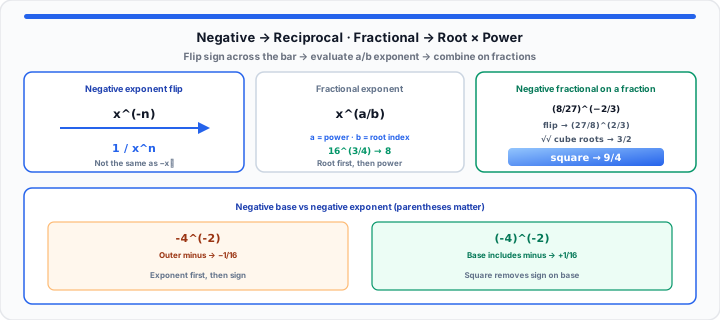
Few symbols cause as much sudden mental whiplash in algebra as a tiny minus sign floating next to an exponent. When I’m grading student work, I routinely see bright test-takers panic and treat 3−2 as if it means −6 or −9. It is an extremely common reflex. Your brain sees a negative sign and immediately wants to pull the entire calculation into negative value territory.
In reality, a negative exponent has nothing to do with making a number negative. Think of a negative exponent as a literal trapdoor or elevator button on a fraction bar. When a base number carries a negative exponent, it is simply signaling that it is sitting on the wrong floor of a fraction building. Punching that negative sign acts like pressing the down button, dropping the base through the floor into the basement (the denominator) where its exponent becomes positive, turning multiplication into a clean division problem.
The Core Flip Rule: Demystifying Negative Exponents
To get started, let’s unpack why exponents change behavior when they turn negative. Standard positive exponents represent repeated multiplication: 23 simply means 2 × 2 × 2 = 8. When you move backwards by dividing by 2 at each step (8 ÷ 2 = 4, 4 ÷ 2 = 2, 2 ÷ 2 = 1), you eventually cross past zero into negative power territory. Dividing 1 by 2 gives you 1/2 (or 2−1). Dividing by 2 again gives you 1/4 (or 2−2).
b−n = 1 / bn
To resolve any negative exponent manually, follow these four structured steps:
- Isolate the base and negative exponent: Identify the exact term attached to the negative power.
- Draw a fraction bar: Place a 1 in the numerator above the fraction line.
- Drop the base into the denominator: Move the base and its power under the fraction bar.
- Strip away the negative sign: Change the exponent from negative to positive, then evaluate the power.
Here is how standard base numbers transform as powers shift from positive to negative across common exponential scales:
| Base value | Positive power expression | Standard value | Negative power expression | Reciprocal fraction value |
|---|---|---|---|---|
| 2 | 23 | 8 | 2−3 | 1/23 = 1/8 |
| 2 | 22 | 4 | 2−2 | 1/22 = 1/4 |
| 5 | 52 | 25 | 5−2 | 1/52 = 1/25 |
| 10 | 102 | 100 | 10−2 | 1/102 = 1/100 |
| 10 | 103 | 1,000 | 10−3 | 1/103 = 1/1,000 |
Paste any base and exponent pair into the Exponent Calculator to see numeric results and, for small integer powers, a step panel that mirrors the flip logic above. For lab-report decimal conversions that follow negative powers of ten, pair this with the small scientific notation conversion guide and the Scientific Notation Calculator.
Fractional Powers: Roots and Radicals in Disguise
Moving onto fractional exponents, students often encounter a second layer of notation confusion when powers appear as fractions like x1/2 or x2/3.
In my experience breaking down advanced algebra, the easiest way to visualize a fractional exponent is to think of it as an engine with a gear ratio split between two distinct operations: powering up and taking roots. A fractional exponent xa/b is a two-part instruction where the top number (the numerator) acts as the power and the bottom number (the denominator) acts as the root index.
xa/b = ( b√x )a
- The numerator (top number a): Represents the standard exponent power (raising the base value).
- The denominator (bottom number b): Represents the radical root index (taking the b-th root of the base).
For instance, 163/4 tells you to take the 4th root of 16, and then raise the result to the 3rd power. Because taking roots reduces large numbers before you square or cube them, performing the root operation first makes mental arithmetic dramatically simpler:
- Take the 4th root of 16: ⁴√16 = 2 (since 2 × 2 × 2 × 2 = 16).
- Raise that result to the 3rd power: 23 = 8.
Thus, 163/4 = 8. When you prefer radical notation over caret form, open the Root Calculator and cross-check intermediate roots before you apply the final power.
Combining the Two: Solving Negative Fractional Exponents in 3 Steps
When an expression combines both negative signs and fractional powers—such as (8/27)−2/3—it can look intimidating at first glance. However, by breaking the operation down into three predictable sequential moves, you can solve even complex exam problems without getting lost in intermediate decimal estimates.
In my coaching sessions, we use this exact 3-step workflow:
- Step 1: Flip the base (clear the negative sign): Apply the elevator rule first. If your base is a fraction, flipping the entire fraction upside down immediately transforms the negative exponent into a positive one. Formula: (a/b)−m/n = (b/a)m/n.
- Step 2: Take the root (evaluate the denominator): Look at the denominator of your now-positive fractional power. Take that radical root of both the top and bottom values. This shrinks your numbers into manageable integers.
- Step 3: Apply the power (evaluate the numerator): Take the remaining integer values from Step 2 and raise them to the power indicated by the numerator.
Let’s walk through a concrete calculation example step by step: evaluate (8/27)−2/3.
First, clear the negative exponent by flipping the fraction inside the parentheses: (8/27)−2/3 = (27/8)2/3.
Next, address the denominator of the exponent (3), which means taking the cube root of both 27 and 8: ³√27 = 3 (since 3 × 3 × 3 = 27) and ³√8 = 2 (since 2 × 2 × 2 = 8). So, (27/8)1/3 = 3/2.
Finally, apply the numerator of the exponent (2) by squaring our result: (3/2)2 = 32/22 = 9/4.
Your final reduced answer is 9/4 (or 2 1/4). Check the arithmetic with the Mixed Fraction Calculator if you rewrite the result as a mixed number.
Instead of guessing whether the negative sign applies to your entire base or just the power during a timed exam, paste your equation into the Exponent Calculator to see the clean, stepped-out reduction instantly.
Common Traps: Negative Bases vs. Negative Exponents
In practical environments, one specific notation error causes more lost test points than all other exponent rules combined: failing to distinguish between a negative base and a negative exponent.
Consider these two similar-looking expressions: −4−2 and (−4)−2. They look nearly identical, but they yield completely different answers due to standard order of operations:
- Case A: Without parentheses (−4−2): The negative sign is not attached to the base. It sits outside as a multiplication by −1. You process the exponent first: 4−2 = 1/42 = 1/16. Then you attach the outer negative sign, yielding −1/16.
- Case B: With parentheses ((−4)−2): The negative sign is part of the base being raised to the power. First, apply the flip rule: 1/(−4)2. Since any negative number squared yields a positive result (−4 × −4 = 16), the answer is positive 1/16.
Whenever you see a negative sign near an exponential term, always check for surrounding parentheses before executing your first reduction step. Logarithms invert powers—when you need to reverse an exponential result, use the Log Calculator or the log base 2 guide for computer-science contexts.
Open Exponent Calculator Open Root Calculator
Frequently Asked Questions
Why does a negative exponent result in a fraction instead of a negative number?
An exponent indicates how many times to multiply a base value by itself. A negative sign on an exponent indicates the inverse operation: division. Instead of repeatedly multiplying the base, a negative exponent instructs you to divide 1 by the base raised to that power, creating a reciprocal fraction rather than a negative product.
How do you handle a negative exponent on a fraction that is already inside parentheses?
To handle a negative exponent on a fraction like (a/b)−n, invert the fraction to its reciprocal (b/a) and change the exponent’s sign to positive: (b/a)n. You can then distribute the positive exponent to both the numerator and denominator individually.
What does an exponent of zero mean, and how does it relate to negative powers?
Any non-zero base raised to the power of zero equals 1 (x0 = 1). This acts as the bridge between positive and negative exponents. When you decrease powers (x3, x2, x1), you divide by x at each step. Dividing x1 by x yields x0 = 1. Dividing by x again moves below 1 into negative power territory: x−1 = 1/x.
Can a fractional exponent have a negative denominator?
Standard mathematical convention always places the negative sign on the entire exponent or on the numerator rather than the denominator (for example, writing x−2/3 instead of x2/−3). If a negative sign appears in a denominator exponent, move the negative sign to the numerator first before applying the flip rule.