
The misplaced zero disaster
A single shifted decimal can change assay molarity by an order of magnitude. Small scientific notation is compressed shorthand for values much less than one—common in titration logs, spectrometer exports, and microfluidic flow readouts. Before you paste into a LIMS row or spreadsheet, expand through the Scientific Notation Calculator or follow the manual steps below. For broader lab-report conventions (E-notation, positive exponents, SI tables), see scientific notation to decimal for lab reports.
Quick check: Paste 3.1e-5 or 3.1 × 10^-5 into the Scientific Notation Calculator and compare with your hand-expanded decimal.
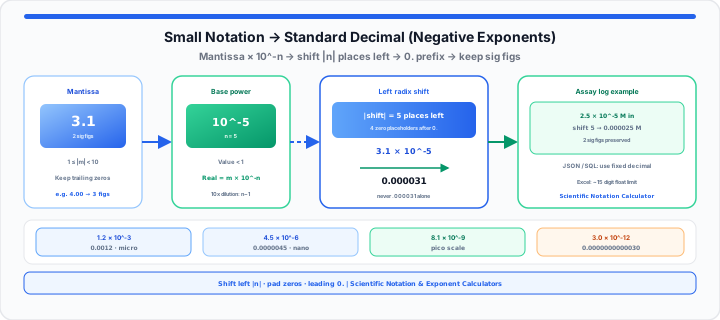
Step 1: Mantissa precision floor
The mantissa holds significant digits; in standard form its absolute value stays at least 1 and below 10. Base ten carries the scale; a negative exponent means the value is smaller than one.
Real value = Mantissa × 10−n
Do not drop trailing zeros that encode precision—4.00 carries three significant figures. Spectrometer and balance readouts depend on that count when you linearize calibration curves. Pair mantissa checks with the Exponent Calculator when you rewrite powers after dilutions.
Step 2: Left-shift the radix
For negative exponent n, move the decimal point left exactly n places. Each move inserts a zero placeholder when needed. Write 0.000031, not .000031.
Shift distance = |Exponent index|
Example: 3.1 × 10⁻⁵ → five places left → 0.000031. A tenfold serial dilution decreases the exponent magnitude by one; a hundredfold dilution decreases it by two. Use the Place Value Calculator when you teach or audit digit positions.
Microscopic fluid measurement lookup
| Measurement | Exponential form | Decimal form | Prefix |
|---|---|---|---|
| Micro fluid sample | 1.2 × 10⁻³ | 0.0012 | Micro (µ) |
| Nano trace solution | 4.5 × 10⁻⁶ | 0.0000045 | Nano (n) |
| Pico concentration assay | 8.1 × 10⁻⁹ | 0.0000000081 | Pico (p) |
| Femto cellular isolate | 3.0 × 10⁻¹² | 0.0000000000030 | Femto (f) |
Production solution log audit
- Initial readout: 2.5 × 10⁻⁵ M assay sample.
- Exponent magnitude: −5 (shift five places left).
- Placeholder zeros: four zeros after 0.
- Sanitized decimal: 0.000025 M.
- Significant figures: two active digits retained from 2.5.
JSON parsers and SQL NUMERIC columns behave more predictably with fixed decimals than raw e strings. Excel and other double-precision sheets may truncate beyond ~15 significant digits—export critical micro-scale values through a high-precision tool or decimal type. Related scale math: logarithmic scales in the lab.
Open Scientific Notation Calculator
FAQ
- How do you change a negative scientific notation to a standard decimal number manually?
- Move the decimal left by the exponent magnitude, pad zeros, and prefix 0. before the fraction.
- Why do microscopic fluid logs utilize negative exponents instead of plain text decimals?
- Exponents shorten long zero runs and make column alignment easier in dense lab tables.
- What happens to trailing zeros when converting scientific notation to decimal?
- They often reflect measured precision; keep them when your SOP counts significant figures.
- Why does Excel corrupt very small scientific notation decimal conversions?
- IEEE double precision limits fine-grained tails; use decimal-first tools for sub-nanomolar storage.