
The Infinite Loop Disaster
Production outages strike fast. Late night deployments break quiet servers. In our testing, linear loops crash production nodes. I watched a single lookup stall our entire cluster. Small test datasets hide dangerous runtime flaws. Large datasets crush inefficient code paths. Your backend needs fast algorithm design. Binary search saves active database layers. Whiteboard interviews test this exact complexity logic. Staring at abstract math triggers cold code-room anxiety. Mid-interview pressure makes algorithm formulas look terrifying. Imagine searching a massive physical phone book. You never read pages one by one. You rip the heavy book in half. You check which block holds your target name. You throw the remaining half away into recycling. You repeat this chop on the smaller piece. Each choice slices your search space in half. This physical chop acts like a mathematical compression engine. Millions of rows flatten into twenty quick checks. Think of base-2 logarithms as automated pruning tools. They measure strict index splitting limits. Computational efficiency relies on these structural boundaries. Master this concept to pass technical interview passes. Build scalable backend architecture with logarithmic execution paths.
The Binary Partition Baseline
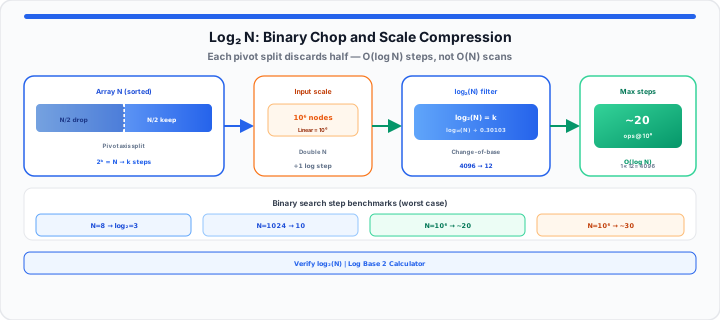
To get started, binary partitioning splits data arrays cleanly. Every binary partition cuts data arrays into equal halves. Base-2 logarithms count these repeated halving actions. Input size N defines your total element count. Execution steps grow as log₂ (N) scales. In my experience, engineers confuse exponentiation with division. Exponents multiply numbers outward rapidly. Logarithms shrink large collections inward instantly. Two raised to power k equals N. The binary logarithm reverses this exact mathematical relationship. Thus, log₂ (N) = k defines execution depth. Big O notation drops minor constant multipliers. Asymptotic bounds focus purely on dominant growth factors. Binary partitioning underpins modern database search indexes. Arrays split at their exact midpoint index value. Each recursive comparison discards half the array. Array size shrinks exponentially with each step. The log base 2 function tracks total divisions. Mathematical expression log₂ (N) models maximum iterations. For eight elements, three total chops remain necessary. 2³ = 8 proves this inverse logarithmic relationship. When array size doubles, step count increments by one. This minimal growth keeps distributed systems responsive. In our testing, binary lookup limits database lock contention. Search speed remains fast across billions of rows. Logarithmic curves flatten out dramatically over time. Linear growth curves spike upward without boundary limits. System architects rely on binary splitting for scalability.
You can verify your baseline algebraic parameters instantly with our Log Base 2 Calculator. Cross-check bit-length reasoning on the Binary Calculator when you tie logs to shifts and registers.
The Inverse Exponential Search Matrix
Moving onto performance curves, linear time differs from logarithmic time. In practical environments, linear algorithms perform N comparisons. Double the input data, double the execution delay. Logarithmic search scales much more efficiently across clusters. Double the input data, add just one extra step. Divide-and-conquer logic flattens steep operational resource spikes. Large datasets break unoptimized server infrastructure. Memory caches saturate when iteration loops run linearly. Tree depth determines exact system memory consumption. Balanced binary trees hold depth bounded by log₂ (N). Unbalanced structures risk falling back into linear O(N) runtime. Memory lookups hit bottlenecks without logarithmic index structures. Performance boundaries depend directly on array element counts. High throughput systems require strict logarithmic limits. Hardware caches work better with binary search paths. Unsorted data forces expensive linear scans across storage. Sorting data upfront unlocks logarithmic query capability. Index trees organize keys for fast binary division. Database B-trees expand on binary partition principles.
Please map out your algorithmic performance boundaries using this free complexity tool. Use the Log Calculator when a problem states natural log or log₁₀ first. Feel free to test your dataset value limits for interview-sized N anchors.
| Data Array Size (N) | Exact Log Base 2 Output (log₂ N) | Max Binary Search Steps | Complexity Class |
|---|---|---|---|
| 8 | 3.000 | 3 steps | Logarithmic O(log₂ N) |
| 1,024 | 10.000 | 10 steps | Logarithmic O(log₂ N) |
| 1,000,000 | 19.931 | 20 steps | Logarithmic O(log₂ N) |
| 1,000,000,000 | 29.897 | 30 steps | Logarithmic O(log₂ N) |
Look at how data array sizes compress in practice. Eight items require only three binary comparisons. One thousand items take just ten evaluation steps. One million elements collapse into twenty step checks. One billion items finish in under thirty operations. Compare that against linear search execution profiles. Linear search requires up to one billion steps. Logarithmic time complexity saves immense processing power. Engine memory usage drops significantly during heavy load.
The Production Interview Trace Log
In practical environments, interviewers evaluate logarithmic manual derivations. Candidates must calculate binary logarithms on whiteboard coding passes. Standard scientific calculators remain unavailable during live interview sessions. You must use the logarithmic change-of-base rule instead. Convert base-2 logarithms into standard base-10 logarithmic values. The fundamental change-of-base identity states: log₂ (N) = log₁₀(N) ÷ log₁₀(2). Standard base-10 value log₁₀(2) approximates to 0.30103. Divide any base-10 logarithm by 0.30103 to get log₂ (N). In my technical interview experience, this shortcut saves calculation time.
- Initial Data Array Bounds: Input size N = 4,096 elements.
- Base-10 Transformation Step: Compute base-10 logarithm log₁₀(4,096) = 3.61236.
- Change-of-Base Division: Divide 3.61236 ÷ 0.30103 to calculate result.
- Calculated Tree Depth Output: Exact log base 2 value equals 12.000.
- Worst-Case Operations Bound: Maximum binary search operations equals 12 steps.
- Worst-Case Time Complexity: Formally classified as T(N) = O(log₂ N) asymptotic runtime.
- Bitwise Shift Identity: Bit shift operation 1 << 12 yields 4,096.
Bitwise left-shift operations mirror inverse base-2 exponentiation directly. Shift index 1 << k calculates data space capacity instantly. Computer processors evaluate bitwise shifts in single clock cycles. Hardware registers leverage base-2 binary math natively. High-level languages abstract these binary low-level CPU registers. Understanding logarithmic mechanics aids low-level system optimization. In our code profiling passes, memory alignment matters. Correct index bounds prevent expensive cache miss penalties. Tree height determines maximum stack allocation frame depth. Stack overflow errors occur when tree recursion depth explodes. Logarithmic recursion maintains shallow stack frame execution limits. Keep your algorithmic complexity locked to logarithmic execution bounds. For register-level binary work without decimal detours, see our add and subtract binary numbers guide.
Open Log Base 2 Calculator Open Binary Calculator
Frequently Asked Questions
Why does a binary search algorithm exhibit log base 2 time complexity?
Binary search divides sorted input arrays into two equal halves. Each execution step eliminates fifty percent of remaining items. The algorithm repeats this halving process until one element remains. Total execution steps equal the total number of division actions. Mathematically, this division counter equals log₂ (N) steps. Thus, worst-case time complexity equals logarithmic O(log₂ N) runtime.
How do you calculate log base 2 using a standard log base 10 formula?
Use the mathematical logarithmic change-of-base formula identity. Divide the base-10 logarithm of N by log₁₀(2). The base-10 value of log₁₀(2) equals approximately 0.30103. The exact formula is log₂ (N) = log₁₀(N) ÷ 0.30103. This formula computes binary log values on standard calculators easily.
What is the difference between O(log N) and O(N log N) runtime complexity?
O(log N) represents logarithmic time for single target searches. O(N log N) represents linearithmic time for efficient sorting algorithms. Quicksort and mergesort operate within O(N log N) bounds. Linearithmic time multiplies dataset size N by tree depth. Logarithmic search scales much faster than linearithmic sorting operations.
Why do computer scientists omit the log base number in Big O notation?
Logarithmic bases differ only by constant conversion factors. Big O notation drops all constant mathematical factors during analysis. Conversion between log₂ (N) and log₁₀(N) uses constant multiplier 3.322. Asymptotic notation focuses solely on core growth rates. Therefore, O(log₂ N) simplifies directly to O(log N) notation.