
On morning site estimates, nothing breaks a homeowner’s spirit faster than a massive, three-cubic-yard mountain of dark bark dumped squarely in the center of the driveway—only for them to realize they needed less than half of it. The remaining pile sits there for weeks, leaching dark organic stain into the concrete during heavy spring rains. On the flip side, we have all experienced the Sunday evening frustration of carrying the last bag from the trunk, slitting it open with a pocketknife, and realizing we are three bags short of finishing a front flower border. Your lower back is aching, the home center is closed, and half your soil remains completely bare.
Think of spreading organic material across your plant beds like pulling a thick wool winter blanket over a mattress. To insulate sensitive feeder roots from blazing July heat and suppress aggressive weed seeds, you need a consistent, uniform 3-inch barrier layer. Stacking it too shallow leaves gaps for dandelion seeds to drop anchor, while piling it six inches deep against plant stems suffocates root systems and starves the soil of oxygen. Finding that exact sweet spot requires accurate math before you make a trip to the local nursery or place a bulk supply order.
The Math of the Soil: Why Guessing Your Mulch Yardage Leads to Blown Budgets
When I’m calculating bulk soil or bark orders for client properties, eyeballing coverage is the quickest path to an inflated budget. A quick visual estimation almost always leads to massive compounding errors because depth is deceptive. Spread across a 500-square-foot perennial bed, an extra single inch of organic cover adds over 1.5 cubic yards of material—which translates to nearly 20 extra standard retail bags sitting in your garage or roughly $100 burned in raw material costs alone.
Conversely, skimping on depth creates immediate long-term yard maintenance problems. If you spread shredded hardwood at a skimpy one-inch depth to make a thin delivery last longer, sunlight will still penetrate straight down to buried weed seeds. Within three weeks of spring rain, opportunistic weeds break through the surface, forcing you to buy more material anyway.
Getting your measurements down to the exact cubic foot protects both your plant roots and your wallet. Instead of guessing yardage counts or trying to manually convert fractional depth inches on a muddy sketchpad out in the garden, plug your raw bed measurements directly into our Mulch Calculator to determine your precise bulk or bag totals instantly. For irregular footprints, start with the Square Footage Calculator, then run depth and volume in the mulch tool.
Step-by-Step: How to Calculate Mulch Yardage Manually
If you want to pull out a measuring tape and crunch the numbers yourself, figuring out mulch yardage requires just a few basic arithmetic conversions. Bulk soil and wood products are sold by the cubic yard (a three-dimensional box measuring three feet high, three feet wide, and three feet deep, equaling 27 cubic feet).
Follow this four-step manual math protocol to estimate your exact project demands:
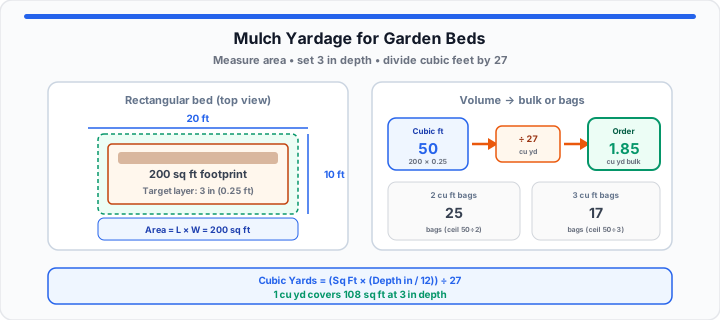
- Measure Your Total Surface Area: Take your measuring tape and record the length and width of your planting areas in feet. Multiply length by width to establish total square footage (Area = Length × Width).
- Convert Target Depth from Inches to Feet: Decide on your target depth (3 inches is the gold standard for most garden beds). Because your surface area is measured in feet, convert depth into feet by dividing it by 12 (Depth in Feet = Depth in Inches / 12). For a 3-inch layer, this equals 0.25 feet.
- Calculate Total Cubic Feet: Multiply your total surface area by your decimal depth figure (Cubic Feet = Area in Square Feet × Depth in Feet).
- Apply the 27 Bulk Divisor for Cubic Yards: To convert cubic feet into wholesale commercial supply units, divide your total cubic feet by 27 (Cubic Yards = Total Cubic Feet / 27).
Written out as a unified mathematical formula, the full calculation looks like this:
Cubic Yards = (Area in Square Feet × (Depth in Inches / 12)) / 27
For example, if you are treating a 20-foot by 10-foot rectangular bed (200 square feet) to a 3-inch depth, multiply 200 by 0.25 feet to get 50 cubic feet. Dividing 50 by 27 yields 1.85 cubic yards of material.
Tip: Always divide total cubic feet by 27 to get standard wholesale yardage. The same volume logic applies to gravel bases—see the Gravel Calculator when you are sizing stone instead of bark.
Adjusting for Complex Shapes: Segmenting Curvy Borders
Very few residential garden beds are perfect rectangles. In my experience prepping flower beds for spring, organic kidney shapes, sweeping perimeter curves, and circular tree rings are far more common. Trying to compute one giant, complex shape all at once usually leads to calculation errors.
To keep your numbers accurate, break your yard layout down into basic geometric blocks:
- For Rectangles and Straight Borders: Measure the longest length and widest width, multiply them together, and treat the space as a basic box.
- For Circular Tree Rings: Measure from the center of the tree trunk out to the outer edge of the border to find your radius (r). Calculate square footage using the standard circle formula (Area = 3.14 × r²). If you have a mature shade tree with a 4-foot ring radius, your surface area is 3.14 × 4 × 4 = 50.24 square feet. Subtract the trunk’s surface area if it takes up significant space. You can cross-check ring area with the Circle Calculator or Area Calculator.
- For Sweeping Curved Edges: Divide the bed into a series of smaller adjacent squares or rectangles. Calculate the square footage of each block individually and sum them up before running your depth conversion.
For contractor markup context on mixed gravel and mulch slabs, see our Gravel & Mulch Slab Guide.
The Quick Reference Material Sheet: Bag Counts vs. Bulk Deliveries
Once you know your required cubic yardage, you face a major logistical choice: should you order a loose bulk truck drop or haul pre-packaged retail bags from the local garden center? As a rule of thumb, if your project requires more than two cubic yards (roughly 54 cubic feet), ordering a bulk truck drop is usually significantly cheaper and saves your vehicle’s suspension from heavy weight strain.
Standard retail bags come in two common sizes: 2-cubic-foot bags and 3-cubic-foot bags. Since one cubic yard equals 27 cubic feet, it takes 13.5 bags of the 2-cubic-foot size or 9 bags of the 3-cubic-foot size to make up a single cubic yard.
The reference guide below shows common garden bed square footage figures at the recommended 3-inch depth alongside exact bag and bulk conversion requirements:
| Total Bed Area (Sq Ft) | Depth (Inches) | Cubic Yards Needed | 2 cu. ft. Bag Count | 3 cu. ft. Bag Count | Best Delivery Option |
|---|---|---|---|---|---|
| 100 sq. ft. (Small border) | 3" | 0.93 cu. yd. | 13 Bags | 9 Bags | Retail Bags (Car Trunk) |
| 250 sq. ft. (Medium garden) | 3" | 2.31 cu. yd. | 32 Bags | 21 Bags | Bulk Delivery |
| 500 sq. ft. (Large front yard) | 3" | 4.63 cu. yd. | 63 Bags | 42 Bags | Bulk Delivery |
| 750 sq. ft. (Property perimeter) | 3" | 6.94 cu. yd. | 94 Bags | 63 Bags | Bulk Delivery |
| 1,000 sq. ft. (Full yard redesign) | 3" | 9.26 cu. yd. | 125 Bags | 84 Bags | Bulk Delivery (Dump Truck) |
When working with loose bulk deliveries, always add a 5% to 10% material buffer to account for uneven grade settling, slope wash, or low spots in your soil bed. The Volume Calculator can help sanity-check prism volumes if you split beds into multiple sections.
Open Mulch Calculator Open Square Footage Calculator
Frequently Asked Questions
How many square feet does a standard cubic yard of mulch cover at 3 inches deep?
A single cubic yard of material covers exactly 108 square feet at a standard 3-inch depth. If you spread the material thinner at a 2-inch depth, one cubic yard covers 162 square feet. If you apply a heavy 4-inch layer, coverage drops to 81 square feet per cubic yard.
How do you figure out how much mulch you need if your garden bed is a perfect circle?
To calculate coverage for a circular bed, measure from the center point to the outer edge to find your radius in feet. Multiply the radius by itself, then multiply by 3.14 to find total surface square footage (Area = 3.14 × radius²). Multiply that square footage by your depth in feet (0.25 for 3 inches) and divide by 27 to find total cubic yards.
Is it cheaper to purchase mulch by the individual bag or in bulk truck yard loads?
Purchasing in bulk is almost always more cost-effective for medium to large projects. Bulk supplier material typically costs between $30 and $50 per cubic yard, plus a delivery fee. Equivalent coverage in 2-cubic-foot retail bags (13.5 bags per yard at $4 to $6 per bag) costs $54 to $80 per yard. If your bed requires more than 2 cubic yards, bulk delivery is cheaper and far easier on your back.
Can laying mulch too deep damage flower beds and young shrubs?
Yes. Applying more than 4 inches of organic cover can trap excess moisture against plant trunks and root crowns, causing fungal rot and root suffocation. It also prevents oxygen and light rain from reaching the topsoil. Maintain a steady 2- to 3-inch layer and keep the material pulled back 2 inches away from tree trunks and woody stems.