
You have seen it on offer sheets: one employer quotes $85,000 base, another flashes $55/hour on a statement of work. Your stomach drops either way—because the bigger number might hide forty-five-hour weeks, and the hourly rate might ignore taxes, benefits, and the admin hours you never invoice. When I am auditing contract agreements or mapping salary structures for freelancers re-entering corporate budgets, the first sanity check is always the same: put both numbers on one hourly baseline before anyone negotiates.
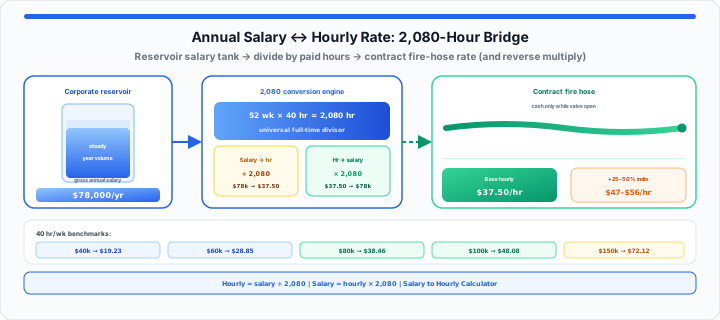
Picture your yearly salary as a massive water reservoir. It holds a predictable volume of gross pay for the whole year. An hourly contract rate is a fire hose: cash shoots out fast per minute, but only while you hold the valve open. If you never calculate runtime—paid hours, billable hours, unpaid gaps—the tank looks fuller than your bank account feels.
To get started without scribbling divisors on a napkin under deadline, drop your gross figures into our Salary to Hourly Calculator. It runs salary-to-hourly and hourly-to-salary with your real hours-per-week and weeks-per-year assumptions, plus weekly and monthly gross equivalents you can feed into the Budget Calculator after you model withholding.
The 2,080 Rule: The Baseline Math of Corporate Pay Schedules
U.S. full-time compensation data usually anchors on one divisor: 2,080 paid hours. That is not mystical HR folklore—it is calendar mechanics. Take a standard 52-week tracking year and multiply by a 40-hour workweek floor:
2,080 = 40 hours per week × 52 weeks per year
Payroll systems, government wage tables, and internal leveling guides all lean on that block because it gives every salaried role a comparable “per hour” line without opening individual time cards. In our corporate offer testing, teams rarely dispute the salary figure; they dispute whether the role is truly 40 hours or a 45-hour culture with the same base.
Part-time schedules scale the divisor down in one step. Twenty hours weekly for fifty-two weeks yields 1,040 hours; thirty hours yields 1,560. Four-day weeks at thirty-two hours land near 1,664 hours if you still work fifty-two weeks. The hourly equivalent of identical salary rises when fewer hours split the same annual pot—that is why a four-day salaried offer can look generous until you divide.
Step-by-Step: Converting Annual Salary to an Hourly Rate Manually
Moving onto the salary-down direction, you are spreading one fixed annual gross across every paid hour the employer expects. These steps mirror what I walk clients through when they compare a W-2 letter to a vendor rate card.
- Confirm gross annual salary. Use the offer letter base, not projected bonus or sign-on unless you are modeling scenarios separately. Stick to pre-tax gross.
- Lock your hour divisor. Full-time default: Hourly Rate = Annual Salary ÷ 2,080. Custom schedule: Hourly Rate = Annual Salary ÷ (Hours per week × Weeks per year).
- Run the division once. Example: $62,400 ÷ 2,080 = $30.00 per hour. Round to cents for offer comparisons; keep extra decimals if you are stacking commission or shift differentials later.
- Stress-test unpaid time. If the plant closes two unpaid weeks, weeks drop from 52 to 50 while salary stays flat: $62,400 ÷ (40 × 50) = $31.20 per hour. Same paycheck, sharper hourly reality.
- Cross-check pay frequency. Hourly math does not replace bi-weekly deposit timing. Use the Salary Calculator when you need holiday and vacation adjusted frequencies side by side.
Instead of manually tracking multi-tiered equations on scratch pads while evaluating a job offer under a tight deadline, you can enter the same gross annual pay, hours per week, and weeks per year in the Salary to Hourly Calculator and read the highlighted hourly wage plus the calculation block that shows the exact divisor.
Converting part-time and compressed schedules
A $48,000 offer at twenty-four hours weekly for fifty-two weeks divides across 1,248 hours, not 2,080. That produces $48,000 ÷ 1,248 = $38.46 per hour—materially higher than the $23.08 you would wrongly infer if you still used the full-time divisor. Always match the divisor to the schedule written in the handbook, not the title on LinkedIn.
Flipping the Math: How to Calculate Annual Income from an Hourly Baseline
Contract listings speak hourly; mortgage lenders and retirement calculators speak annual. Scaling up is multiplication, not division:
Annual Salary = Hourly Wage × Hours per week × Weeks per year
At $42/hour, forty hours, fifty-two weeks: $42 × 2,080 = $87,360 gross before adjustments. That is the mirror image of dividing $87,360 by 2,080 to recover $42. For deeper walkthroughs on unpaid leave, overtime pools, and shift premiums on the hourly-to-annual path, read our companion hourly wage to gross annual salary guide.
In practical environments, flip the calculator mode to hourly-to-salary, keep the same schedule inputs, and you avoid reversing the formula by hand when fatigue sets in during a counter-offer window.
The Hidden Costs: Tracking the True Price of Going Independent
Here is where the fire-hose metaphor stings. A salaried $40/hour equivalent on paper is not what a solo operator can charge and still match W-2 take-home. When I am auditing contract agreements, we stack costs the employer used to carry:
- Self-employment tax on net profit (employer plus employee FICA equivalents land on you).
- Health, dental, and disability premiums that group plans subsidized.
- Software, insurance, accounting, and unpaid sales time that never hits a timesheet.
- Billable utilization below 2,080 because marketing, training, and gaps between clients are real hours.
A workable shorthand: take the W-2 hourly equivalent from the division step and add a 25% to 50% premium before you quote clients. On a $38.46 base, that band suggests roughly $48 to $58 per billable hour as a floor—not a ceiling—before profit. Pair that target with the Side-Hustle Tax Guide for 1099 freelancers and the Income Tax Calculator when you move from gross rate to quarterly cash set-asides.
Accounting for unpaid time off in salaried hourly equivalents
Paid vacation and paid holidays typically stay inside the 2,080 baseline for salaried roles—you still receive salary during those weeks. Unpaid furloughs, seasonal layoffs, or startup “shutdown” weeks remove paid hours while salary holds steady, which raises your true hourly equivalent. Track those weeks explicitly; the Time Card Calculator helps when schedules are uneven across the year.
The Quick Reference Benchmark Sheet: Standard Pay Scale Equivalents
Assumes gross salary, forty-hour weeks, fifty-two paid weeks (2,080 hours), no unpaid leave. Monthly figures divide annual gross by twelve.
| Annual gross salary | Hourly equivalent (2,080 hr) | Weekly gross | Monthly gross |
|---|---|---|---|
| $40,000 | $19.23 / hr | $769.23 | $3,333.33 |
| $60,000 | $28.85 / hr | $1,153.85 | $5,000.00 |
| $80,000 | $38.46 / hr | $1,538.46 | $6,666.67 |
| $100,000 | $48.08 / hr | $1,923.08 | $8,333.33 |
| $150,000 | $72.12 / hr | $2,884.62 | $12,500.00 |
Reverse any row in seconds: multiply the hourly column by 2,080 to rebuild annual gross, or plug the salary into the Salary to Hourly Calculator if your weeks or hours differ from the table defaults.
Ready to compare offers? Open the Salary to Hourly Calculator, then run net scenarios in the Take-Home Paycheck Calculator so gross hourly lines match what hits your account.
Frequently Asked Questions
- How do you quickly convert an annual salary to an hourly rate without a calculator?
- Divide gross annual salary by 2,080 for standard full-time schedules. Mental shortcut: $52,000 ÷ 2,080 = $25.00 per hour. For $78,000, divide by 2,080 to get $37.50 per hour.
- Does a standard hourly rate calculation take paid vacation and national holidays into account?
- Salaried 2,080-hour math assumes you are paid through normal PTO and paid holidays. It does not grant extra hourly credit for those weeks—the annual salary already covers them. Unpaid weeks are the exception; subtract them from total paid hours before dividing.
- Why do independent contractors need to charge a significantly higher hourly rate than full-time salaried employees?
- W-2 employers fund benefits, match payroll taxes, and pay you during many non-billable hours. Contractors must recover those costs, tax burden, and idle time in the rate. A 25% to 50% markup on the W-2 hourly equivalent is a common opening bracket before margin.
- How do you convert an hourly wage back to annual salary?
- Multiply hourly rate by weekly hours and by working weeks, or multiply by total annual paid hours. Example: $33 × 2,080 = $68,640 gross per year.
- What is the difference between this hourly equivalent and net pay?
- Everything here is gross—before withholding and deductions. After you align offers on gross hourly lines, model net deposits separately; never compare a contractor gross rate to an employee net paycheck.
Open Salary to Hourly Calculator