
Every winter, I get called out to homes where the owners are shivering in a drafty bedroom despite running a brand-new space heater full blast. On the flip side, I see folks who bought massive, high-wattage units that cycle on and off every three minutes, spiking their electric bills while leaving the room feeling alternately like a sauna and an icebox.
The problem isn’t usually the heater itself—it’s the guess-and-check method people use when buying one. Walking into a big-box store and picking whatever unit has the biggest promise on the box is a recipe for frustration.
Think of your room like a leaky bucket. The colder it gets outside, and the worse your window seals are, the faster heat drains out. Your space heater’s job is simply to match that leak rate drop for drop. If you buy a heater without knowing your room’s thermal leak rate, you’re shooting in the dark. Calculating your true heating load takes less than ten minutes, and it guarantees you get the right heat output without burning through cash.
Run the numbers: Enter room dimensions and winter ΔT on the BTU Calculator (Heating BTU tab), measure floor area with the Square Footage Calculator, then project plug-in cost on the Electricity Calculator.
The Three Pillars of Room Heating Requirements
To size a space heater accurately, we need to examine three thermal variables that govern how heat moves through a residential space.
Cubic Volume (Not Just Square Footage)
Most heat loss formulas start with floor area, but heat fills a three-dimensional space. A 12×12 bedroom with standard 8-foot ceilings has a volume of 1,152 cubic feet. Put that same 144 square feet under a vaulted 12-foot ceiling, and you are suddenly heating 1,728 cubic feet—a massive 50% increase in air volume. Always measure floor space and multiply by floor-to-ceiling height.
Temperature Delta (ΔT)
Temperature delta (ΔT) is the difference between your desired indoor temperature (typically 70°F) and the outdoor winter design temperature for your region. In mild winter climates like southern Georgia, your outdoor low design baseline might be 30°F, leaving you with a ΔT of 40. In Minnesota, that outdoor design temperature could drop to -10°F, creating an extreme ΔT of 80. If you aren’t sure what extreme winter lows to expect locally, cross-check ambient conditions with our Wind Chill Calculator and Wet-Bulb Calculator so you do not underestimate ΔT when cold snaps stack wind and moisture on top of air temperature.
Thermal Boundaries & Air Infiltration
Your room’s boundary walls act as a thermal barrier. Double-pane windows, dense wall insulation, and tight weatherstripping keep the heat contained. Single-pane windows, uninsulated exterior walls, and hollow-core doors let heat migrate rapidly into colder zones.
Step-by-Step: Calculating Your True Heating Load
Let’s walk through the exact calculations I perform during an on-site audit. You don’t need advanced software—just a tape measure, a notepad, and a basic calculator (or the BTU Calculator to skip the arithmetic).
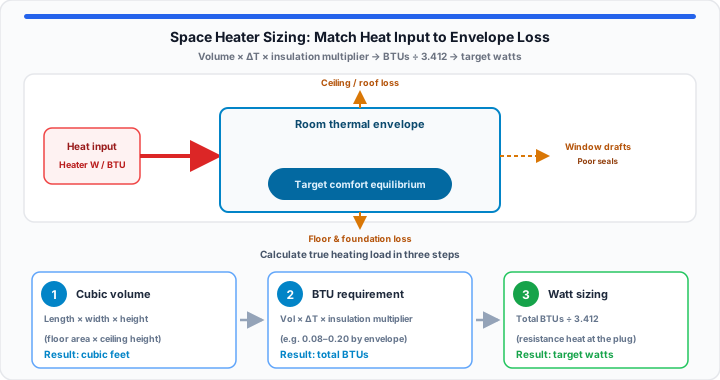
Volume = Length (ft) × Width (ft) × Height (ft)
Next, calculate your base thermal load in British Thermal Units (BTUs). A BTU represents the energy needed to raise the temperature of one pound of water by one degree Fahrenheit.
Heat Load (BTUs) = Volume (cu ft) × Temperature Delta (ΔT) × Insulation Multiplier
Finally, convert your target BTU requirement directly into electric heating power (Watts). Electric resistance heaters convert power to heat at a fixed rate of roughly 3.412 BTUs per watt-hour.
Required Power (Watts) = Heat Load (BTUs) ÷ 3.412
Need a quick unit check? The Watt Converter moves between watts, kilowatts, and BTU per hour when you compare heater nameplates to HVAC specs.
Real-World Example
Suppose you want to heat a 15-foot by 20-foot room with 9-foot ceilings in an older home built around 1980.
- Calculate volume: 15 × 20 × 9 = 2,700 cubic feet.
- Determine ΔT: Indoor target of 70°F minus an outdoor design temperature of 20°F gives a 50°F ΔT.
- Select insulation multiplier: For an older home with original windows and average insulation, use 0.13.
- Calculate BTUs: 2,700 × 50 × 0.13 = 17,550 BTUs.
- Convert to watts: 17,550 ÷ 3.412 = 5,143 watts.
In this scenario, a standard 1,500-watt plug-in space heater will fall significantly short of heating the entire room during extreme winter weather. It can offer localized spot-heating near a chair or desk, but it won’t raise the whole room to 70°F on its own. Recognizing this gap prevents you from returning a perfectly functional 1,500-watt heater thinking it’s defective.
The Insulation Multiplier Matrix
The table below provides empirical insulation adjustment factors to match your building’s structural realities.
| Insulation level | Building characteristics | Multiplier factor |
|---|---|---|
| Poor (uninsulated) | Single-pane windows, uninsulated exterior walls, drafty doors, unheated spaces above/below, pre-1970 construction. | 0.18 – 0.20 |
| Average (moderate) | Double-pane windows, standard fiberglass wall insulation, basic attic insulation, minor weatherstripping wear (1980s–2000s). | 0.12 – 0.14 |
| Excellent (tight) | Modern construction, double/triple-pane Low-E windows, spray-foam or high-R wall/attic insulation, tight air seals. | 0.08 – 0.10 |
Real-World Budgeting: Translating Watts Into Winter Utility Costs
Once you know your target wattage, consider how different heater types handle that draw. Space heaters generally rely on resistance wire, ceramic elements, or oil-filled columns:
- Convection fan heaters: Rapidly warm ambient air, making them great for short bursts, but they shut off completely when target temps are hit.
- Oil-filled radiant radiators: Take longer to warm up, but hold thermal mass over time. Their heating elements cycle on and off while the hot oil continues radiating heat.
- Micathermic panels: Blend radiant and convection heating, providing fast, balanced warmth across medium spaces.
Regardless of the interior design, all electric resistance heaters convert electricity to heat at near 100% efficiency at the plug. A 1,500-watt ceramic heater consumes the exact same amount of electricity as a 1,500-watt oil-filled radiator when running continuously.
The primary difference lies in the duty cycle—how often the unit pulls full wattage from your wall outlet to maintain comfort. Running a 1,500-watt unit for 8 hours a day adds 12 kilowatt-hours (kWh) of daily consumption to your utility invoice.
Before buying that high-draw oil-filled radiator, run its maximum wattage through the Electricity Calculator to project long-term winter consumption patterns and spot utility bill spikes before they land in your mailbox.
Frequently Asked Questions
- Does ceiling height affect space heater sizing?
- Yes, ceiling height significantly impacts space heater performance. Rising heat settles near the ceiling, leaving cold air down where you sit. When heating rooms with ceilings over 9 feet tall, increase your final calculated wattage requirement by 15% to 20% to account for heat stratification, or use a ceiling fan on low in reverse (clockwise) to push warm air back down.
- Can I run two 1,500-watt space heaters on the same room circuit?
- In almost all residential homes, no. A standard residential circuit branch is rated for 15 amps at 120 volts, delivering a maximum continuous capacity of 1,800 watts (using the 80% continuous load safety threshold, that’s 1,440 watts). Plugging two 1,500-watt heaters (3,000 watts combined) into the same circuit will trip the circuit breaker almost instantly. Always operate large space heaters on separate electrical branch circuits. See our Wire Gauge Calculator when you are verifying ampacity on dedicated heater runs.
- Is it cheaper to run a space heater or turn up the central furnace?
- It depends on your primary heat source and home usage patterns. If you spend most of your evening in one room (like a home office or bedroom), lowering your central thermostat to 62°F and running a space heater in that single room (zone heating) usually saves money. However, using multiple space heaters throughout an entire house to replace a central natural gas furnace is almost always far more expensive per unit of heat generated.