
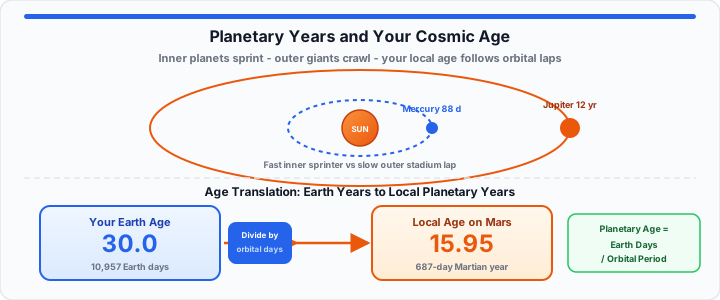
Imagine celebrating your first birthday while attending middle school. On Earth, that sounds completely impossible. On Jupiter, that is actual physical reality. In our observations, space shifts your temporal perspective instantly. A twelve-year-old child on Earth turns one on Jupiter. That same child turns six on dusty red Mars.
Your age depends entirely on planetary orbital physics. When I plot planetary trajectories, human calendars collapse quickly. Think of your birthday as a cosmic lap counter. Each lap around the sun adds one year. Inner planets race around the sun like track sprinters. Outer giant planets walk a massive outer stadium loop. Gravitational forces dictate every single cosmic revolution. Human body clocks rely on Earth rotational cycles. Alien worlds operate under vastly different physical laws. Let us explore the orbital mechanics governing cosmic time.
The Orbital Revolution Constant
To get started, examine how orbital distances dictate year length. A planetary year measures one full lap around the sun. Gravity controls planetary speed according to solar distance. Planets close to the sun experience intense gravitational pull. They must orbit extremely fast to avoid solar destruction. Distance stretches the orbital path into a vast loop. In my astrophysics experience, distance dictates orbital velocity completely. Mercury finishes a full orbit in eighty-eight Earth days. Neptune requires over one hundred sixty-four Earth years.
Calculate your localized cosmic age using this standard equation:
Planetary Age = Earth Age in Days ÷ Planetary Orbital Period in Days
You can verify your cosmic age matrix instantly with our Age on Other Planets Calculator. Enter your birthday or Earth age and see local years on every world. Start from your exact Earth day count with the Age Calculator if you need years, months, and days first.
Keplerian Velocity Multipliers and Solar Gravity
Kepler’s laws of planetary motion define cosmic speeds clearly. The square of orbital period equals the cube of semi-major axis distance:
P² = a³
Variable P represents orbital period measured in Earth years. Variable a represents average distance from sun in astronomical units. A planet’s orbital speed decreases as solar distance increases. Mercury speeds through space at forty-seven kilometers per second. Earth travels at thirty kilometers per second along its orbit. Saturn crawls slowly at nine kilometers per second. This speed variance changes your physical age calculation completely. Inner worlds compress your age into huge numerical totals. Outer worlds stretch your age into small fractional numbers. When I analyze celestial mechanics, Keplerian math never fails.
Elliptical Paths and Orbital Velocity Shifts
Planetary orbits are not perfect symmetrical circles. Kepler proved orbits form slightly stretched elliptical loops. Planets speed up when approaching solar perihelion points. They slow down when reaching distant aphelion points. This orbital speed variance alters daily celestial progress slightly. However, total yearly orbital duration remains strictly constant. In our observations, elliptical variance alters seasonal speeds.
Martian Sol Variables and Rotational Friction
Planetary year length operates independently from daily spin rates. A Martian day, or sol, lasts twenty-four hours thirty-nine minutes. A Martian year requires six hundred eighty-seven Earth days. Daily rotation tracks planetary spin around its own axis. Yearly revolution tracks complete orbital loops around the sun. Confusing daily rotation with orbital revolution creates major errors. In our observations, separating spin from revolution remains vital. A world can spin fast while orbiting very slowly. Jupiter spins completely every ten hours on its axis. Yet Jupiter takes twelve Earth years to finish one orbit.
Quick Check: Enter your birthday in the Age on Other Planets Calculator to see local years on Mercury through Pluto in one table.
The Sidereal Period Variance
Moving onto sidereal physics, calendars must adjust to gravity. A sidereal period measures one true orbit against stars. Earth calendars rely on three hundred sixty-five days. Other planets ignore our artificial human calendar entirely. Venus orbits the sun in two hundred twenty-four days. However, Venus spins backward extremely slowly on its axis. A single day on Venus lasts two hundred forty-three Earth days. Therefore, a day on Venus lasts longer than its year. In my astrophysics experience, Venus breaks normal human intuition.
You should test your custom solar system metrics today. Map out your planetary birthday with this free cosmic age tracking engine.
Jovian Mass and Gas Giant Orbital Mechanics
Jupiter holds massive gravitational influence in our solar system. It sits five astronomical units away from the sun. One Jovian year equals eleven point eight six Earth years. Living on Jupiter means waiting twelve years for birthdays. Gas giant orbits require vast physical space to complete. Their immense orbital circumferences slow down local yearly accumulation. You age much slower in Jovian orbital years. Farther out, ringed Saturn takes nearly thirty Earth years. An entire human career fits inside one single Saturnian year.
Ice Giant Extremes on Uranus and Neptune
Uranus sits nineteen astronomical units from the sun. It requires eighty-four Earth years to complete one orbit. A human lifetime equals just one year on Uranus. Neptune orbits thirty astronomical units from our sun. It takes one hundred sixty-four Earth years per loop. No living human has reached two years old on Neptune. In our observations, deep space ice giants stretch time immensely.
Planetary Orbital Conversion Matrix
| Planet Name | Sidereal Orbital Period (Earth Days) | Age of 10-Year-Old Earth Child | Local Year Length Relative to Earth |
|---|---|---|---|
| Mercury | 87.97 Days | 41.50 Local Years | 0.24 Earth Years |
| Venus | 224.70 Days | 16.25 Local Years | 0.62 Earth Years |
| Earth | 365.25 Days | 10.00 Local Years | 1.00 Earth Year |
| Mars | 686.98 Days | 5.31 Local Years | 1.88 Earth Years |
| Jupiter | 4,332.59 Days | 0.84 Local Years | 11.86 Earth Years |
| Saturn | 10,759.22 Days | 0.34 Local Years | 29.46 Earth Years |
| Uranus | 30,685.40 Days | 0.12 Local Years | 84.01 Earth Years |
| Neptune | 60,189.00 Days | 0.06 Local Years | 164.79 Earth Years |
| Pluto | 90,560.00 Days | 0.04 Local Years | 247.94 Earth Years |
The Real-World Cosmic Age Transformation
In practical environments, converting ages requires precise orbital mathematics. Let us process two realistic diagnostic conversion case studies.
Case Study One: The Active Astronaut (Earth Age 30)
- Base Earth Age Metrics: Exactly 30.0 Earth solar years.
- Converted Earth Lifetime in Days: 10,957.5 total solar days.
- Target World One: The desert planet Mars.
- Martian Orbital Period Divisor: 686.98 total Earth solar days.
- Calculated Martian Local Age: Exactly 15.95 Martian years old.
- Target World Two: The ringed gas giant Saturn.
- Saturnian Orbital Period Divisor: 10,759.22 total Earth solar days.
- Calculated Saturnian Local Age: Exactly 1.01 Saturnian years old.
- Target World Three: The scorching inner world Mercury.
- Mercurian Orbital Period Divisor: 87.97 total Earth solar days.
- Calculated Mercurian Local Age: Exactly 124.55 Mercurian years old.
Case Study Two: The Elementary Student (Earth Age 10)
- Base Earth Age Metrics: Exactly 10.0 Earth solar years.
- Converted Earth Lifetime in Days: 3,652.5 total solar days.
- Target World One: The cloud-wrapped world Venus.
- Venusian Orbital Period Divisor: 224.70 total Earth solar days.
- Calculated Venusian Local Age: Exactly 16.25 Venusian years old.
- Target World Two: The massive gas giant Jupiter.
- Jovian Orbital Period Divisor: 4,332.59 total Earth solar days.
- Calculated Jovian Local Age: Exactly 0.84 Jovian years old.
- Target World Three: The distant ice giant Uranus.
- Uranian Orbital Period Divisor: 30,685.40 total Earth solar days.
- Calculated Uranian Local Age: Exactly 0.12 Uranian years old.
A thirty-year-old Earthling is a teenager on red Mars. That same adult just celebrated their first birthday on Saturn. On Mercury, that adult is over a century old. A ten-year-old child is a sweet sixteen teen on Venus. That same child has not reached age one on Jupiter. In my astrophysics experience, planetary age shifts your whole perspective. Converting your age highlights how unique Earth really is.
Open Age on Other Planets Calculator Open Age Calculator
Frequently Asked Questions
Which planet has the shortest year in our solar system?
Mercury possesses the shortest year in our solar system. It sits closest to the intense gravity of the sun. Mercury completes a full solar lap in eighty-eight Earth days.
How long is a single day on Mars compared to Earth?
A Martian day is remarkably close to an Earth day. One Martian sol lasts twenty-four hours thirty-nine minutes. However, a Martian year takes nearly two Earth years.
Why do outer giant planets take so long to orbit the sun?
Outer giant planets sit vast distances away from solar gravity. Their orbital pathways cover immense spatial circumferences across deep space. Farther planets move slower through space to maintain stable orbits.
Does your physical body age differently on other planets?
Your physical biological aging rate remains completely unchanged in space. Only the calendar numerical count changes based on local orbits. A year represents an astronomical loop, not biological cell decay.
What is the difference between a solar day and a sidereal year?
A solar day measures one complete planetary rotation on its axis. A sidereal year measures one complete orbital loop around the sun. Axis rotation creates days, while orbital revolution creates years.