
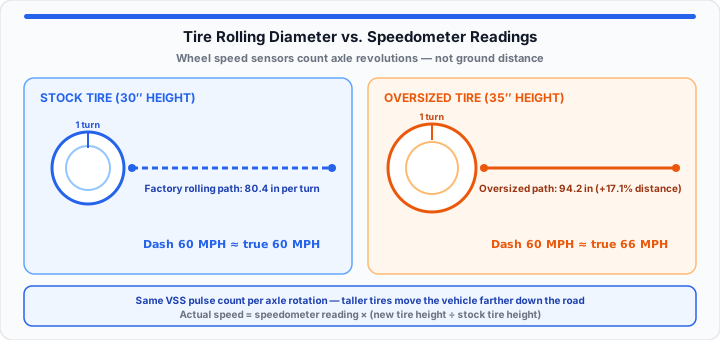
You are cruising down the highway with cruise control set to a lawful 60 MPH on your digital cluster. Out of nowhere, flashing blue lights fill your rearview mirror. You get pulled over, and the officer hands you a ticket for doing 67 in a 60 zone. You swear your speedometer said 60, but you recently bolted an aggressive set of 35-inch off-road tires—or wider low-profile performance rubber—onto your rig. In our shop testing, this exact scenario happens every week to drivers who upgrade their wheels without recalibrating their drivetrain telemetry.
To understand why this happens, picture a standard physical tape measure wrapped around a continuous conveyor belt system. If you take a tiny handheld toy wheel and roll it across a workbench, it has to spin like crazy just to cover a few feet. But if you roll a massive tractor tire across the floor, one single lazy rotation covers a huge distance. Your car’s internal engine computer does not actually watch the road surface passing beneath your frame; it simply counts how many times the vehicle’s axle spins per minute. If you slap a taller rubber ring onto your wheels without telling the vehicle’s computer, the axle covers significantly more pavement per revolution than the factory baseline anticipated—meaning you travel much faster than the needle on your dashboard indicates.
How Wheel Speed Sensors Measure Velocity
Modern vehicles measure road velocity through wheel speed sensors or a vehicle speed sensor (VSS) mounted inside the transmission tailshaft housing. This tone-ring setup measures pulse frequencies generated as the output shaft spins. When your car rolled off the factory assembly line, engineers programmed the engine control unit (ECU) with an unalterable variable: the precise rolling circumference of the original stock tire profile.
When you install aftermarket rubber with a taller overall height, you alter the effective final drive ratio of your drivetrain. Because the outer perimeter of the tire is larger, each complete rotation of the axle carries the vehicle farther down the highway. Because the sensor only tracks shaft rotations rather than ground speed, the speedometer cluster continues to calculate speed based on the smaller stock diameter. When I’m calibrating differential gear sets or troubleshooting speedometer drift on lifted trucks, I often find owners driving 5 to 10 MPH faster than their dashboard display shows simply because they ignored rolling diameter variations.
Manual Tire Height Conversion Calculations
Executing accurate tire height conversion calculations requires translating alphanumeric sidewall codes into physical inches or millimeters. Most metric vehicle tires feature a standardized code stamped directly into the rubber casing (for example, P265/70R17). For inflation and load context before you change sizes, see our PSI to Bar tire pressure conversion guide.
Follow these four steps to calculate overall height manually:
- Extract the section width. The first three digits indicate the tire’s width in millimeters from sidewall to sidewall (e.g., 265 mm). Convert this value to inches by dividing by 25.4.
- Calculate sidewall height. The two-digit number following the slash is the aspect ratio—the sidewall height as a percentage of section width (e.g., 265 mm × 0.70 = 185.5 mm sidewall height).
- Double the sidewall cushion. A complete wheel cross-section includes rubber above and below the center rim, so multiply sidewall height by 2 (e.g., 185.5 mm × 2 = 371 mm total rubber height). Divide 371 mm by 25.4 to yield 14.60 inches.
- Add the wheel rim base. Add the final rim diameter number (e.g., 17 inches) to your total rubber height to determine total outer rolling height (14.60 + 17 = 31.60 inches).
Sidewall Height (in) = (Section Width in mm × Aspect Ratio %) ÷ 25.4
Total Tire Height (in) = Rim Diameter + (2 × Sidewall Height)
Enter stock and target sizes side by side in our Tire Size Calculator to skip hand math on diameter, circumference, and speedometer error percent.
Speedometer Variance Formulas
Once you have determined the outer height dimensions of both tire options, calculate the percentage variance to see how dashboard readings will shift on the highway.
Variance % = ((New Tire Height − Stock Tire Height) ÷ Stock Tire Height) × 100
Actual Vehicle Speed = Speedometer Reading × (1 + (Variance % ÷ 100))
Map any indicated speed through the same ratio with the Speed Calculator when you are converting between mph and km/h for cross-border trips. After installation, log real-world fuel changes with the MPG and fuel economy guide and the Gas Mileage Calculator.
Common Upgrade Scenarios at a 60 MPH Display
The reference grid below illustrates how typical light-truck, SUV, and performance tire upgrades affect true road speed when your cluster holds a steady 60 MPH reading.
| Vehicle application | Original factory size | Upgraded size | Height shift | Speedo error | True speed at 60 MPH display |
|---|---|---|---|---|---|
| Half-ton truck (stock step) | 265/70R17 (31.6″) | 285/70R17 (32.7″) | +1.1″ taller | +3.48% faster | 62.09 MPH |
| Aggressive off-road lift | 265/70R17 (31.6″) | 35×12.50R17 (34.8″) | +3.2″ taller | +10.12% faster | 66.07 MPH |
| Heavy-duty truck conversion | 275/65R18 (32.1″) | 37×12.50R18 (36.8″) | +4.7″ taller | +14.64% faster | 68.78 MPH |
| Sports sedan low-profile | 225/45R17 (25.0″) | 245/40R18 (25.7″) | +0.7″ taller | +2.80% faster | 61.68 MPH |
| Undersized performance track | 245/40R18 (25.7″) | 245/35R18 (24.8″) | −0.9″ shorter | −3.50% slower | 57.90 MPH |
In practical environments, a tire height setup that causes more than a 3% shift from factory specifications usually requires recalibrating your vehicle’s computer to maintain accurate dashboard telemetry.
Beyond the Speedometer: TCM, ABS, and ESC
An inaccurate speedometer is often just the most visible symptom of an uncalibrated tire change. Modern automatic transmissions rely on speed sensor data to execute smooth gear shifts. When you install taller tires without updating the computer, the transmission control module (TCM) receives speed signals that do not align with engine RPM and load parameters.
This mismatch causes transmission “hunting”—where the gearbox constantly shifts back and forth between gears—along with delayed downshifts and harsh engagement. Additionally, anti-lock braking systems (ABS), electronic stability control (ESC), and four-wheel-drive transfer cases use individual wheel speed sensors to detect loss of traction. If your tire sizing strays too far from factory parameters, it can trigger ABS trouble codes or cause stability control systems to engage unexpectedly during normal cornering.
Common Tire Size and Speedometer Questions
How does changing tire size affect speedometer readings on the highway?
Changing tire size alters the overall rolling diameter and circumference of your wheels. Because vehicle speed sensors track shaft revolutions rather than ground movement, installing taller tires covers more distance per rotation than the computer expects. This causes your speedometer to read lower than your true road speed. Conversely, installing shorter tires causes your speedometer to display a speed faster than you are actually traveling.
What is the step-by-step formula to calculate tire height conversion variations manually?
First, calculate sidewall height by multiplying section width in millimeters by the aspect ratio percentage, then divide by 25.4 to convert to inches. Next, double this sidewall value and add the wheel rim diameter to find overall tire height. Finally, calculate the variance percentage by subtracting stock height from new height, dividing by stock height, and multiplying by 100.
Can a tire size increase of just one inch cause a noticeable error on a digital vehicle dashboard?
Yes. Increasing overall tire diameter by just one inch typically introduces a 3% to 4% calculation error into your vehicle telemetry. At highway speeds of 70 MPH, a 4% variance means your actual vehicle speed is roughly 73 MPH, which is enough to register on radar units or affect transmission shift patterns.