
The Radical Negative Trap
Algebra homework causes instant stress. Negative numbers under square roots stop students cold. In my algebraic grading experience, panic sets in quickly. You see a negative sign inside the radical symbol. You assume your entire calculation is completely broken. Do not panic. You just entered the phantom zone of imaginary coordinates.
Think of throwing a basketball toward a hoop. The peak height of the ball is its vertex. The spots hitting the level floor are x-axis intercepts. A short throw never touches the gym floor. It floats in a phantom zone of imaginary coordinates. Think of the quadratic formula as a strict pathfinder tool. It reveals where curves cross straight boundaries. Standard parabolas follow the classic equation y = ax² + bx + c. Solving for zero gives equation x = (−b ± √(b² − 4ac)) ÷ 2a. When the radical holds a negative value, real intercepts disappear. You need clear mathematical rules to navigate these complex curves.
Many students give up at this exact junction. They rewrite their original numbers incorrectly. They assume an imaginary answer is an invalid answer. In reality, complex roots are mathematically complete. They describe symmetric curves that do not touch axes. Understanding this concept elevates your algebraic mastery.
The Discriminant Variance Constant
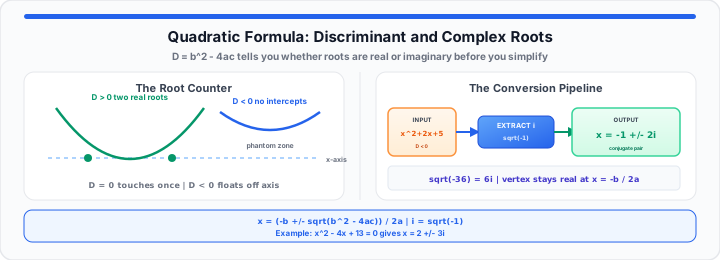
To get started, evaluate the internal radical core first. The term b² − 4ac is the discriminant. We abbreviate this internal core value as D = b² − 4ac. The discriminant acts as a strict trajectory detector. In our classroom testing, D determines overall curve geometry. It dictates whether roots are real or imaginary numbers. A positive discriminant yields two distinct real x-axis intercepts. A zero discriminant places the parabola vertex directly on the axis. A negative discriminant pushes the entire curve off the axis. You can simulate your polynomial roots with our interactive Quadratic Equation Calculator online. Automated tools verify your baseline calculations instantly. You can also verify imaginary unit powers with the Powers of i Calculator on screen. Never skip calculating D before attempting full root evaluation. Finding D early saves time and reduces calculation steps. It prevents confusion during complex radical simplifications.
Review our structural diagnostic lookup table below. This grid maps discriminant outcomes to curve graphing behavior.
| Discriminant Value | Root Type Output | Real Intercept Count | Graphing Behavior |
|---|---|---|---|
| D > 0 | Two Real Roots | 2 Intercepts | Parabola crosses x-axis twice cleanly. |
| D = 0 | One Real Root | 1 Intercept | Vertex touches x-axis at one point. |
| D < 0 | Two Complex Roots | 0 Intercepts | Curve floats entirely above or below axis. |
The Radical Complex Intercept
Moving onto complex algebra, negative radicands require careful handling. When I evaluate raw graphing outputs, errors cluster here. A negative sign under a radical represents an imaginary unit. We define the fundamental imaginary constant as i = √(−1). Never drop the negative sign without adding variable i. For example, simplify the expression √(−36) directly. First, factor out the negative unit as √(36) × √(−1). Next, convert √(36) into the integer six. Finally, append imaginary constant i to yield 6i. This conversion keeps your algebraic system stable and accurate. Neglecting variable i causes severe coordinate alignment drift. You can map out your radical simplifications using the Root Calculator online. You can also test your custom value metrics with the Exponent Calculator to check complex outputs.
Negative Radicand Thresholds
Negative radicands signal that no real roots exist. The solution splits into two conjugate complex numbers. The general complex form appears as x = p ± qi. Term p represents the real offset baseline. Term q dictates the imaginary vertical coordinate multiplier. Both terms are essential for plotting complex polynomial behavior. Omitting either component corrupts the mathematical solution space.
Vertex Axis Lines
The real part p defines the central symmetry axis. Calculus students use this term to locate curve centers. Even when roots are complex, the symmetry axis remains real. The vertex always sits directly on line x = −b ÷ 2a. This horizontal position never shifts into imaginary dimensions. It serves as an anchor for symmetrical curve graphing.
Imaginary Number Modifiers
Complex roots always occur in balanced conjugate pairs. If 3 + 2i is a root, 3 − 2i must exist. This symmetry maintains balanced polynomial coefficient properties. Real polynomials always produce matched complex conjugate pairs. Unmatched imaginary roots indicate a calculation sign error. Cross-check with the Powers of i Calculator when simplifying nested imaginary expressions.
The Coordinate Mapping Audit
In practical environments, accurate parameter extraction prevents graph drift. We analyze leading coefficients to locate critical curve features. Our coordinate mapping protocol isolates central axes and vertices cleanly. Review these key parameter rules for complex parabola evaluation:
- Peak Vertex Horizontal Location: Calculated using h = −b ÷ 2a.
- Peak Vertex Vertical Location: Calculated using k = c − (b² ÷ 4a).
- Vertical Axis Symmetry Line: Defined by equation x = −b ÷ 2a.
- Real Intercept Count: Equals zero when discriminant D < 0.
- Complex Intercept Offset: Calculated using q = √(4ac − b²) ÷ 2a.
- Parabola Opening Direction: Upward when a > 0, downward when a < 0.
- Quadratic Constant Intercept: Y-axis contact point at coordinate (0, c).
Now evaluate a complete sample problem using these rules. Consider polynomial equation x² − 4x + 13 = 0. First, identify leading coefficients a = 1, b = −4, and c = 13. Calculate the discriminant using formula D = b² − 4ac. Substitute numbers: (−4)² − 4(1)(13) = 16 − 52 = −36. The discriminant equals negative thirty-six. This negative value confirms two imaginary complex roots. Next, substitute variables into formula x = (−b ± √D) ÷ 2a. Write the numerator as −(−4) ± √(−36). Simplify the double negative to positive four. Convert √(−36) into complex term 6i. The equation becomes x = (4 ± 6i) ÷ 2. Divide each term by two to simplify. The complex roots are x = 2 + 3i and x = 2 − 3i. Notice how the real offset matches the vertex location. The horizontal vertex coordinate equals x = 2. The imaginary coefficient determines the root elevation offset. Use our Quadratic Equation Calculator to check your work automatically. Fast digital checks keep your homework accurate and stress-free. Need to factor a related expression afterward? Open the Factor Calculator for the reverse direction.
Open Quadratic Equation Calculator Open Powers of i Calculator
Frequently Asked Questions
How do you handle negative square roots in the quadratic formula?
Extract the negative sign inside the square root as unit i. Then calculate the positive square root normally. Combine terms into standard complex form p ± qi.
What does a discriminant of zero tell you about a parabola’s graph?
A zero discriminant means the parabola has one real root. The vertex touches the x-axis at exactly one point. The curve does not cross through the axis.
Can a parabola have both real and imaginary roots simultaneously?
No, a parabola cannot have mixed root types. Quadratic equations yield either two real roots or two complex roots. Single equations never split into mixed root classes.
How do you find the vertex of a parabola with imaginary roots?
Use formula x = −b ÷ 2a for the x-coordinate. Then evaluate original equation y = f(x) for the y-coordinate. The vertex remains real even when roots are imaginary.