
Few kitchen experiences match the sheer panic of waking up on Thanksgiving morning, rolling up your sleeves to prep dinner, and reaching into the refrigerator only to discover your 20-pound turkey feels like a solid block of ice. As guest arrival times creep closer, many hosts resort to desperate measures—running hot tap water over the wrapper or cranking the oven up to 425°F to force heat through the bird. Both choices are major culinary mistakes.
In our kitchen temperature trials, attempting to flash-thaw or rush-roast a massive bird destroys its texture and creates serious food safety hazards. Think of a frozen whole turkey like a thick block of hardwood or an ice sculpture sitting in an insulated chest. Heat cannot instantly teleport into the core. It must transfer slowly through dense muscle tissue millimeter by millimeter. Rushing the exterior with high heat simply scorches the outer breast meat to dry cardboard long before the thermal center drops its icy core.
To serve juicy meat on a stress-free schedule, you need a backwards-planned timeline based on actual thermal mass. When I’m auditing holiday prep timelines, we map out every step from the refrigerator thaw curve down to the final resting minute on the carving board. Map your bird’s exact weight with our Turkey Cooking Time Calculator.
The Thawing Curve: Why Waiting Until Wednesday Kills Your Schedule
The most common failure point in holiday hosting is underestimating refrigerator defrost times. Poultry muscle is roughly 75% water bound inside cellular walls. When frozen, that water locks into a dense lattice that resists rapid temperature shifts.
In my experience handling heavy commercial roasting runs, a standard residential refrigerator set between 37°F and 40°F defrosts poultry at a rate of roughly 4 pounds per 24-hour block. If you buy a 20-pound bird and throw it in the fridge on Wednesday morning expecting to roast it Thursday afternoon, you will end up trying to cook a turkey that is still frozen solid in the center.
Thawing on the kitchen counter at room temperature is equally dangerous. The outer layer of meat warms into the USDA “Danger Zone”—between 40°F and 140°F—where harmful bacteria multiply rapidly, while the interior core remains frozen solid. Safe defrosting requires steady, low-temperature energy transfer inside the refrigerator.
Core rule: Allow 1 full refrigerator day (24 hrs) for every 4 pounds of whole turkey weight. Count thaw days on a calendar with the Day Counter if your grocery pickup date shifts.
Step-by-Step: The Chef’s Method for Manual Roasting Calculations
To calculate your exact roasting schedule without running into late-dinner panics or dry meat, build your timeline backward from your target serving time. Follow these steps:
- Verify your net weight: Read the exact weight on the butcher tag. Do not estimate. A 15.8-pound bird cooks differently than a 14.1-pound bird. If your scale uses kilograms, convert with the Conversion Calculator or our cooking weight conversion guide.
- Calculate base roasting time at 325°F: For an unstuffed bird, multiply the net weight in pounds by 13 to 15 minutes. For a stuffed bird, multiply by 15 to 17 minutes.
- Include the mandatory resting buffer: Add a non-negotiable 30 to 45 minutes for tented resting after the bird comes out of the oven. This allows juices to redistribute and carries the internal temperature through its final rise.
- Account for oven prep time: Add 30 minutes for seasoning, trussing, and letting the bird sit on the counter briefly to take the chill off before roasting.
- Plot the target oven entry time: Subtract your total operational window (prep + roasting + resting) from your planned dinner hour. Stack intervals with the Time Duration Calculator or Time Calculator.
Expressed in simple kitchen math:
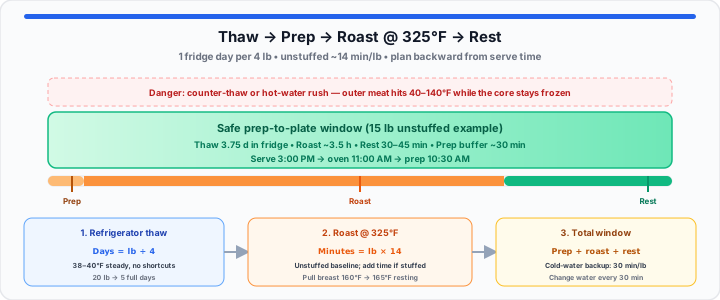
Refrigerator thaw days = total weight in pounds ÷ 4
Unstuffed roasting duration (hours) = (total weight in pounds × 14 minutes) ÷ 60
Total prep-to-table window = prep time (0.5 hrs) + roasting duration + rest period (0.5 hrs)
For example, if you are figuring out how long to cook a 15 lb turkey unstuffed at 325°F, your base cooking calculation runs: 15 lbs × 14 minutes = 210 minutes, or 3.5 hours. Adding a 30-minute rest period and a 30-minute prep buffer brings your total operational window to 4.5 hours. To serve at 3:00 PM, your turkey must enter the oven at 11:00 AM sharp, and your prep work must begin at 10:30 AM.
Instead of manually wrestling with conflicting cookbook charts or running the risk of simple math slips while balancing oven temperatures under holiday stress, you can drop your bird’s exact weight directly into our interactive Turkey Cooking Time Calculator to map your entire preparation timeline instantly.
Open Turkey Cooking Time Calculator Open Time Duration Calculator
Stuffed vs. Unstuffed: The Volumetric Density Shift
Placing bread stuffing inside a turkey cavity changes how heat moves through the bird. Stuffing acts as a dense, absorbent insulation sponge right at the center of the bird.
When hot air circulates in the oven, heat must travel through the outer breast meat and ribs before it can heat the stuffing. To make stuffed turkey safe to eat, the center of the stuffing must reach a minimum internal temperature of 165°F.
Achieving this required temperature adds roughly 15 to 30 extra minutes of total oven time, which often dries out the breast meat. For the best balance of safety and moisture, bake your stuffing in a separate casserole dish and roast the turkey unstuffed with aromatics (like herbs, onion, and garlic) placed loosely in the cavity.
Insert the probe into the thickest part of the breast. Pull at 160°F; carryover heat hits 165°F during rest. Avoid touching the keel bone—bone contact produces a false high reading and leads to undercooked meat.
The Quick Reference Benchmark Sheet: Standard Bird Timelines
To help you plan your timeline, here is a quick reference guide comparing retail turkey weights with their required refrigerator defrost times and unstuffed roasting durations at 325°F:
| Retail bird weight (lbs) | Refrigerator thaw window (38°F–40°F) | Unstuffed roast time @ 325°F | Stuffed roast time @ 325°F | Total operational prep-to-plate window |
|---|---|---|---|---|
| 10 lbs | 2.5 days (60 hours) | 2.25 – 2.5 hours | 2.5 – 3.0 hours | ~3.5 hours |
| 12 lbs | 3.0 days (72 hours) | 2.75 – 3.0 hours | 3.0 – 3.5 hours | ~4.0 hours |
| 15 lbs | 3.75 to 4.0 days (90–96 hours) | 3.25 – 3.75 hours | 3.75 – 4.25 hours | ~4.75 hours |
| 20 lbs | 5.0 days (120 hours) | 4.25 – 4.75 hours | 4.75 – 5.25 hours | ~5.75 hours |
| 24 lbs | 6.0 days (144 hours) | 5.0 – 5.5 hours | 5.5 – 6.0 hours | ~6.5 hours |
Emergency Submersion: The Cold-Water Defrost Protocol
If you miss your refrigerator defrost deadline, use the cold-water submersion method as a safe backup plan.
Keep the turkey sealed in its original, leak-proof factory packaging and submerge it completely in a clean sink or container filled with cold tap water (below 40°F). Calculate 30 minutes of submersion time per pound of turkey weight.
To keep this method safe and prevent bacterial growth, you must change the water every 30 minutes to keep it cold. A 15-pound turkey will defrost in roughly 7.5 hours using this method. Once defrosted, cook the turkey immediately. Use the Online Timer for 30-minute water-change reminders.
Frequently Asked Questions
How long does it take to safely cook a 15 lb turkey in a conventional oven at 325 degrees?
An unstuffed 15-pound turkey takes between 3.25 and 3.75 hours to cook in a conventional oven at 325°F. If the turkey is stuffed, it takes between 3.75 and 4.25 hours. Always verify readiness with a digital thermometer inserted into the thickest part of the breast rather than relying on oven time alone.
What is the exact mathematical rule for calculating turkey thawing time in a refrigerator?
The standard rule for refrigerator thawing is 24 hours of defrost time for every 4 pounds of whole turkey weight in a refrigerator set at 37°F to 40°F. For example, a 12-pound turkey requires 3 full days (72 hours), while a 20-pound turkey requires 5 full days (120 hours).
Why does a scaled turkey timeline require a 30-minute tented resting period after pulling it from the oven?
Resting your turkey loosely tented under foil for 30 to 45 minutes allows muscle fibers to relax and reabsorb juices throughout the meat. Cutting into a hot turkey immediately out of the oven causes juices to run out onto the board, leaving the meat dry. Resting also relies on carryover cooking to safely raise the internal temperature the final 5°F.
How do I know if my meat thermometer is placed correctly to get an accurate reading?
Insert your digital thermometer probe into the thickest part of the breast muscle and the deepest part of the thigh, making sure the probe does not touch bone, cartilage, or fat pockets. Touching bone leads to an inaccurate high reading, causing you to take the turkey out of the oven before the meat is fully cooked. Pull the bird when the internal breast temperature reads 160°F; carryover heat will bring it up to the safe target temperature of 165°F while resting.