
A French macaron batch fails without precise metric accuracy. In my production baking experience, imperial measurements ruin delicate structures. Guessing fractional pounds creates heavy, sunken cake centers. European recipes demand exact metric digital scale readings. One bad cup conversion ruins hydration in sourdough dough. A pound of flour varies by humidity and scoop density. Grams eliminate volume guessing entirely across mixing bowls. We must abandon legacy imperial units for true consistency. Think of your imperial scale as a legacy framework. It holds heavy mass readings needing metric division. Shifting to metric guarantees professional yield every single bake. Precision starts when we convert mass units accurately. Unstable dough structures disappear once you convert cooking weights imperial to metric.
The Base Mass Baseline
Macro Scale Dynamics and Kilogram Anchors
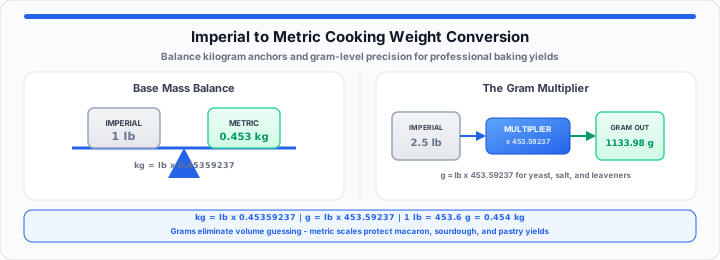
Large dough batches rely on fundamental kilogram baseline metrics. In our kitchen testing, macro conversions stabilize production schedules. One standard imperial pound equals zero point four five three kilograms. The exact mathematical ratio is:
kg = lb × 0.45359237
A heavy one-pound block of butter sits like a brick. Converting that block requires precise metric mass calculation. When I convert flour weights at the pastry bench, precision matters. Small rounding errors compound across large bulk production runs. A ten-pound flour sack becomes four point five three kilograms. Always calculate macro weights before preparing commercial mixers. You must verify your kitchen measurement parameters instantly with the Pounds to Kilograms Converter to avoid batch failure. Bakers can simulate your recipe scaling with our instant pounds to kilograms converter today. Macro tracking prevents costly ingredient waste in commercial bakeries. To get started, benchmark your primary dough formulas in kilograms. Kilogram mass targets keep bulk inventory tracking accurate. Scale shifts protect your profit margins on high-volume production days. Pastry chefs calculate baseline weights before mixing large batches. Bulk dry goods align faster under metric scale standards. Metric baselines simplify recipe expansion across large commercial baking vessels. Master kitchen managers eliminate conversion guesswork before measuring ingredients.
The Granular Sub-Unit Matrix
Micro-Ingredient Density and Gram Conversions
Pastry work requires dropping down to raw gram intervals. Micro-ingredients like yeast, salt, and leaveners demand fine scales. One imperial pound converts to four hundred fifty-three point fifty-nine grams. The exact sub-unit equation is:
g = lb × 453.59237
Shifting to metric is like shredding solid butter into chips. That solid one-pound block breaks down into single-gram pieces. You gain four hundred fifty-four individual single-gram elements of precision. In practical environments, half a pound equals two hundred twenty-seven grams. A quarter pound equals one hundred thirteen point four grams. Moving onto small items, precise gram shifts save delicate batters. Total base product mass dictates final mixture stability. Target batch density requirements force strict gram adherence. Bakers need reliable tool access for exact formulation shifts. You should map out your raw gram data lines using the Pounds to Kilograms Converter now — it outputs both kilograms and grams on every entry. Operators can also test your custom batch options with the Weight Converter during menu development. Single-gram adjustments prevent structural collapse in sensitive egg white foams. Small micro-ingredient shifts alter baking chemistry instantly. Digital gram readings ensure batch consistency across multiple pastry stations. Metric precision elevates simple recipes into award-winning baked goods. Using a pounds to grams kitchen baking scale eliminates guesswork. Professional kitchens rely on digital scales for every recipe test.
Use this recipe conversion chart pound to kilograms lookup grid. It bridges imperial measurements with metric baking requirements quickly. Converting pounds to grams kitchen baking scale numbers saves prep time. Reference these exact values during fast-paced commercial production shifts.
| Imperial Weight (lb) | Kilogram Output (kg) | Gram Equivalent (g) | Flour Cup Estimate | Sugar Pack Estimate |
|---|---|---|---|---|
| 0.25 lb | 0.113 kg | 113.4 g | ~0.9 Cups | ~0.5 Packs |
| 0.50 lb | 0.227 kg | 226.8 g | ~1.8 Cups | ~1.0 Packs |
| 1.00 lb | 0.454 kg | 453.6 g | ~3.6 Cups | ~2.0 Packs |
| 2.00 lb | 0.907 kg | 907.2 g | ~7.2 Cups | ~4.0 Packs |
| 5.00 lb | 2.268 kg | 2268.0 g | ~18.0 Cups | ~10.0 Packs |
The Production Batch Scaling Protocol
High-Volume International Recipe Adjustments
International bakery managers handle overseas dough bills daily. Commercial operations must adjust yield without altering crumb texture. Converting bulk imperial inventory into metric scale configurations stops errors. We analyze raw metrics and project parameters directly below.
- Bulk Flour Base: Fifty pounds equals twenty-two point sixty-eight kilograms.
- Granulated Sugar Mass: Twelve point five pounds equals 5,669.9 grams.
- Butter Fat Content: Five pounds equals two thousand two hundred sixty-eight grams.
- Yeast Active Target: Zero point twenty-five pounds equals one hundred thirteen grams.
- Salt Balance Level: Zero point one hundred twenty-five pounds equals fifty-six point seven grams.
- Total Mix Mass: Sixty-seven point eight seven five pounds becomes thirty point seventy-eight kilograms.
Scaling up requires maintaining exact ratio percentages across ingredients. Imperial fractions create rounding drifts in large batch mixing. A single ounce error distorts overall dough hydration ratios. Metric scaling keeps commercial bakeries profitable and quality consistent. Digital scales prevent human calculation mistakes on high-volume lines. Standardize your entire recipe binder using metric gram units. In practical environments, overseas bakery formulas shift smoothly to metric. Precise conversions protect product texture across scaled batch runs. Pastry chefs calculate ingredient mass before scaling commercial mixers. Metric units remove guesswork from international production schedules. Automated dough production relies on strict metric weight inputs. Scaling batches across international bakeries demands clear metric standards. Cross-check bulk totals with the Conversion Calculator when your production sheet also lists volume or temperature columns.
Open Pounds to Kilograms Converter Open Weight Converter
Frequently Asked Questions
How do you accurately convert pounds to grams for baking?
Multiply your total pound value by four hundred fifty-three point fifty-nine. The exact balance equation is g = lb × 453.59237. Use digital scales for precise measurements.
Why do bakers prefer grams over pounds on a digital kitchen scale?
Grams provide finer granularity without messy fractional numbers. Small baker adjustments require single-gram accuracy for yeast. Imperial pounds lack micro-precision for delicate pastry work.
What is the fastest formula for converting pounds to kilograms?
Multiply the pound mass by zero point four five three five nine. The operational formula is kg = lb × 0.45359237. This conversion handles large dough batches easily.
How do fractional pound weights impact baking hydration percentages?
Imperial fractions introduce rounding errors in liquid calculations. Converting water to grams ensures exact one-to-one milliliter alignment. Metric units guarantee stable sourdough fermentation rates.