
Miscalculating a fraction during batch scaling ruins an entire shift. In our kitchen batch testing, small errors compound fast. One wrong fractional flour measure ruins hundreds of dough pounds. When I calculate blueprint tolerances at the workbench, precision matters. Reading messy tape measure fractions mid-workflow creates extreme stress.
Think of your fraction as a strict physical blueprint. It is a raw division command waiting for processing. A sourdough loaf explains this partition logic clearly. The denominator defines how many equal slices build the loaf. The numerator represents the slices resting on your counter. To get started, review our shop reference conversion matrix below. You can verify your measurement parameters instantly using the Fraction to Decimal Calculator.
The trade conversion reference grid below maps standard shop fractions. Evaluating these decimal and percentage outputs prevents shop calculation errors.
| Trade Fraction | Decimal Output | Percentage Value | Kitchen & Shop Metric Equivalent |
|---|---|---|---|
| 1/8 | 0.125 | 12.5% | 2 tbsp / 0.125 in shim |
| 1/4 | 0.250 | 25.0% | 4 tbsp (1/4 cup) / 0.250 in plate |
| 3/8 | 0.375 | 37.5% | 6 tbsp / 0.375 in stock |
| 1/2 | 0.500 | 50.0% | 8 tbsp (1/2 cup) / 0.500 in bore |
| 5/8 | 0.625 | 62.5% | 10 tbsp / 0.625 in fitting |
| 3/4 | 0.750 | 75.0% | 12 tbsp (3/4 cup) / 0.750 in tube |
| 7/8 | 0.875 | 87.5% | 14 tbsp / 0.875 in bar |
The Numerator Partition Baseline
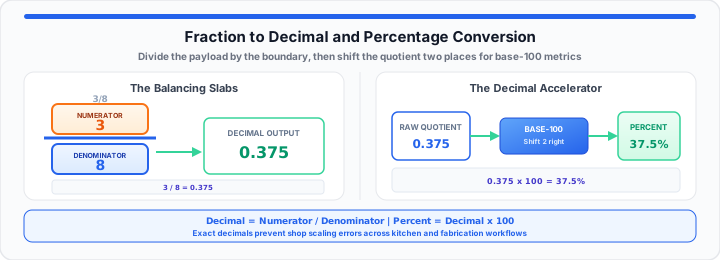
Static ratio analysis governs every material conversion workflow. Division converts fractional partitions into uniform linear decimal scales. The top value acts as your active numerical payload. The bottom value dictates your absolute boundary limit. Dividing the payload by the boundary reveals real unit values. We express this mathematical relationship using clean formula syntax:
Decimal Value = Numerator ÷ Denominator
Moving onto division mechanics, long division extracts exact decimals. Add a decimal point and zeros past the numerator value. Divide the denominator into your new padded numerator string. In my production layout experience, exact decimals prevent layout failures. You can simulate your scaling dimensions with our instant fraction to decimal calculator now.
Division Bar Load Dynamics
The fraction bar represents a literal division operation symbol. It separates available payload parts from total capacity counts. Computational systems process numerators as active dividend inputs. Denominators serve as fixed divisor values during calculations. Unbalanced inputs shift output decimals away from whole units. Standardized decimal outputs streamline automated machine tool code. Digital gauges read decimal values directly without manual translation.
Payload Ratios and Scale Limits
Proper fractions maintain numerators smaller than their denominators. These values always yield decimal outputs below one whole unit. Improper fractions contain numerators larger than their denominators. Their resulting decimal outputs always exceed one whole unit. Mixed numbers combine whole units with remaining fractional parts. Convert mixed numbers to improper fractions before starting division — see our Mixed Fractions vs Improper Fractions guide or use the Mixed Fraction Calculator. Alternatively, add the whole number to the fractional decimal output.
The Base-100 Spectrum Scaling
Percentage targets express decimal values against a base-100 grid. Scaling raw decimals requires shifting digit columns two positions right. This shift locks in your relative percentage metrics cleanly. In our kitchen batch testing, percentages simplify ingredient scaling. Bakers calculate recipe formulas using percentage proportions relative to flour. We define the percentage conversion using this standard formula:
Percentage Target = Decimal Value × 100
In practical environments, percentage shifts streamline material ordering. Multiplying by one hundred aligns shop metrics with standardized scales. You can map out your raw decimal data lines using this free ratio tool with the Percentage Calculator. Be sure to test your custom scaling options with the Fraction Calculator before production runs.
Quotient Digit Column Shifts
Moving decimal points two places right scales base values. The hundredth position becomes your new units percentage column. Thousandth values transition into fractional percentage decimal places. This positional shift preserves underlying mathematical value relationships perfectly. Digital calculation tools eliminate manual decimal shift placement errors.
Absolute Density Metrics
Density ratios determine real material weights across scaled batches. Converting recipe fractions to percentages stabilizes industrial mixing runs. Decimal adjustments prevent costly chemical proportion errors in manufacturing. Consistent percentage scaling guarantees uniform final product quality outputs. Percentage metrics allow direct comparisons between different batch sizes. Track percent change across scaled batches with the Percentage Change Calculator.
The Production Tolerances Workshop
Trade shops require strict conversion standards during active fabrication. Machining blueprints demand exact decimal inputs for CNC programming paths. Commercial kitchens scale bulk recipes using decimal weight factors.
- CNC Tool Path Input: Convert imperial fractions to four decimal places.
- Baker Percentage Baseline: Set flour weight as one hundred percent reference.
- Shim Stock Tolerance: Measure clearance gaps in thousandths of an inch.
- Fluid Volume Scaling: Convert fractional fluid ounces to metric milliliters.
- Rounding Limit Cutoff: Round non-critical dimensions to three decimal places.
- Repeating Decimal Ceiling: Truncate repeating quotients at required shop tolerance.
Machining Precision and Blueprint Rules
CNC mills read decimal coordinates rather than traditional fractions. Entering three-eighths inch requires typing zero point three seven five. A single misplaced decimal digit ruins expensive metal alloy stock. Precision shops enforce strict four-digit decimal conversion standards daily. Fabricators store reference conversion charts directly near workstation equipment.
Culinary Recipe Batch Scaling
Scaling a fifty-portion recipe to five hundred portions requires decimals. Multiplying fractional cups directly leads to severe measurement errors. Converting fractions to decimal pounds ensures accurate ingredient weights. Digital kitchen scales read decimal weights for exact batch consistency. Executive chefs standardize master recipes using decimal weight units.
Repeating Decimal Handling
Some fraction divisions yield infinite repeating decimal strings. One-third produces zero point three three three infinitely repeating. Trade specifications require rounding repeating decimals at specific limits. Machinists round one-third to zero point three three three. Bakers round one-third cup to zero point three three cups. Reverse a rounded decimal back to a fraction with the Decimal to Fraction Converter, or compare two trade fractions side by side with the Butterfly Method vs Common Denominators guide and Fraction Comparison Calculator.
Open Fraction to Decimal Calculator Open Percentage Calculator
Frequently Asked Questions
How do you turn a fraction into a decimal manually?
Divide the top numerator by the bottom denominator using division. Add a decimal point and trailing zeros to the numerator. Continue long division until reaching your desired precision level. The resulting quotient represents your exact decimal value output.
What is a repeating decimal and how do you round it for blueprint math?
A repeating decimal contains digit sequences that repeat forever. One-sixth equals zero point one six six six endlessly. For blueprint math, round to three or four decimal places. Rounding zero point one six six six yields zero point one six seven.
Why do commercial kitchens convert recipe fractions to decimals?
Digital commercial scales weigh ingredients using decimal pounds or grams. Decimals eliminate fractional cup conversion errors during large batch scaling. Percentage-based formulas ensure consistent flavor profiles across large production. Decimal weights speed up prep worker ingredient measuring times significantly.
How do you convert a decimal output into a percentage value?
Multiply the decimal output value by one hundred directly. This operation shifts the decimal point two positions right. Attach a percentage symbol to the final numerical result. For example, zero point seven five becomes seventy-five percent.