
In my advising sessions, nothing causes more immediate student anxiety than staring at a confusing transcript evaluation. You earn a solid ‘A’ in a studio seminar, work hard all semester, and then feel your stomach drop when your cumulative average stays flat—or worse, drops because you pulled a ‘C’ in a massive 5-credit core lecture class. It feels unfair, but it stems from a basic misunderstanding of how registrar systems weigh your academic workload.
Think of your semester credit hours like filling a grocery bag with items of wildly different physical weights. Getting an extra apple—a 1-credit physical education elective—is nice, but dropping it into the bag doesn’t swing the scale nearly as much as dropping a heavy bowling ball, like a 4-credit chemistry lecture with an integrated lab. Your Grade Point Average (GPA) is not a simple tally of the letter marks printed on your report card; it is a balanced distribution of total academic mass.
The Straight-Average Trap: Why Simply Adding Up Your Grades Fails
When students calculate their performance on scratch paper, they almost always fall into the straight-average trap. They add up their letter grade values—say, a 4.0 for Biology, a 3.0 for English, and a 2.0 for a leadership workshop—and divide that sum by three.
In practical environments, this math completely misrepresents your true standing because it treats every course as if it carries the exact same academic weight. A 1-credit seminar demands roughly one hour of classroom time per week, whereas a 4-credit core course demands four times the contact time and carries four times the mathematical leverage on your permanent transcript.
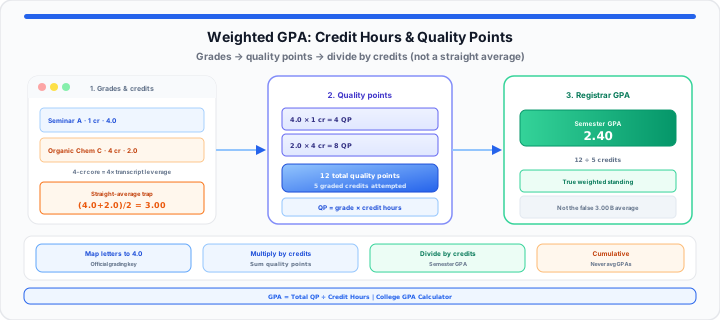
If you get an ‘A’ (4.0) in a 1-credit orientation class and a ‘C’ (2.0) in a 4-credit Organic Chemistry class, a simple straight average falsely tells you your performance is a 3.0 (‘B’). The registrar’s actual weighted calculation reveals a starkly different reality:
Weighted Semester Performance = ((4.0 × 1) + (2.0 × 4)) / (1 + 4) = 12 / 5 = 2.40
That is a massive gap. The heavy 4-credit course pulls your academic standing down toward a ‘C’ far more aggressively than the 1-credit class can pull it up. Compare the 0.60-point swing with the Percentage Calculator when you express how far a false 3.00 sits above the true 2.40 figure.
Step-by-Step: The Registrar Method for Manual GPA Sizing
When I’m auditing graduation transcripts or verifying honors eligibility, our office follows a strict four-step accounting method. To get started calculating your accurate standing across mismatched credits manually, execute this exact sequence:
- Translate letter grades to 4.0 decimal values: Convert every letter mark on your transcript into its standard numerical equivalent using your school’s official grading key—the Letter Grade to GPA Calculator lists common mappings.
- Calculate quality points per course: Multiply the numerical grade value of each course by its assigned credit hour value using Quality Points = Grade Decimal Value × Course Credit Hours.
- Sum your totals: Add up all individual course quality points to find your term total, then add up all graded credit hours attempted across the same period.
- Execute final division: Divide your total quality points by your total graded credit hours using Semester GPA = Total Quality Points / Total Credit Hours Attempted.
Drop your courses into the GPA Calculator or College GPA Calculator to skip column arithmetic and track semester plus cumulative totals in one pass.
The Standard 4.0 Decimal Conversion Metric Sheet
Most universities, scholarship committees, and graduate admissions boards rely on a standard 4.0 grading scale. Use this reference grid to translate your letter marks into decimal values before multiplying against your course credit weights:
| Letter Grade | 4.0 Decimal Value | Standard Percentage Range | Quality Points (3-Credit Course) | Quality Points (4-Credit Course) |
|---|---|---|---|---|
| A+ / A | 4.00 | 93% – 100% | 12.00 | 16.00 |
| A- | 3.70 | 90% – 92% | 11.10 | 14.80 |
| B+ | 3.30 | 87% – 89% | 9.90 | 13.20 |
| B | 3.00 | 83% – 86% | 9.00 | 12.00 |
| B- | 2.70 | 80% – 82% | 8.10 | 10.80 |
| C+ | 2.30 | 77% – 79% | 6.90 | 9.20 |
| C | 2.00 | 73% – 76% | 6.00 | 8.00 |
| C- | 1.70 | 70% – 72% | 5.10 | 6.80 |
| D+ | 1.30 | 67% – 69% | 3.90 | 5.20 |
| D | 1.00 | 63% – 66% | 3.00 | 4.00 |
| F | 0.00 | Below 63% | 0.00 | 0.00 |
Cumulative Scaling: Merging Past Semesters with New Terms Safely
Moving onto long-term academic tracking, calculating a true cumulative GPA requires bridging multiple semesters without falling for mathematical shortcuts. Never average your past semester GPAs together directly. A 3.80 GPA earned during a light 12-credit freshman term does not carry the same mathematical weight as a 2.90 GPA earned during a heavy 18-credit junior term.
Cumulative GPA = (Prior Quality Points + Current Quality Points) / (Prior Attempted Credits + Current Attempted Credits)
In our student success tracking, we regularly see students struggle with special transcript designations like Pass/Fail courses, Withdrawals (‘W’), or repeated classes. Keep these registrar rules in mind:
- Pass/Fail classes: Passing marks award credit hours toward graduation but contribute zero quality points and zero attempted hours to your GPA. Failing a Pass/Fail class, however, often registers as zero quality points across attempted credits depending on institutional policy.
- Withdrawals (‘W’): Official withdrawals recorded before campus deadlines drop off the grade calculation completely, preserving your attempted credit baseline.
- Repeated courses: When you retake a class, most institutions replace the original grade in the cumulative quality point calculation, though the original attempt remains visible on official transcripts.
For course-level weighting inside a single syllabus (not transcript credits), see our guide on computing weighted average grade matrices across unequal assignments. For semester recovery tactics once you know the math, read the Ultimate College GPA Guide.
To keep your academic trajectory clear instead of manually tracking massive multi-column equations on scratch paper or risking a math error that misrepresents your academic standing before an internship deadline, you can drop your semester grades into our interactive GPA Calculator or College GPA Calculator to track your cumulative path instantly.
Open College GPA Calculator Open GPA Calculator
Frequently Asked Questions
How do credit hours affect your overall cumulative GPA calculations?
Credit hours act as mathematical weights that determine how much leverage a single grade exerts on your overall average. High-credit courses (such as 4 or 5-credit core lectures and labs) contribute more total quality points to your cumulative balance than 1 or 2-credit electives, meaning grades in higher-credit classes shift your cumulative GPA more significantly.
Do pass/fail classes or withdrawn courses count toward your grade point average?
In most university registrar systems, courses completed on a Pass/Fail basis or marked with an official Withdrawal (‘W’) do not calculate into your cumulative GPA. Passing grades award degree credit hours without affecting quality points, and official withdrawals remove the course from attempted credit hours entirely. However, failing a Pass/Fail course may count as zero quality points depending on your institution’s specific academic policies.
What is the mathematical difference between a semester GPA and a cumulative GPA?
A semester GPA measures your academic performance strictly across a single term by dividing the quality points earned in those specific months by the credit hours attempted during that same term. A cumulative GPA measures your entire academic history by dividing all quality points earned across all completed semesters by the total number of graded credit hours attempted throughout your enrollment.
How does repeating a course impact your cumulative GPA?
When you repeat a course under a university’s forgiveness policy, the new grade typically replaces the old grade in your cumulative quality point calculation, recalculating your overall average using the updated decimal value. While the original course attempt and grade usually remain visible on your official transcript history, its quality points are removed from your cumulative GPA math.