
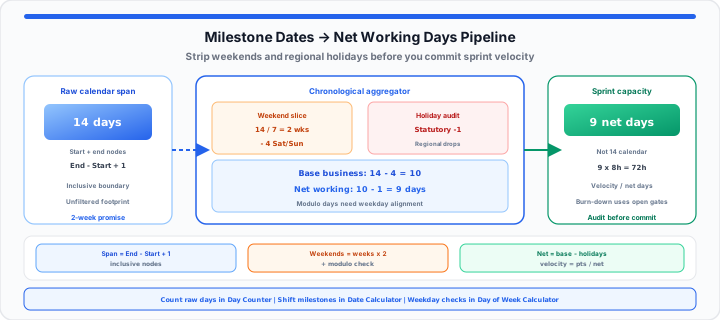
A product manager promises stakeholders a new feature in fourteen days. The client expects production code delivery in two full weeks. Four weekend days and one statutory holiday cut the timeline. The actual development window drops down to nine net days. The delivery pipeline stalls and missed deadline penalties hit hard. In our sprint testing, uncounted weekend overlaps destroy agile velocity. Planning with raw calendar days triggers severe delivery delays across teams.
Think of your development sprint window as a strict asset timeline. Picture your project schedule as a multi-story empty parking garage. Total calendar time represents the physical footprint of the building. Weekends act as locked security gates stopping all incoming traffic. Cars cannot enter or park while those security gates remain locked. Sizing up working days means counting open gate hours only. Your team can park and execute code during active hours.
The Absolute Calendar Baseline
Date Node Boundaries and Temporal Span Metrics
To get started, isolate your raw calendar start and end dates. Raw calendar span measures total elapsed time without operational filters. Subtracting the start date from the end date gives raw days. Start date and end date alignment dictates the initial boundary. Inclusive date counting adds one extra day to your raw span. Exclusive date counting measures elapsed interval hours between boundary nodes. When I plot code shipping velocity at the desk, precision matters. Unfiltered calendar spans inflate capacity calculations during early sprint planning. Engineers must isolate active work days from passive calendar time. Uncounted non-working days distort project burn-down charts during active sprints.
Proper baseline metrics establish accurate timeline expectations for senior executives. Project leads track milestone boundaries to protect engineering team capacity. Inconsistent date boundaries create friction between developers and product managers. Clear baseline tracking eliminates guessing during high-stakes client roadmap reviews. Precise start and end dates establish predictable milestone boundaries across teams. Historical milestone data improves capacity forecasting for subsequent product sprints. Clean date inputs protect sprint velocity calculations from artificial calendar noise. Always verify your baseline sprint metrics instantly with our Day Counter before committing code. Scrum teams can scan milestone pathways on the online Calendar and shift delivery dates with the Date Calculator.
Raw Calendar Span = Target End Date − Initial Start Date + 1
Sprint Capacity = Raw Calendar Span × Daily Developer Hours
Leap Year Adjustments and Annual Boundary Drift
Leap years add one extra day to February every four years. Ignoring leap year adjustments shifts long-term project delivery roadmaps unexpectedly. Multi-month milestones spanning February require precise leap year calendar tracking. System clocks shift automatically across standard leap year boundary conditions. Manual spreadsheet models often fail to capture this February shift. Tracking multi-quarter epics requires exact calendar boundary alignment across years. Leap day additions alter net business days inside Q1 release schedules. System architects account for February twenty-ninth during annual planning cycles. Automation tools recalculate long-term delivery targets when leap years occur. Verifying leap year logic keeps software deployment roadmaps completely accurate. Use the Date Calculator to add whole years across February boundaries and confirm the returned weekday with the Day of the Week Calculator.
The Non-Production Weekend Exclusion
Base-7 Numerical Reduction and Weekend Slicing
Moving onto weekend filtering, standard weeks follow base-7 cycles strictly. Every full seven-day block contains exactly two non-production days. Dividing raw calendar days by seven reveals total full weeks. Multiply full week counts by two to find baseline weekend drops. The remaining modulo days require manual day-of-week alignment checks. A five-day span starting on Thursday crosses a weekend boundary. That short five-day span contains only three active business days. In my production project management experience, weekend overlaps sink releases. Failing to account for Saturday and Sunday inflates capacity expectations. Development teams burn out trying to match uncalibrated delivery estimates.
Rigid deadline commitments collapse when weekend gaps remain unaccounted for. Skipping weekend extraction skews resource allocation models in multi-team organizations. Software delivery roadmaps align better when weekend exclusions are applied upfront. Burn-down charts reflect true team productivity when weekend gaps are removed. Isolating net working days provides actionable data for sprint retrospectives. Engineers must map out your chronological parameters using this free timeline tracking engine today. Agile coaches can test custom sprint metrics across changing start dates to see whether modulo days land on Saturday or Sunday.
Full Weeks = Raw Calendar Span ÷ 7
Base Business Days = Raw Calendar Span − (Full Weeks × 2)
Velocity Constraints and Capacity Normalization
Velocity measures completed story points per net active business day. Including weekend days distorts story point velocity calculations significantly. A team completing thirty points over ten net days averages three. Counting fourteen calendar days lowers calculated velocity to two point one. Distorted velocity metrics cause poor capacity forecasts for future sprints. Normalizing capacity against net business days keeps sprint estimates accurate. Predictable velocity calculations depend on strict business day isolation models. Accurate capacity planning builds team confidence across multi-sprint product releases. When you translate net days into engineer hours, multiply by your daily focus window and cross-check long spans in the Time Duration Calculator.
| Raw Calendar Interval | Standard Weekend Drops | Net Working Days | Sprint Estimation Impact |
|---|---|---|---|
| 7 Calendar Days | 2 Days | 5 Net Days | Standard 1-week sprint allocation window |
| 14 Calendar Days | 4 Days | 10 Net Days | Typical 2-week agile sprint capacity |
| 30 Calendar Days | 8 Days | 22 Net Days | Standard monthly milestone release window |
| 60 Calendar Days | 16 Days | 44 Net Days | Multi-sprint quarterly epic delivery target |
The Statutory Pipeline Holiday Audit
Regional Holiday Parameters and Distributed Team Outages
In practical environments, statutory holidays disrupt development cadence across regions. Distributed software teams operate across multiple international public holiday calendars. A US holiday stops domestic code reviews while offshore engineers work. An offshore holiday halts feature development while US teams test. Auditing regional holiday calendars prevents unexpected mid-sprint delivery blockages. Cross-referencing regional outage dates yields true active development capacity. Subtracting holiday drops from net business days forms your delivery window. Engineering managers map global holidays before finalizing quarterly project commitments. Unscheduled holiday outages create severe bottlenecks in continuous integration pipelines. Proactive holiday tracking protects team delivery commitments across international jurisdictions.
Offshore Coordination and Resource Allocation
Offshore development teams require distinct regional holiday calendar audits regularly. Aligning offshore working schedules with onshore release dates prevents pipeline stalls. Resource availability drops significantly during regional holiday festival periods worldwide. Scrum masters reallocate task assignments when offshore teams observe local holidays. Cross-regional scheduling alignment ensures uninterrupted code deployment pipelines continuously.
- Raw Calendar Interval: 30 total elapsed days across milestone dates.
- Full Week Extraction: 4 full weeks equals 8 excluded weekend days.
- Modulo Day Check: 2 remaining days contain 0 weekend overlaps.
- Base Business Days: 22 active business days before statutory checks.
- Regional Holiday Drops: 2 regional holidays fall on business days.
- Net Working Slabs: 20 net working days available for engineering.
- Adjusted Sprint Velocity: 60 story points divided by 20 days.
- Net Daily Output: 3 completed story points per working day.
Net Working Days = Base Business Days − Statutory Holiday Drops
Adjusted Velocity = Planned Story Points ÷ Net Working Days
Contractors who bill by the day should pair net working-day math with split-shift billable hour aggregation so client invoices match sprint calendars.
Open Day Counter Open Date Calculator
Frequently Asked Questions
How do you calculate the exact number of working days between two dates?
Subtract start date from end date for total calendar days. Divide calendar days by seven to find full calendar weeks. Multiply full weeks by two to subtract standard weekend days. Subtract any statutory holidays falling on active business days.
Why does missing regional holidays skew agile velocity metrics?
Uncounted holidays reduce available working days inside sprint windows. Teams appear underperforming when planned velocity misses raw calendar targets. Tracking net working days keeps team velocity metrics steady and realistic.
How do leap years impact long-term project timeline calculations?
Leap years add one extra calendar day in February automatically. Long-term epics crossing February receive one additional working day option. Failing to account for leap years skews milestone completion targets.
What is the difference between elapsed days and net business days?
Elapsed days count every calendar day between two date nodes. Net business days exclude weekends and active regional statutory holidays. Engineers use net business days to calculate realistic software capacity.