
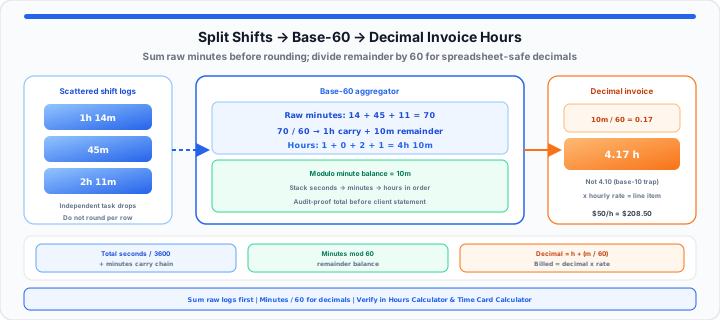
A remote contractor completes six scattered task drops today. The notebook records random time segments across client projects. The entries read 1h 14m, 45m, and 2h 11m. At month end, the contractor guess-rounds these entries. They estimate total project time for client invoices. The client questions mismatched numbers on the line item statement. An invoice dispute halts payment for three weeks. The contractor loses revenue through uncollected billable minutes. In our billing tracking tests, manual estimation fails consistently. Loose estimates trigger billing leakage across independent contractor accounts. Fragmented schedules strain tracking spreadsheets and mental math limits.
Think of your split shifts as independent cash buckets. Isolated temporal units wait to be consolidated backwards cleanly. Fragmented daily time blocks resemble loose liquids in mismatched glasses. Splashing water blindly between cups loses track of true volume. Routing time logs through a base-60 compiler creates order. It funnels each separate shift into a marked beaker. That structure locks down your true earnings weight accurately.
The Sexagesimal Time Anchor
Modulo Remainder Constraints and Base-60 Aggregation
To get started, isolate your raw shift entries into base units. Time tracking relies on the base-60 sexagesimal numerical system. Standard financial software operates on base-10 decimal systems instead. Mixing base-60 tracking logs with base-10 billing systems creates friction. Sixty seconds form one complete, billable minute unit. Sixty minutes form one full, consolidated billable hour block. When I reconcile scattered shift segments at the desk, I stack units.
First, sum all recorded raw seconds across your daily logs. Divide total seconds by sixty to extract whole added minutes. Second, sum all recorded raw minutes including carried values. Divide total minutes by sixty to extract consolidated whole hours. The remainder value becomes your final modulo minute balance. Third, sum all recorded raw hours plus carried hour blocks. This calculation produces an audit-proof, error-free total project time. Always verify your baseline billing metrics instantly before drafting client statements. Contractors can convert your split shifts with our quick Time Calculator or run the full day total in the Time Card Calculator.
Total Billable Hours = (Total Seconds ÷ 3600) + (Total Minutes ÷ 60) + Total Hours
Modulo Minute Balance = Total Raw Minutes Modulo 60
For a single clock span before you stack rows, the Hours Calculator converts start and end times to decimal hours. When a block crosses midnight or spans two calendar dates, switch to the Time Duration Calculator so elapsed time stays tied to real timestamps.
The Fractional Base Conversion
Minute-to-Decimal Multipliers and Positional Divisors
Moving onto spreadsheet entries, raw minutes require decimal conversion. Typing 4h 30m as 4.30 into spreadsheets ruins invoice billing calculations. Financial software interprets 4.30 as four hours and eighteen minutes. That error shortchanges your billed time by twelve full minutes. Multiply total converted decimal hours by your hourly billable rate. Dividing raw minutes by sixty yields the true decimal equivalent. Fifteen minutes equals exactly zero point two five hours. Thirty minutes equals exactly zero point five zero hours. Forty-five minutes equals exactly zero point seven five hours. Messy minute totals require precise base-60 positional division operations.
In my contract invoicing experience, accuracy protects client trust. Unbillable overhead gaps creep in when contractors round numbers too early. Always sum raw base-60 totals before applying decimal conversion formulas. You can map out your chronological parameters using this free billing calculation engine directly. Independent contractors should test custom spreadsheet metrics to prevent revenue loss. Pair decimal hours with the Percentage Calculator when you need to split a fixed retainer across multiple clients or projects.
Decimal Multiplier = Minutes ÷ 60
Total Billed Amount = (Consolidated Hours + Decimal Multiplier) × Hourly Rate
| Raw Shift Minutes | Positional Divisor | Decimal Hour Output | Sample Billing Rate ($50/hr) |
|---|---|---|---|
| 14 Minutes | 14 ÷ 60 | 0.233 Hours | $11.67 |
| 15 Minutes | 15 ÷ 60 | 0.250 Hours | $12.50 |
| 22 Minutes | 22 ÷ 60 | 0.367 Hours | $18.33 |
| 30 Minutes | 30 ÷ 60 | 0.500 Hours | $25.00 |
| 45 Minutes | 45 ÷ 60 | 0.750 Hours | $37.50 |
| 47 Minutes | 47 ÷ 60 | 0.783 Hours | $39.17 |
The Production Invoice Audit Protocol
Itemizing Fluctuation Task Chains
In practical environments, virtual assistants track fragmented workflows daily. Morning, afternoon, and evening blocks create complex billing records. Consolidating erratic task drops protects revenue and client clarity. A complete audit protocol prevents client invoice disputes entirely.
- Morning Shift Block: 1 hour 24 minutes recorded on client tasks.
- Midday Shift Block: 0 hours 42 minutes spent reviewing project files.
- Late Afternoon Block: 2 hours 18 minutes spent drafting deliverables.
- Raw Minute Summation: 24m + 42m + 18m equals 84 total minutes.
- Base-60 Hour Extraction: 84 minutes yields 1 hour plus 24 minutes.
- Raw Hour Consolidation: 1h + 0h + 2h + 1h carried equals 4 hours.
- Final Decimal Output: 4 hours 24 minutes converts to 4.40 hours.
Applying a sixty-dollar hourly rate yields $264.00 total earnings. Pristine itemization stops client pushback before invoices get sent. Consistent audit logs build long-term trust with key agency clients. Rebuild the same three-row day in the Time Card Calculator, then cross-check the decimal in the Hours Calculator before you send the PDF. For 1099 contractors who bill hours and owe quarterly tax, see our Side-Hustle Tax Guide for 1099 Remote Freelancers and 1099 Tax Recovery & Planning Playbook.
Open Hours Calculator Open Time Card Calculator
Frequently Asked Questions
How do you calculate total billable hours from minutes accurately?
Sum all raw minutes from your split shift tracking logs first. Divide total minutes by sixty to convert them into hours. The whole number represents hours, while the remainder represents minutes. Divide remainder minutes by sixty to obtain the exact decimal value.
Why does rounding individual split shifts skew freelancer invoicing metrics?
Rounding each short shift individually compounds artificial time additions. It inflates client totals or accidentally reduces your actual billable work. Sum all raw exact minutes before applying rounding rules at invoice time.
How do you convert minutes to decimal hours for billing spreadsheets?
Divide your total accumulated minute balance directly by sixty. For example, divide forty-two minutes by sixty to get 0.70 hours. Enter 0.70 into your spreadsheet to multiply by your hourly rate.
What is the difference between base-60 time logs and base-10 billing?
Time logs track sixty seconds per minute and sixty minutes per hour. Billing systems calculate financial payout metrics using standard base-10 decimals. Converting base-60 minutes to base-10 decimals ensures accurate client invoicing.