
There is a distinct mental exhaustion that comes from staring at a smartphone tracking app every night, logging every single leaf of spinach, and starving on tiny dinner portions—only to step on the bathroom scale the next morning and see the exact same number staring back at you. When progress stalls, the knee-jerk reaction is almost always to slash food intake even further. Yet, cutting your food down to severe, starvation-level calories rarely speeds up fat loss. Instead, it leaves you tired, moody, and losing precious lean muscle tissue while your body stubbornly holds onto stored fat.
The key to escaping this cycle is shifting your mindset from emotional food restriction to precise energy management. Think of your body like a high-efficiency hybrid vehicle on a long cross-country drive. Your Basal Metabolic Rate (BMR) represents the fuel the idling engine burns just to power the battery, dashboard sensors, and cabin heater while parked in your driveway. Your activity multiplier represents the extra gasoline pulled from the fuel tank when you step on the accelerator pedal to climb steep mountain highways. If you panic and cut off the fuel supply entirely, the car’s central computer forces the vehicle into an emergency limp mode to prevent catastrophic engine failure.
Learning how many calories should I eat to lose weight requires establishing your engine’s true baseline before pulling back fuel. When you calculate daily calorie deficit boundaries using proven metabolic formulas, you give your body enough energy to protect active tissue while forcing it to burn stored body fat for the remainder of its daily energy needs. Run the numbers with our Calorie Calculator.
The Idling Engine Trap: Why Blind Caloric Restriction Crashes Your Metabolism
In our metabolic rate tracking tests, the single most common mistake chronic dieters make is dropping their daily intake directly below their baseline idling speed. When you feed a 170-pound adult 1,100 calories per day, you are asking their body to run vital internal organs—brain function, cardiac output, kidney filtration, and cellular repair—on a severe deficit before they even take a single step out of bed.
When I’m restructuring client nutrition plans after a severe diet crash, we regularly diagnose the physical fallout of adaptive thermogenesis. When caloric intake remains below your biological floor for weeks at a time, your thyroid down-regulates hormone production, your core body temperature drops slightly, and your brain subtly suppresses spontaneous physical movement (like fidgeting or pacing). Worse yet, your endocrine system begins converting muscle tissue into usable glucose via gluconeogenesis to keep your brain fueled. You end up lighter on the scale, but with a softer composition and a significantly lower metabolic capacity than when you started.
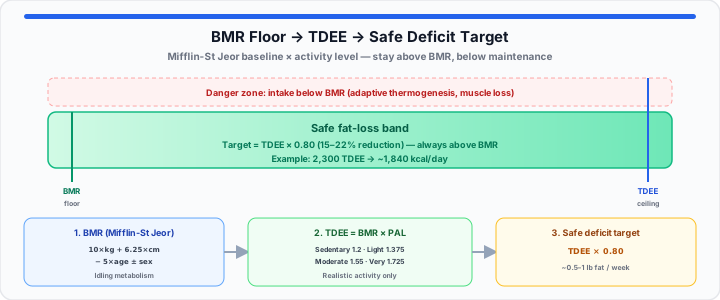
Total Daily Energy Expenditure (TDEE) = Idling Baseline (BMR) + Acceleration Burn (Activity Multipliers)
Estimate your idling baseline with the BMR Calculator and full maintenance burn with the TDEE Calculator.
Step-by-Step: The Underwriter’s Method for Manual TDEE Sizing
To establish a safe, sustainable caloric reduction that strips fat without dragging down your metabolic rate, use this step-by-step calculation method:
- Calculate Your Biological Base (BMR): Use the Mifflin-St Jeor equation to establish your exact idling energy requirements based on lean weight, total height, age, and sex.
- Apply Your Real-World Motion Factor: Multiply your baseline BMR by a realistic Physical Activity Level (PAL) scalar to establish your Total Daily Energy Expenditure (TDEE).
- Establish Your Fat-Loss Target Band: Subtract a controlled percentage (15% to 22%) from your calculated TDEE. This creates a sustainable caloric gap that forces your body to burn stored body fat for fuel.
- Verify Your Safe Caloric Floor: Check your final daily target against your baseline BMR. Your target daily calories must always sit safely above your BMR to protect baseline metabolic function.
Expressed in mathematical terms, these core metabolic formulas run as follows:
Daily BMR (Men) = (10 × weight in kg) + (6.25 × height in cm) − (5 × age in yrs) + 5
Daily BMR (Women) = (10 × weight in kg) + (6.25 × height in cm) − (5 × age in yrs) − 161
Baseline TDEE = Calculated BMR × Activity Multiplier
Safe Deficit Target = Baseline TDEE × 0.80 (20% Energy Reduction)
Keep your daily calorie target inside the green zone—above your BMR floor and below your TDEE ceiling.
To avoid manually calculating nested macro brackets on a scratchpad or running the risk of simple math slips while planning your weekly meal prep under a tight schedule, you can drop your weight metrics directly into our interactive Calorie Calculator to map out your structural fat-loss deficit instantly.
Size Your Deficit in One Pass: Enter age, height, weight, and an honest activity level in the Calorie Calculator —BMR, TDEE, and a safe deficit target update together from the same Mifflin-St Jeor baseline as the BMR Calculator.
Pinning the Multiplier: Why Most Gym-Goers Overestimate Activity Levels
In my experience breaking through weight plateaus, incorrect activity multipliers cause more calculation errors than any other variable. Most people overestimate how active they truly are throughout the day.
If you work a desk job for eight hours and lift weights for 45 minutes four days a week, your biological baseline is “Lightly Active” (a multiplier of 1.375), not “Very Active” (1.725). Classifying a sedentary desk job as highly active adds 300 to 500 phantom calories to your baseline calculation, completely erasing your target calorie deficit.
To keep your calculations accurate:
- Sedentary (1.2): Desk job, minimal walking, under 4,000 steps per day, no structured exercise.
- Lightly Active (1.375): Desk job with 5,000 to 7,000 daily steps plus 3 days of moderate exercise.
- Moderately Active (1.55): Active job (on your feet) or desk job with 10,000+ daily steps and 4–5 regular training sessions.
- Very Active (1.725): Physical labor job (construction, farming) plus heavy daily training sessions.
Cross-check structured workout burn with the Calories Burned Calculator and read our guide on daily activity versus intense workout burn so PAL choices stay realistic.
The Weight Management Matrix: Finding Your Deficit Bracket
To help you choose the right caloric reduction for your current starting point, review the decision framework below. These target tiers outline baseline metrics for a 170-pound individual with a baseline TDEE of 2,300 calories:
| Deficit Level & Strategy | Daily Energy Reduction | Daily Calorie Intake Target | Target Weekly Fat Loss | Primary Use Case & Profile |
|---|---|---|---|---|
| Conservative Trim (10–12% Drop) | −230 to −275 kcal | 2,025 – 2,070 kcal | 0.5 lbs / week | Lean individuals under 12% (men) or 20% (women) body fat looking to keep performance high. Cross-check composition with the Body Fat Calculator. |
| Moderate Baseline (18–20% Drop) | −415 to −460 kcal | 1,840 – 1,885 kcal | 1.0 lbs / week | The Gold Standard. Optimal balance of steady fat loss, high energy, and muscle retention for most lifters. |
| Aggressive Phase (25% Drop) | −575 kcal | 1,725 kcal | 1.25 to 1.5 lbs / week | Higher starting body fat levels; recommended for short 3-to-4-week fat loss phases only. |
Open Calorie Calculator Open TDEE Calculator
Frequently Asked Questions
How many calories should I drop from my baseline TDEE to ensure safe weekly weight loss?
A safe, sustainable calorie drop is 15% to 20% below your baseline Total Daily Energy Expenditure (TDEE). For most moderately active adults, this creates a manageable daily energy deficit of 300 to 500 calories, which yields approximately 0.5 to 1.0 pound of fat loss per week without causing muscle loss or metabolic adaptation.
What is the biological difference between my basal metabolic rate and my total daily energy expenditure?
Your Basal Metabolic Rate (BMR) is the minimum amount of energy your body burns at complete rest to keep your heart, lungs, brain, and internal organs functioning. Your Total Daily Energy Expenditure (TDEE) includes your baseline BMR plus all additional calories burned through daily physical movement, walking, working, digesting food, and structured exercise.
How can you tell if your daily calorie deficit is too aggressive for your current body weight?
Key signs of an excessively aggressive deficit include persistent brain fog, continuous muscle soreness that takes days to recover, loss of strength in the gym, disrupted sleep patterns, and feeling constantly cold. If your daily caloric intake drops below your calculated BMR, raise your food intake immediately to protect your thyroid and preserve lean muscle mass.
What should you do when your scale weight plateaus during a structured caloric deficit?
Before slashing your calories further, average your daily morning scale weight over a full 14-day window to confirm a true plateau. If your average weight remains flat for two consecutive weeks, increase your daily step count by 1,500 to 2,000 steps per day or drop your daily calorie target by a modest 100 to 150 calories. Monitor your body composition for another two weeks before making additional changes. Log trends with our weight loss graphing guide and pair scale data with the BMI Calculator for context.