
Standing next to a hospital bed or reviewing a complex home care regimen, reading a prescription label filled with precise milligram-per-square-meter figures can feel intimidating. When someone you care for requires high-stakes therapy—whether chemotherapy agents, intravenous immunosuppressants, or pediatric cardiac drugs—every single digit matters. Feeling anxious when trying to verify these technical medical metrics is entirely normal. A common question naturally arises: why does the clinical team calculate a spatial measurement instead of simply relying on the weight recorded on the scale?
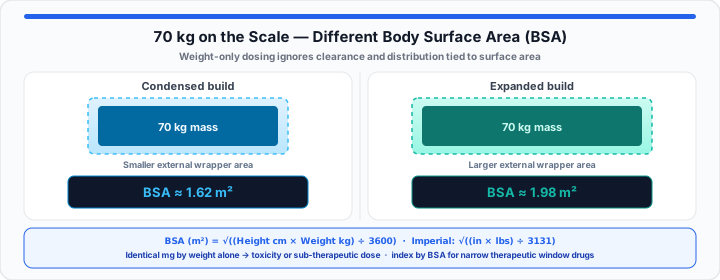
In my experience managing therapeutic indexing metrics, relying strictly on total body mass introduces significant clinical misalignments. Think of your body’s surface boundary layer as a custom-tailored, protective physical suit wrapper. If you pack two completely different containers with the exact same 70-kilogram weight—one filled with heavy, ultra-dense steel parts and the other filled with sprawling, lightweight sheets of corrugated cardboard—the exterior wrapping paper required to shield each container will be entirely mismatched.
Human physiology follows this exact spatial principle. Two individuals can step onto a clinic scale and weigh the exact same 70 kilograms, yet possess vastly different surface boundary areas and metabolic clearance profiles. When administering narrow-therapeutic-window compounds where the boundary between treatment efficacy and severe toxicity is extremely slim, calculating the active biological square meters—your Body Surface Area (BSA)—is what ensures the drug distributes and clears safely across the body.
In our clinical pharmacology testing, we consistently observe that biological fluid clearance, cardiac output, and renal filtration rates correlate far more accurately with total skin surface boundary area than with raw gravitational weight. Adipose tissue, lean skeletal muscle mass, and vascular fluid volumes process active pharmacological agents at markedly different speeds. If a practitioner doses a narrow-therapeutic-index drug strictly by weight, an individual with a higher proportion of adipose tissue risks receiving a dangerous toxic overdose, while a tall, lean patient risks receiving an ineffective sub-therapeutic dose. For kidney-related clearance context, cross-check estimated filtration with the GFR Calculator; for how total mass alone can mislead screening, see our BMI and healthy weight milestones guide.
Clinical impact: Dosing both profiles with identical milligrams based only on scale weight causes severe toxicity or treatment failure.
The Mosteller BSA Formula: Four Manual Steps
While medical literature contains several mathematical formulas—including the DuBois, Haycock, and Gehan-George equations—the Mosteller method serves as the primary global standard in clinical practice. It delivers an optimal balance between mathematical simplicity and high biometric precision. Learning how to calculate body surface area manually using the standard BSA formula medical baseline allows caregivers and clinicians to audit prescription charts with complete confidence. The Body Surface Area Calculator runs Mosteller alongside DuBois, Haycock, Gehan-George, and Boyd for side-by-side verification.
In practical environments, manual extraction of a patient’s biological square meters follows four direct operational steps:
- Gather precise metric baseline inputs: Measure height in exact centimeters (cm) and weight in exact kilograms (kg). Confirm that the recorded weight reflects true dry baseline mass rather than acute fluid retention.
- Multiply height and weight inputs: Multiply the height value directly by the weight value to establish the preliminary product anchor.
- Apply the fixed clinical divisor (3,600): Divide the preliminary product obtained in step 2 by the constant mathematical baseline divisor of 3,600.
- Extract the square root: Take the square root of the quotient from step 3. The resulting decimal value represents the patient’s body surface area in square meters (m²).
Expressed cleanly in standard clinical typography, the Mosteller formula is structured as:
BSA (m²) = √((Height in cm × Weight in kg) / 3600)
To illustrate this workflow, let’s process a chart validation for an adult patient measuring 172 cm in height and weighing 68 kg:
- First, multiply height by weight: 172 × 68 = 11,696.
- Next, divide by the constant baseline: 11,696 / 3,600 = 3.2488.
- Finally, calculate the square root: √3.2488 = 1.802 m².
Standard metric Mosteller pipeline—designed for clinical double-checking.
Verify in one pass: Enter height and weight in metric or imperial units in the Body Surface Area Calculator to see Mosteller BSA plus alternate clinical formulas and a step-by-step breakdown.
Metric vs Imperial Units and Conversion Factors
When you are cross-checking patient charts under stress or evaluating urgent clinical orders, performing multi-step square-root operations manually creates unwanted cognitive strain and risks calculation errors. Instead of manually wrestling with complex nested square-root multipliers on a scratchpad or running the risk of dangerous decimal slips while checking crucial medical charts under family stress, you can pass your raw metrics straight into our interactive Body Surface Area Calculator to verify your clinical metrics instantly.
When I’m cross-checking patient charts across mixed EHR systems, unit conversion oversight is a frequent cause of dosing discrepancies. The primary Mosteller formula requires height in centimeters and weight in kilograms. Inputting height in inches or weight in pounds directly into the standard metric equation skews the final surface calculation significantly.
To maintain calculation accuracy, convert imperial raw measurements using these fixed conversion factors before executing the formula steps:
- Converting height: Multiply height in inches by exactly 2.54 to determine total centimeters (e.g., 66 inches × 2.54 = 167.64 cm).
- Converting weight: Divide weight in pounds by 2.2046 to determine total kilograms (e.g., 150 lbs / 2.2046 = 68.04 kg).
In practical environments where imperial units are recorded natively, you can utilize the modified imperial Mosteller equation directly:
BSA (m²) = √((Height in inches × Weight in lbs) / 3131)
Notice that the baseline constant divisor changes from 3,600 to 3,131 to adjust for imperial unit factors. Verifying that your constant divisor matches your measurement units prevents critical calculation errors.
Reference BSA Profiles (Mosteller Method)
To assist caregivers, healthcare personnel, and nursing students in validating patient values, the reference table below outlines standard biometric profiles from infant to adult stages, showing corresponding body surface area values derived from the Mosteller method.
| Patient Profile Category | Reference Height (cm / in) | Reference Weight (kg / lbs) | Target Body Surface Area (m²) | Clinical Focus & Dosing Application |
|---|---|---|---|---|
| Newborn / Infant | 50 cm (19.7 in) | 3.5 kg (7.7 lbs) | 0.22 m² | Critical fluid management; pediatric BSA indexing required to prevent fluid overload. |
| Toddler (2 Years) | 88 cm (34.6 in) | 12.5 kg (27.6 lbs) | 0.55 m² | High weight-to-surface velocity; sensitive to high-potency anti-infective dosing. |
| Child (9 Years) | 135 cm (53.1 in) | 30.0 kg (66.1 lbs) | 1.06 m² | Baseline marker for pediatric oncology protocols and biological clearance indexing. |
| Adolescent / Small Adult | 155 cm (61.0 in) | 50.0 kg (110.2 lbs) | 1.47 m² | Transition point between pediatric standardized scaling and adult clinical tables. |
| Average Adult Female | 163 cm (64.2 in) | 65.0 kg (143.3 lbs) | 1.72 m² | Standard outpatient reference point for pharmacological trials and therapeutic dosing. |
| Average Adult Male | 176 cm (69.3 in) | 78.0 kg (171.9 lbs) | 1.95 m² | Historical benchmark value utilized in traditional adult medical dosing tables. |
| Large / Tall Adult | 190 cm (74.8 in) | 95.0 kg (209.4 lbs) | 2.24 m² | Expanded distribution volume; prevents underdosing in intensive care therapies. |
When reviewing a patient’s care plan against these benchmark targets, keep in mind that individual anatomical differences alter final results. To eliminate manual error risks when verifying prescriptions, use our on-page Body Surface Area Calculator to run custom height and weight pairings in real time. For composition context beyond total mass, pair results with the Body Fat Calculator and Lean Body Mass Calculator.
Open Body Surface Area Calculator Open BMI Calculator
Frequently Asked Questions
Why do clinicians calculate body surface area instead of using scale weight alone?
Two people can weigh the same yet differ in surface area, vascular volume, and drug clearance. For narrow-therapeutic-window therapies, dosing by BSA in square meters aligns better with cardiac output, renal filtration, and distribution than weight alone.
What is the Mosteller body surface area formula?
In metric units: BSA (m²) = √((Height cm × Weight kg) / 3600). With imperial inputs: BSA (m²) = √((Height in × Weight lbs) / 3131).
How do you convert height and weight before using the metric Mosteller equation?
Multiply height in inches by 2.54 to get centimeters. Divide weight in pounds by 2.2046 to get kilograms. Alternatively, use the imperial Mosteller equation directly with inches and pounds and the 3131 divisor.