
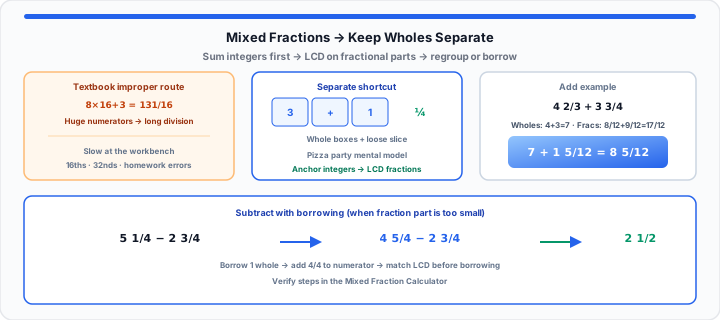
If you have ever tried to cut a board to 8 3/16 inches at the workbench or helped a child with middle school math homework, you know the frustration of traditional fraction rules. Standard textbooks almost always teach the same rigid routine: turn every mixed number into an improper fraction, find a huge common denominator, perform the addition or subtraction with massive numerators, and then do long division at the end to turn it back into a mixed number.
When I am calculating dimensions at the workbench or breaking this down for students, that classic method feels needlessly slow and ripe for mental arithmetic errors. Multiplying 8 by 16 and adding 3 just to subtract a tiny fraction creates bloated numbers like 131/16.
There is a cleaner, more practical shortcut that lets you add and subtract mixed fractions by keeping whole numbers and fractional parts separate.
Think of a mixed fraction like ordering pizza for a party. A mixed number like 3 1/4 represents three whole pizzas still sitting inside their original cardboard boxes, plus one loose quarter-slice sitting on a side plate. If you want to figure out how much pizza is left at the end of the night, you would not pull every single whole pizza out of its box, chop them all into tiny quarter-slices, throw them into a giant pile, count 13 individual slices, and then try to pack them back into boxes. You leave the whole boxed pizzas stacked on the table and simply handle the loose slices first.
Why Keep Whole Numbers Separate?
Converting mixed numbers into improper fractions forces you to work with unnaturally inflated numerators. When denominators are small—like halves or thirds—the mental strain is minimal. But in practical environments like woodworking, carpentry, sewing, or advanced algebra, denominators frequently stretch into 16ths, 32nds, or uncommon multiples like 12ths and 15ths.
Keeping whole numbers separate serves as a mathematical anchor. It splits one complex problem into two simple sub-tasks: combining whole integers and combining partial fractions.
By keeping the whole units separate from the fractional remainders, you eliminate three entire steps of long-form multiplication. Instead of risking a basic arithmetic error while converting massive numerators in your head, you can plug your numbers into our Mixed Fraction Calculator to instantly check your work or handle complex project measurements on the fly. When denominators disagree, the LCM Calculator prints the lowest common denominator you need for the fractional row.
How to Add Mixed Fractions in 3 Direct Steps
Adding mixed fractions without converting them to improper form follows a clear, logical sequence. You work with the whole values first, resolve the fractions second, and recombine everything at the end.
To get started, follow these three sequential steps:
- Add the whole numbers together: Extract the integer values from both mixed numbers and sum them up immediately. Set this number aside as your baseline whole total.
- Find a common denominator for the fractions: Match the denominators of the fractional parts using the Lowest Common Denominator (LCD). Add the updated numerators while keeping the common denominator intact.
- Regroup and combine: If your fractional sum results in a value smaller than 1, simply attach it to your whole number baseline. If the fraction sum turns into an improper fraction (greater than 1), convert that fractional portion into a whole number plus a remainder, then add the new whole number to your running total.
Let’s look at an example: 4 2/3 + 3 3/4.
First, take the whole numbers and add them: 4 + 3 = 7.
Next, handle the fractional remainders: 2/3 + 3/4. The smallest number both 3 and 4 divide into evenly is 12.
Convert each fraction to match denominator 12:
- 2/3 becomes 8/12 (by multiplying top and bottom by 4)
- 3/4 becomes 9/12 (by multiplying top and bottom by 3)
Now add the fractional parts together: 8/12 + 9/12 = 17/12.
Notice that 17/12 is greater than 1. Convert 17/12 into a small mixed number: 1 5/12.
Finally, combine your original whole number sum with your new regrouped value: 7 + 1 5/12 = 8 5/12.
| Calculation step | Action taken | Result |
|---|---|---|
| 1. Whole number baseline | Combine integer units (4 + 3) | 7 |
| 2. Fractional LCD matching | Scale denominators of 2/3 and 3/4 to 12 | 8/12 + 9/12 |
| 3. Fraction addition | Add scaled numerators | 17/12 |
| 4. Regrouping | Convert improper fraction remainder | 1 5/12 |
| 5. Final combination | Add baseline whole to regrouped value (7 + 1 5/12) | 8 5/12 |
The Tricky Part: Subtracting and the Art of “Borrowing”
Subtraction works smoothly using this separated approach—until you run into a problem where the second fraction is larger than the first.
For instance, consider trying to evaluate 5 1/4 − 2 3/4.
Subtracting the whole numbers gives 5 − 2 = 3. But when you turn to the fractions, you are asked to calculate 1/4 − 3/4. In standard arithmetic, taking 3 away from 1 yields a negative number. This single hurdle is why many teachers abandon the mixed approach and force students back into improper fraction conversions.
However, you can solve this easily without converting the entire expression into massive improper fractions. You simply borrow 1 whole unit from your starting whole number, exactly as you would borrow a ten when subtracting standard multi-digit numbers like 52 − 17.
Here is how borrowing breaks down step by step:
- To recalculate 5 1/4, reduce the whole number 5 by 1, turning it into 4.
- Take that borrowed 1 unit and express it as a fraction using your target denominator (in this case, 4). One whole unit equals 4/4.
- Add that 4/4 to your existing fraction of 1/4. Your starting fraction now becomes 5/4.
Your restructured calculation looks like this: 4 5/4 − 2 3/4.
Now subtract each part directly:
- Subtract the whole numbers: 4 − 2 = 2
- Subtract the fractions: 5/4 − 3/4 = 2/4 (which simplifies to 1/2)
- Combine your remaining values: 2 1/2
When you are making multiple angled cuts on project materials, applying this quick regrouping shortcut keeps your workspace notes clear. If you ever run into a tricky problem while working through multi-step measurements, our Mixed Fraction Calculator offers instant step-by-step verification so you can confirm your borrowed numerators in seconds. For a visual introduction to mixed versus improper forms, see Mixed Fractions vs Improper Fractions: A Parent’s Guide.
Troubleshooting Uncommon Denominators Fast
Moving onto problems where denominators do not match and borrowing is required, handling steps in the correct order prevents total confusion.
In my experience breaking this down for students, the most common mistake is attempting to borrow before finding a common denominator. Always adjust your fractions to match common denominators first. Only check if borrowing is required after both denominators match.
Consider this scenario: 7 1/6 − 3 3/8.
First, identify the Lowest Common Denominator for 6 and 8. The smallest number both divide into is 24.
Scale both fractional parts to match denominator 24:
- 1/6 scales up to 4/24 (multiplying top and bottom by 4)
- 3/8 scales up to 9/24 (multiplying top and bottom by 3)
Rewrite the initial problem with matching denominators: 7 4/24 − 3 9/24.
Now inspect your numerators: you cannot subtract 9 from 4 directly. It is time to borrow 1 whole unit from the 7.
Reduce 7 to 6. Convert the borrowed 1 into 24/24, and add it to your existing numerator: 24/24 + 4/24 = 28/24.
Your problem is now rewritten as: 6 28/24 − 3 9/24.
Execute the final subtraction:
- Whole numbers: 6 − 3 = 3
- Fractions: 28/24 − 9/24 = 19/24
Your final answer is 3 19/24. Reduce when helpful using the GCF Calculator, or cross-check decimal equivalents with the Fraction to Decimal Calculator. When you only need to compare two mixed values without combining them, the Butterfly Method vs. Common Denominators guide pairs well with the Fraction Comparison Calculator.
Open Mixed Fraction Calculator Open Fraction Calculator
Frequently Asked Questions
What do you do if the fractional part becomes an improper fraction after adding?
Convert the improper fractional portion into a small mixed number, then add its whole number component back to your whole integer sum. For example, if adding your fractions results in 8 + 5/4, convert 5/4 into 1 1/4, then combine the whole numbers to get 9 1/4.
How do you borrow from a whole number when subtracting mixed fractions?
Reduce the starting whole number by 1, convert that 1 into a fraction where the numerator matches the denominator (such as 8/8 or 16/16), and add it to your starting fraction numerator. This creates a temporary improper fraction attached to a smaller whole number, allowing you to subtract cleanly.
Is it always faster to avoid improper fractions, or are there exceptions?
Keeping whole numbers separate is significantly faster for addition, subtraction, and practical measurement tasks where denominators are large. However, when multiplying or dividing mixed fractions, converting to improper form first remains the standard and most reliable mathematical route—use the Fraction Calculator for those operations.
Can you add or subtract three or more mixed fractions at once using this method?
Yes. Group all whole numbers together first to get your base total. Next, find a shared Lowest Common Denominator across all fractional parts, calculate the combined numerator sum or difference, and then regroup any resulting improper fractions back into your primary integer total.