
Parsing raw packet headers manually creates severe mental fatigue. You inspect a raw firewall hex dump
during incident response. The source IP string appears as 0x0A000001. What decimal IP
address does this hex string represent? In our staging tests, manual math slows active threat hunting.
Think of hexadecimal as shorthand code for computers. It condenses long binary traffic streams into compact pairs. Security analysts must convert these values without delay. For ASIC error registers and frame-drop flags, see our hex error code to binary guide. You can decode raw header metrics instantly with our IP Address Converter.
The 32-Bit Octet Architecture
An IPv4 address contains thirty-two total binary bits. Routers split this bit stream into four discrete eight-bit octets. Think of an IP as a four-part shipping warehouse barcode. Each barcode section gets compressed into a tiny two-character code. This compression speeds up packet conveyor sorting wheels inside routers. When I analyze raw packet captures, octet boundaries dictate alignment.
Network hardware processes binary data in fixed bit widths. An eight-bit byte aligns perfectly with modern CPU registers. Thirty-two bits allow over four billion unique address combinations. Understanding this architecture helps engineers troubleshoot deep packet drops. Subnet masks also rely on these exact bit boundaries — see our IP address to binary guide, Subnet Mask beginner guide, and IP Subnet Calculator.
Dot-Decimal Boundaries
Dot-decimal notation exists purely for human readability. Computers never read dot-decimal strings natively inside silicon memory. Network interface cards parse raw binary contiguous blocks instead. To get started, break dot-decimal values into four separate integers. Each integer ranges strictly from zero to two hundred fifty-five. Separating these integers allows clean bitwise shifts in software code. Invalid integers cause application sockets to throw immediate errors. Proper validation prevents memory corruption in custom socket programs. You can parse your networking pathways with our quick IP Address Converter.
Octet Bit Limits
Each eight-bit block maxes out at eight active binary ones. Eight active binary ones equal decimal two hundred fifty-five. In base-16 math, two hundred fifty-five equals hex pair FF. Therefore, two hex characters perfectly represent one single octet. Four octets map cleanly into eight total hexadecimal characters. Zero represents the absolute lowest value in an octet. Hexadecimal pair 00 corresponds to eight binary zeroes. Fixed character counts streamline machine parsing algorithms in firewall engines. For bit-level practice, try the Binary Calculator.
| Dot-Decimal Integer | 8-Bit Binary Script | 2-Character Hex Pair |
|---|---|---|
| 10 | 00001010 | 0A |
| 127 | 01111111 | 7F |
| 168 | 10101000 | A8 |
| 192 | 11000000 | C0 |
| 255 | 11111111 | FF |
Quick decode: Paste 0x0A000001 or 10.0.0.1 into the
IP Address Converter to see decimal, hex, and
binary side by side.
The Hexadecimal Radix Shift
Moving onto conversion mechanics, base-16 uses sixteen unique digits. Digits include zero through nine and letters A through F. Letters A through F represent decimal values ten through fifteen. Base-16 allows single-word memory alignment inside router hardware tables. In my production routing experience, hex speeds up memory lookup tables. Hardware lookup engines perform ternary content-addressable memory searches faster. Binary conversion to base-16 requires zero floating-point arithmetic operations. Bitwise shifting operators execute in a single CPU clock cycle. This efficiency keeps core internet routers running at wire speed.
Base-16 Positional Indexing
Hexadecimal relies on powers of sixteen for positional weighting. The rightmost position holds a weight of sixteen to power zero. Moving left increases the exponential weight by powers of sixteen. Two hex characters combine to form an eight-bit byte value. Position zero equals sixteen to the power of zero. Position one equals sixteen to the power of one. This exponential structure makes large numbers easy to write. Engineers avoid typing cumbersome thirty-two-character binary strings. You can check your packet boundaries with this free conversion tool.
Mathematical Radix Formulas
Calculating a full hex IP requires positional weight multiplication. Multiply each octet by its respective sixteen power index. Combine all four weighted products to find the final hex integer.
Total Hex Value = (Octet1 × 16⁶) + (Octet2 × 16⁴) + (Octet3 × 16²) + Octet4
In practical environments, this equation yields a single consolidated integer. For example, address
10.0.0.1 maps directly to 0x0A000001. Octet one holds the most significant byte position.
Octet four holds the least significant byte position. Engineers can
test your hex address variables to verify
calculation accuracy in the converter.
The Wireshark Raw Packet Blueprint
Firewall logs often expose raw hex bytes without dot-decimal formatting. Intrusion detection systems dump raw frame byte arrays to disk. I inspect packet capture headers directly at byte offset fourteen. Byte offset fourteen marks the start of the IPv4 header block. Source IP addresses occupy byte offsets twenty-six through twenty-nine. Destination IP addresses occupy byte offsets thirty through thirty-three. Security analysts read these byte offsets during live triage operations. Recognizing raw address offsets isolates malicious payloads rapidly. Malformed header length fields often indicate active buffer overflow attacks.
Let us analyze a raw byte stream from a suspicious capture:
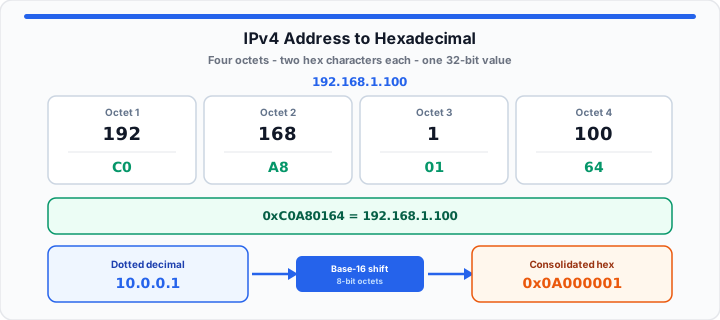
- Frame Byte Offset 26: 0xC0 (Decimal 192)
- Frame Byte Offset 27: 0xA8 (Decimal 168)
- Frame Byte Offset 28: 0x01 (Decimal 1)
- Frame Byte Offset 29: 0x64 (Decimal 100)
- Target Source Address: 192.168.1.100
- Consolidated Hex String: 0xC0A80164
Reading raw hex directly exposes spoofed attack vectors quickly. Security operations center analysts must master this hex identification skill. Automated scripts rely on exact byte offsets for filtering malicious frames. Byte parsing speed determines response times during active ransomware outbreaks. Manual inspection validates whether security orchestrators perform correctly. For related byte-level encoding work, see our corrupted character recovery guide.
Open IP Address Converter Open IP Subnet Calculator
Frequently Asked Questions
How do you read a hexadecimal IP address in packet captures?
Locate the IP header offset within the raw hex frame. Extract the eight hex characters representing source or destination addresses. Divide the eight hex characters into four two-character pairs. Convert each two-character hex pair back into a decimal integer.
Why does 255 translate to FF in networking hex math?
Hex character F represents the decimal integer value fifteen. The left position holds a positional weight of sixteen. Multiply fifteen by sixteen to obtain two hundred forty. Add the right position value of fifteen to get 255.
Why do firewall logs display IP addresses in hexadecimal format?
Hexadecimal saves valuable log storage space and processing cycles. Binary memory dumps align naturally with sixteen-bit and thirty-two-bit boundaries. Hex representation removes variable string lengths caused by dot-decimal notation. Compact fixed-length strings improve database indexing speeds across large SIEM systems.
What is the hexadecimal equivalent of loopback address 127.0.0.1?
Decimal 127 converts directly to hexadecimal value 7F. Decimal zero converts directly to hexadecimal pair 00. Decimal one converts directly to hexadecimal pair 01. The complete consolidated loopback hex string is 0x7F000001.