
If you have ever had to compare two fractions like 4/7 and 5/9 in a hurry, you know the tradeoffs: careful steps versus a shortcut. Students and teachers debate whether to use the classic common denominator approach or the Butterfly Method (cross-multiplication). Here is a practical side-by-side view of both—and when each shines.
What is the common denominator method?
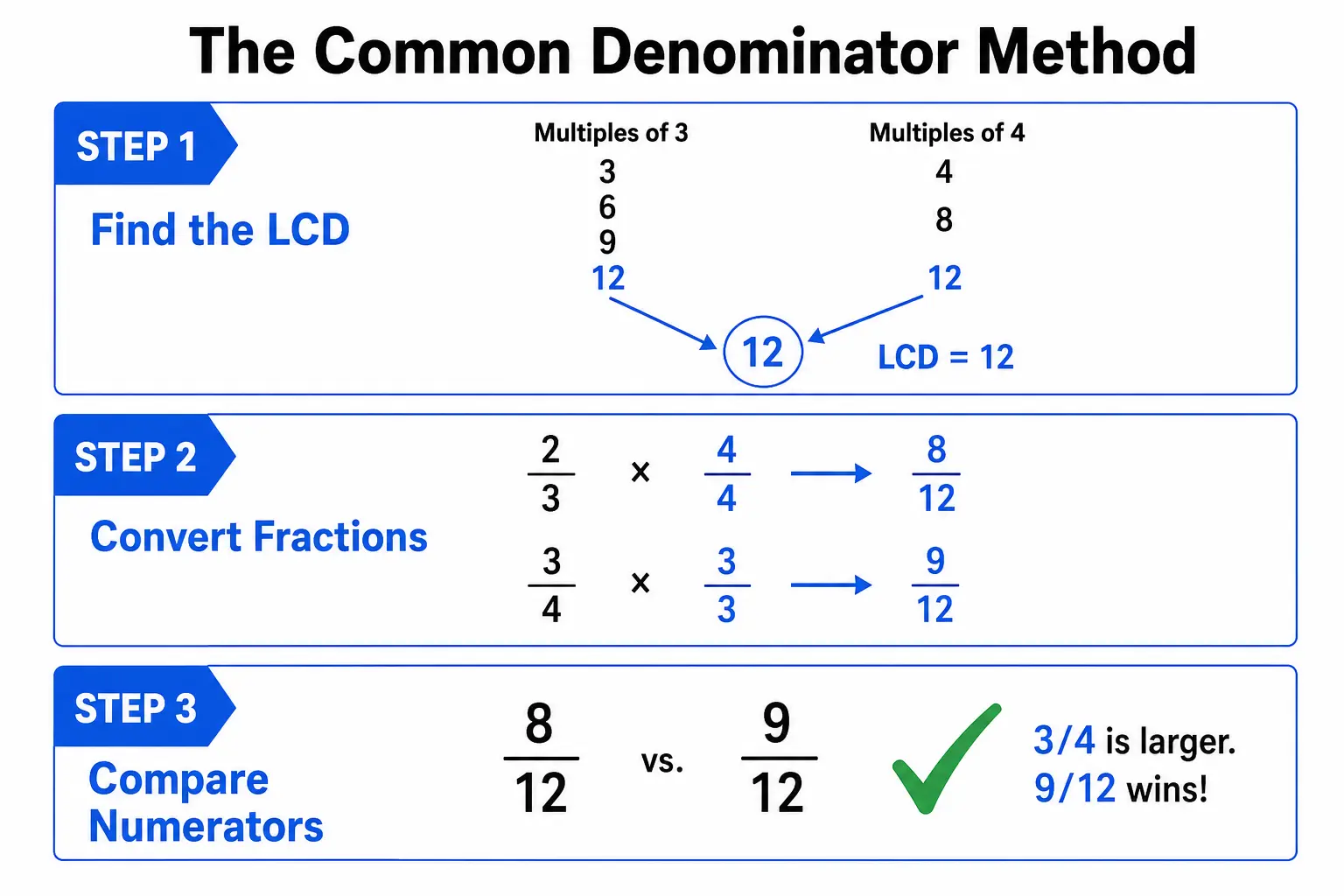
This is the standard textbook route: make denominators match, then compare numerators.
How it works
- Find a number both denominators divide into (often the least common multiple).
- Rewrite both fractions with that shared denominator.
- Compare the numerators; the larger top number belongs to the larger fraction.
Example: compare 2/3 and 3/4.
- The common denominator for 3 and 4 is 12.
- 2/3 becomes 8/12.
- 3/4 becomes 9/12.
- 9 is greater than 8, so 3/4 > 2/3.
Verdict: Excellent for accuracy and for working with several fractions, but it usually takes more steps and notation.
What is the Butterfly Method? (The shortcut)
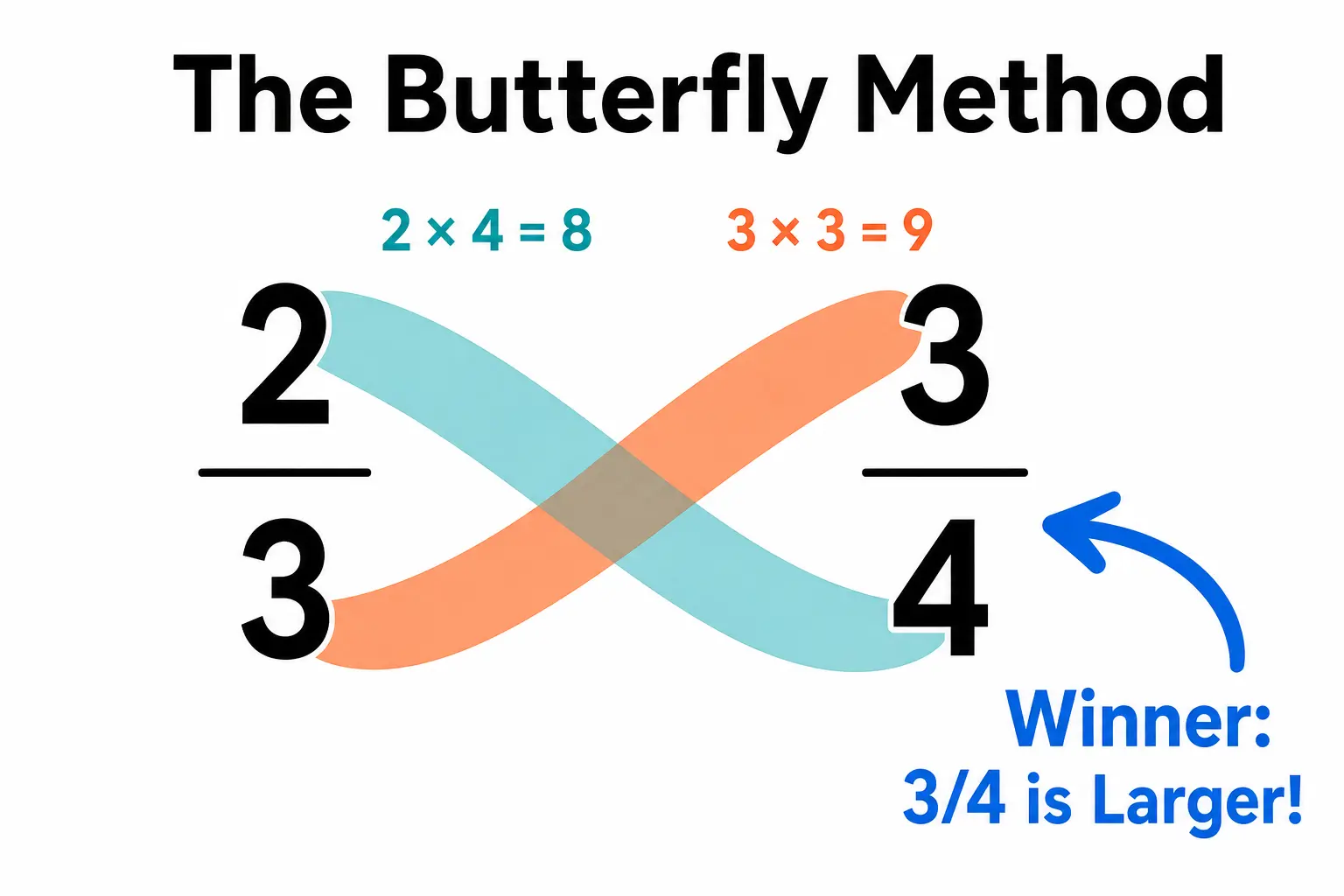
Also called cross-multiplication, the Butterfly Method is a fast visual trick for comparing two fractions without finding a common denominator first.
How it works
- Draw an oval from the left numerator to the right denominator; multiply those two numbers.
- Draw another oval from the right numerator to the left denominator; multiply those two numbers.
- Compare the two products. The side with the larger product is the larger fraction (when both fractions are positive).
Example: compare 2/3 and 3/4.
- Left “wing”: 2 × 4 = 8.
- Right “wing”: 3 × 3 = 9.
- 9 is greater than 8, so 3/4 wins.
Verdict: Very fast for exactly two fractions—great for timed checks and multiple-choice practice.
The showdown: which is actually better?
| Feature | Common denominator | Butterfly Method |
|---|---|---|
| Speed | Slower (multiple steps) | Fast (two multiplications) |
| Best for | Comparing three or more fractions | Comparing two fractions |
| Understanding | Shows the why | Delivers the answer quickly |
| Difficulty | Medium | Easy |
When to use common denominators
Use this when the assignment asks you to show equivalence clearly, or when you will add or subtract fractions next—it reinforces how sized pieces line up.
When to use the Butterfly Method
Use it when you only need which fraction is larger right away—quick homework checks, contests, or verifying a gut feeling.
Compare fractions without the stress
Either route is easy to slip up on by hand. RapidRatio’s Fraction Comparison Calculator shows decimals and common-denominator thinking side by side so you can double-check in seconds.
Why use the tool?
- See decimals and structured reasoning together.
- High-precision arithmetic reduces stray rounding surprises.
- Side-by-side layout makes size differences obvious.
Open Fraction Comparison Calculator
Frequently asked questions
- Does the Butterfly Method work for mixed numbers?
- Yes, but convert them to improper fractions first to avoid confusion.
- Is the Butterfly Method “cheating”?
- No—it is a condensed version of the common denominator idea and is mathematically sound when applied correctly to positive fractions.
- What is the fastest way to compare 1/2 and 1/3?
- When numerators are both 1, the fraction with the smaller denominator is larger—so 1/2 is bigger than 1/3.