
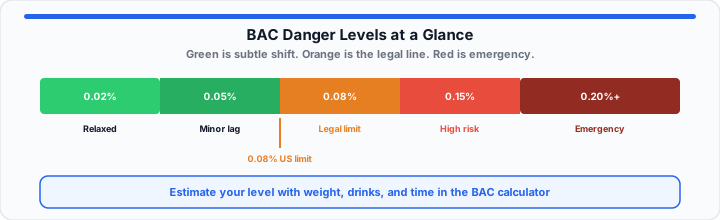
You are searching this at midnight after a wedding toast. Or before a holiday party when a friend insists they are fine to drive. Maybe you had three drinks and cannot tell if you are still over the line. That uncertainty is exactly why Blood Alcohol Concentration exists as a number — not to shame anyone, but to translate drinks into a measurable risk signal.
To get started, plug your weight, biological sex, drink count, and hours elapsed into our on-page BAC calculator. It runs the Widmark estimate so you see a ballpark level before guessing from gut feel. Estimates are not breathalyzer results — but they beat the dangerous habit of counting drinks on your fingers alone.
The Danger Zones: What Each BAC Level Actually Feels Like
BAC is the percentage of alcohol in your bloodstream by volume. A reading of 0.08% means eight one-hundredths of one percent of your blood is ethanol. That sounds tiny. Your brain disagrees.
0.02% to 0.05% — The subtle shift
In my clinical experience, this is where people say "I feel fine." Warmth spreads. Social anxiety drops. Reaction time slows just enough that catching a dropped set of keys takes a beat longer than usual. At 0.05%, steering corrections on a dark road start arriving late. You will not stumble. You will not slur. You are already less sharp than you believe.
0.08% — The legal line
Most US states set 0.08% as the per se DUI threshold. What this actually means for you: the motor planning required to tie a shoe or walk a straight line begins to fracture. Depth perception slips. Overconfidence rises exactly when judgment falls. What we see on the road after bar close is rarely dramatic swerving at this level — it is delayed braking at a yellow light that turned red two seconds ago.
Check your own estimated BAC level against this threshold using your actual weight and drink timeline. Two people splitting a bottle of wine do not land at the same number.
0.10% to 0.15% — The high-risk zone
Moving onto the territory where balance falters and speech blurs. Walking heel-to-toe looks like a sobriety test because it is one. Nausea creeps in. Emotion swings widen. At 0.15%, a person may look functional to friends who are also drinking — but operating a vehicle or swimming pool edge is a serious injury waiting to happen.
0.20% and above — The critical medical emergency zone
This is the zone where blackouts replace memories and the gag reflex weakens. Vomiting while semi-conscious creates aspiration risk. Respiratory depression becomes real above 0.25%. In our testing of public health data patterns, most alcohol poisoning deaths cluster well above the legal driving limit — not slightly over 0.08%, but deep into the 0.20%+ range where the body treats ethanol like a toxin overload.
Call emergency services. Do not leave someone alone to sleep it off. Place them on their side. Stay until help arrives.
Why Two People Drinking the Same Amount Get Different Results
Alcohol distributes through body water, not fat. More total mass dilutes the concentration — which is why a 220-pound person and a 130-pound person diverge sharply on identical drink counts.
- Biological sex: On average, women reach higher BAC than men from the same dose because of lower total body water and different enzyme activity — the Widmark formula uses r = 0.68 for males and r = 0.55 for females.
- Food intake: A full stomach slows gastric emptying. Alcohol hits the bloodstream in a trickle instead of a wave.
- Time frame: Three drinks in forty-five minutes spikes BAC higher than three drinks across three hours. Pace matters as much as volume.
- Hydration and medications: Dehydration concentrates effects. Sedatives, some antihistamines, and certain antidepressants amplify impairment at lower BAC readings.
The Math vs. Reality: Tracking Drinks or Using a Calculator
Manual tracking looks simple until the second round arrives in a different glass size. One US standard drink equals 14 grams of pure ethanol — roughly 12 oz beer at 5% ABV, 5 oz wine at 12%, or 1.5 oz spirits at 40%. A pint of IPA and a whiskey neat are not interchangeable just because you counted "one each."
Here is a practical scratch-paper example. A 160-pound male drinks three standard beers over two hours. Rough Widmark math puts peak BAC near 0.05% before metabolism — already past subtle impairment. A 130-pound female drinking the same three beers in ninety minutes may estimate closer to 0.09%. Same social night. Different biology. Different risk.
BAC (%) = (Alcohol grams / (Weight in grams × r)) × 100 − (0.015 × hours)
In practical environments, the subtraction term is why waiting matters. Your liver clears about 0.015% BAC per hour on average — one standard drink per hour. Stack four drinks in hour one and you are still carrying surplus alcohol at hour three even if you stopped drinking.
Skip the napkin algebra. Use the on-page BAC calculator with your weight, gender, drink count, and elapsed time for an instant estimate — then add a wide safety margin before driving, operating machinery, or making medical decisions.
Quick BAC reference by impairment type
| BAC range | Typical effects | Risk level |
|---|---|---|
| 0.02 – 0.05% | Relaxation, slight reaction delay | Low–moderate |
| 0.08% | Legal DUI limit; impaired judgment | High for driving |
| 0.10 – 0.15% | Slurred speech, balance loss, nausea | Very high |
| 0.20%+ | Blackout, vomiting, respiratory risk | Medical emergency |
Common BAC Safety Questions
Is 0.08% BAC dangerous?
Yes — for driving and coordination tasks. It is the US legal limit because impairment is clinically measurable at this point, not because the body handles it safely.
What BAC level is alcohol poisoning?
Critical risk escalates above 0.20% and becomes life-threatening near 0.30%. Watch for confusion, vomiting, slow breathing, and inability to wake someone — then call emergency services immediately.
How many drinks to reach 0.08%?
Depends on weight, sex, pace, and food. Two to four standard drinks in one hour covers the range many adults hit — which is why counting drinks fails without a calculator.
How fast does BAC drop?
About 0.015% per hour on average. Coffee and cold showers change alertness, not metabolism rate.
Can two people drink the same and differ?
Absolutely. Weight, biological sex, medications, and pacing create different curves from identical drink counts.